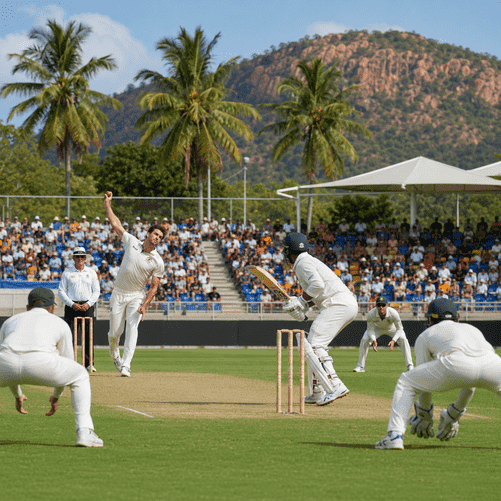
Australia’s home series against Bangladesh is taking Test cricket into the tropical north during the southern winter, highlighting how crowded calendars, new markets and commercial pressures are reshaping one of the sport’s oldest formats.

Australian cricket is preparing for one of the most unusual Test series in its modern history, with Bangladesh touring the country during the southern hemisphere winter — a scheduling experiment that offers a revealing glimpse into how international cricket is being forced to adapt to an increasingly congested global sporting calendar.
Australia will host Bangladesh in a two-Test series in the tropical north of the country, beginning in Darwin before moving to Mackay in Queensland. The matches represent Bangladesh’s first Test tour of Australia since 2003 and will be staged far outside the traditional Australian cricket season.
The choice is more significant than a simple scheduling curiosity.
For generations, Australia’s international cricket calendar has been closely associated with summer, particularly the period between November and January when major stadiums in Melbourne, Sydney, Adelaide and Brisbane traditionally host Test matches.
In August, however, many of those venues are occupied by Australian rules football and other winter sports. Cricket Australia has therefore turned north, where warmer conditions make winter cricket possible and smaller regional venues provide an alternative to the country’s established metropolitan grounds.
Darwin’s Marrara Oval will stage its first Test match since 2004, while Mackay’s Great Barrier Reef Arena is set to become the 12th venue in Australia to host Test cricket.
The geographical shift illustrates a broader trend increasingly visible across international sport: elite competitions are becoming less tied to traditional seasons and locations as governing bodies attempt to fit more events into already crowded calendars.
Cricket provides an especially striking example.
The international game now competes not only with other sports but with its own expanding ecosystem of domestic Twenty20 leagues, bilateral international series, World Cups, franchise competitions and the World Test Championship.
The Indian Premier League has become one of the most valuable annual sporting competitions in the world, while T20 tournaments across Australia, England, the United Arab Emirates, South Africa and the United States occupy increasingly important positions in the global calendar.
Traditional Test cricket consequently has fewer uncontested windows.
Australia’s winter series against Bangladesh was moved forward from 2027 partly because the country is preparing to stage a special 150th-anniversary Test against England in 2027, adding yet another major event to an already complicated schedule.
Rather than abandoning the Bangladesh series, administrators found a different season and different part of the country in which to stage it.
That decision may eventually prove influential.
Northern Australia possesses climatic conditions very different from Melbourne or Sydney. Darwin remains warm and relatively dry during the southern winter, creating the possibility that international cricket could develop a second Australian seasonal window rather than remaining almost exclusively a summer sport.
There is also a strategic audience argument.
Taking Test cricket to Darwin and Mackay brings elite international competition to communities that rarely host it. For governing bodies concerned about maintaining interest in the five-day format, geographic expansion provides an opportunity to reach spectators outside established cricket centres.
Public funding has helped support the series, reflecting the value regional governments place on international sporting events as tourism and promotional tools. Although the Bangladesh matches are unlikely to generate the enormous commercial returns associated with an Ashes series or a tour by India, their broader economic and developmental value may be considerable.
The sporting contest itself also carries significance.
Australia enters the series at the top of the World Test Championship standings and is expected to field an exceptionally strong bowling attack. Pat Cummins, Mitchell Starc, Josh Hazlewood and Nathan Lyon are available together, according to Reuters, potentially reuniting one of the most formidable bowling combinations of the modern era.
Bangladesh, meanwhile, arrives as the clear outsider.
Its only Test victory over Australia came in Dhaka in 2017, when Bangladesh produced one of the most celebrated results in its cricket history. Winning a Test series on Australian soil would represent an even greater achievement.
Yet the importance of the tour extends beyond the likely result.
Bangladesh has spent years seeking more regular Test cricket against the wealthiest international teams. The enormous commercial imbalance within the sport means nations such as India, England and Australia tend to dominate the most lucrative parts of the calendar, while smaller cricketing countries frequently receive shorter and less frequent series.
Bangladesh’s return to Australia after more than two decades therefore highlights both the opportunities and the structural inequalities that continue to shape international cricket.
At the same time, cricket itself is becoming increasingly global.
The sport will return to the Olympic Games at Los Angeles 2028 in the Twenty20 format, its first Olympic appearance since 1900. The International Olympic Committee sees cricket as a potentially powerful means of reaching younger audiences and, particularly, the enormous Indian sporting market.
The commercial importance of that audience is difficult to overstate.
Cricket has billions of followers globally, with South Asia accounting for a substantial share of its television audiences, digital engagement and sponsorship revenue. The IPL has become a multibillion-dollar sporting property, while broadcasters are expected to place substantially higher values on Olympic media rights in the Indian subcontinent once cricket becomes part of the Games.
These developments are pushing cricket in two directions simultaneously.
At one extreme sits Twenty20: short, television-friendly, commercially powerful and increasingly international.
At the other remains Test cricket, a format lasting as long as five days and built around traditions developed more than a century ago.
The challenge for administrators is preserving the prestige and sporting complexity of Test cricket while adapting it to a world increasingly dominated by shorter competitions and compressed entertainment cycles.
Australia’s winter experiment provides one possible answer.
Rather than insisting that Test cricket can only be played within traditional seasonal windows, administrators can take the game to new regions, experiment with venues and create additional space in the calendar.
Similar flexibility may become increasingly important as franchise competitions continue to expand and international governing bodies attempt to protect bilateral cricket.
There are risks.
Playing outside traditional seasons could weaken established sporting rituals or produce scheduling conflicts that dilute television audiences. Smaller regional grounds may also generate less ticketing revenue than major stadiums.
But the alternative — squeezing every international series into a shrinking number of conventional windows — is becoming increasingly difficult.
Australia’s decision also reflects a wider transformation across global sport, where climate, broadcasting markets and commercial priorities are challenging traditional ideas about when and where major competitions should take place.
Football leagues increasingly stage matches abroad or adjust schedules around expanding international tournaments. Formula One has aggressively expanded into new markets and night races. Tennis has stretched into an almost year-round global circuit.
Cricket is now undergoing its own version of that transformation.
The Bangladesh tour may not attract the worldwide attention of an Ashes series or an India-Australia confrontation, but its structure could prove more consequential than the scorecard suggests.
A Test match in Darwin during August would once have seemed almost unthinkable.
In the increasingly crowded economics of global sport, it may instead represent the future: traditional competitions surviving not by remaining unchanged, but by becoming flexible enough to find new seasons, new venues and new audiences.