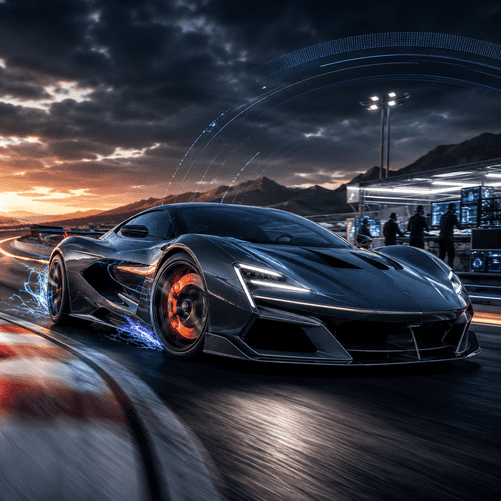
The 1,065-horsepower V12 hybrid combines electric torque vectoring, six-axis sensing, GT3-derived suspension and advanced aerodynamics in a demonstration of how electrification is reshaping the modern supercar.

Lamborghini has unveiled the Revuelto SV, a technologically intensified evolution of its flagship hybrid supercar that illustrates how electrification is moving beyond emissions reduction and becoming an increasingly sophisticated tool for extracting performance.
Presented during Monterey Car Week and making its world debut at The Quail on August 15, the Revuelto SV revives Lamborghini’s historic Super Veloce designation while introducing a new generation of electronic, aerodynamic and hybrid-control systems. The limited-production model develops a combined 1,065 CV, or roughly 1,050 horsepower, from a naturally aspirated 6.5-litre V12 and three electric motors.
That combination enables the car to accelerate from 0 to 100 km/h in 2.4 seconds and from 0 to 200 km/h in 6.7 seconds, while its maximum speed exceeds 345 km/h. Lamborghini’s technical specifications list a top speed of 348 km/h.
Yet the most important development is not simply the increase in power.
The Revuelto SV demonstrates a broader shift taking place across the high-performance automotive industry: software, sensors and electric motors are becoming as important to vehicle dynamics as engines, suspension geometry and mechanical grip.
At the heart of that approach is a new six-dimensional sensor positioned close to the vehicle’s centre of gravity. The system continuously measures acceleration across the car’s lateral, longitudinal and vertical axes while simultaneously monitoring pitch, roll and yaw rates. Lamborghini says the data are fed directly into its integrated vehicle-control architecture, allowing braking and dynamic systems to react more precisely as the car changes direction, accelerates or crosses kerbs on a circuit.
In practical terms, the technology gives the vehicle a much more detailed real-time understanding of how its body is moving.
That information can then be combined with inputs from steering, brakes, electric motors and traction-control systems to determine how torque and braking force should be distributed at each wheel. This type of integrated control represents one of the most consequential technological changes in contemporary performance cars.
Electric motors are particularly valuable in this environment because their torque can be adjusted almost instantaneously. Rather than waiting for mechanical differentials or engine output to influence the car’s behaviour, electronic systems can alter torque distribution extremely rapidly, helping the vehicle rotate into a corner, maintain stability and accelerate more efficiently on exit.
The Revuelto platform was already Lamborghini’s first V12 high-performance electrified vehicle, combining its combustion engine with three electric motors and a dual-clutch transmission. The original model produces 1,015 CV; the SV raises that output to 1,065 CV while significantly expanding the technology surrounding the powertrain.
Lamborghini has also redesigned the battery system specifically to maintain performance during repeated high-load driving. According to the company, the new configuration delivers up to four times greater performance consistency than the standard Revuelto, addressing an important weakness traditionally associated with high-performance hybrid systems: thermal degradation under repeated acceleration and braking.
That distinction is significant.
In a conventional road car, maximum performance may be required only occasionally. On a circuit, however, batteries, motors and power electronics must repeatedly deliver and recover large quantities of energy while operating at extreme temperatures. Maintaining consistent electrical output lap after lap can therefore be as important as achieving a spectacular peak horsepower figure.
The Revuelto SV also incorporates racing-derived suspension technology. Lamborghini has fitted manually adjustable passive dampers inspired by GT3 competition cars, placing greater emphasis on mechanical precision and driver feedback than on simply allowing computer-controlled suspension to compensate for changing conditions.
Braking technology has similarly been upgraded through next-generation CCM-R Plus carbon-ceramic brakes designed to provide greater consistency under extreme thermal loads. Bespoke Bridgestone Potenza Race R tyres complete the performance package.
Aerodynamics form another central component of the SV’s engineering philosophy.
Rather than treating the body primarily as a styling exercise, Lamborghini has reworked airflow around the vehicle to increase high-speed stability and cornering performance. The aerodynamic package produces substantially more downforce than the standard Revuelto, helping the tyres remain loaded as speeds rise.
The result was demonstrated even before the car’s public debut. Lamborghini factory driver Marco Mapelli recorded a 1 minute 41.6 second lap of Germany’s Hockenheimring, which Lamborghini says is the fastest lap achieved there by a production car.
While manufacturer lap records should always be interpreted according to testing conditions, tyre specifications and verification methods, the result provides an indication of how dramatically electronically integrated hybrid supercars have evolved.
The Revuelto SV therefore represents more than another escalation in the horsepower competition that has defined much of the supercar industry.
Its engineering reflects a change in where performance is now being created.
Historically, manufacturers extracted speed primarily through larger engines, lighter vehicles, improved suspension and increasingly sophisticated aerodynamics. Those elements remain fundamental, but modern high-performance cars increasingly depend on software-controlled interaction between propulsion, braking, steering, stability systems and aerodynamics.
Hybridisation gives engineers another layer of control.
Electric motors can provide immediate acceleration, fill gaps in combustion-engine torque delivery and independently influence individual wheels. Regenerative braking can interact with conventional braking systems, while battery management determines when electrical energy should be deployed or recovered.
Sensors then provide the information required to coordinate all those systems in fractions of a second.
The car’s new Pilota driving mode reflects that philosophy by allowing greater adjustment of traction and vehicle-control behaviour for circuit use. Lamborghini describes the system as part of an effort to increase driver engagement rather than simply allowing electronic systems to remove responsibility from the person behind the wheel.
That tension between automation and driver involvement has become one of the defining challenges of modern supercar engineering.
As vehicles become faster, electronic intervention is increasingly necessary simply to make their performance usable. Yet the customers purchasing cars such as the Revuelto SV frequently want precisely the opposite sensation: mechanical involvement, feedback and a perception that the driver remains in command.
Manufacturers are consequently attempting to make increasingly complex technology operate invisibly.
The ideal system is not one that appears to drive the car for its owner, but one that continuously manipulates torque, braking and stability beneath the surface while preserving the sensation of direct mechanical control.
The Revuelto SV is limited to 1,963 examples, a number chosen to commemorate the year Lamborghini was founded.
Its significance, however, extends beyond exclusivity.
The technology appearing in flagship supercars frequently acts as an experimental laboratory for systems that later migrate into broader vehicle ranges. Torque-vectoring software, advanced sensor fusion, brake-by-wire systems, active aerodynamics and sophisticated battery-management technology are already moving progressively beyond the rarefied world of million-dollar performance machines.
For Lamborghini, the Revuelto SV also demonstrates that electrification does not necessarily mean abandoning the combustion engine.
Instead, the company is using electric technology to extend the capabilities of one of the oldest formulas in exotic motoring: a naturally aspirated V12 positioned at the centre of a lightweight, aerodynamically aggressive sports car.
The difference is that the engine is no longer working alone.
It is now surrounded by electric motors, batteries, real-time sensors and increasingly sophisticated algorithms capable of analysing vehicle behaviour hundreds of times every second.
That may ultimately be the Revuelto SV’s most important contribution to the evolution of the supercar. The next technological frontier is not simply more power.
It is the ability to control that power with a level of precision that mechanical engineering alone could never achieve.