Hundreds of Ukrainian drones strike targets from the Moscow region to southern Russia, killing at least six people according to Russian authorities and setting a major logistics warehouse ablaze as the cross-border air war intensifies.

Ukraine launched one of the most extensive aerial attacks of the war against Russian territory on Sunday, sending hundreds of drones towards Moscow and other regions in an operation that underscored Kyiv’s rapidly expanding ability to strike economic and military-related infrastructure deep behind the front lines.
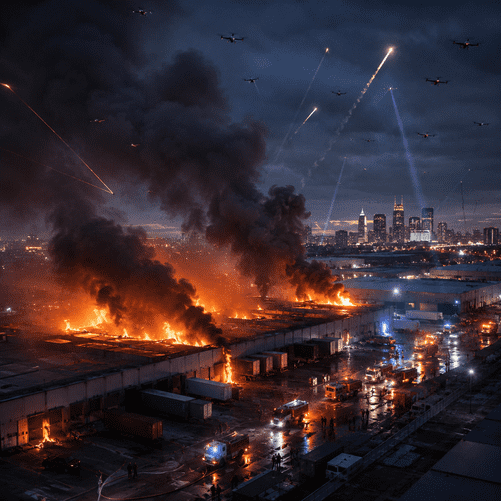
At least six people were killed in attacks across Russia, according to Russian authorities, while several others were injured. Among the most visible targets was a large distribution warehouse belonging to Wildberries, Russia’s dominant online retailer, south of Moscow, where footage showed thick columns of smoke rising above the facility following a drone strike.
The Russian Defence Ministry said its forces had intercepted 822 Ukrainian drones during the latest wave. The figure could not be independently verified, but even if only a proportion of the aircraft reached their intended targets, the scale of the operation marks a significant escalation in Ukraine’s campaign against infrastructure inside Russia.
Moscow regional governor Andrei Vorobyov said an 83-year-old man was killed in Podolsk, south of the capital, where the Wildberries facility at Koledino was struck. Another warehouse in Domodedovo, close to one of Moscow’s principal international airports, was also damaged.
Reuters footage showed dense black smoke rising from the Koledino complex, approximately 45 kilometres south of central Moscow. Ukrainian officials have accused Wildberries infrastructure of contributing to Russian military logistics, part of Kyiv’s broader argument that commercial facilities supplying military or dual-use equipment constitute legitimate wartime targets.
The heaviest loss of life, however, was reported farther south. The Associated Press reported that five people were killed in Russia’s Rostov region during the wider Ukrainian aerial offensive. Additional attacks were recorded elsewhere, including Belgorod region, where Russian officials reported another fatal strike involving a bus.
The barrage illustrates how profoundly drone warfare has changed the geography of the conflict. For much of the first years following Russia’s full-scale invasion in February 2022, Ukraine’s ability to strike targets hundreds of kilometres inside Russian territory was comparatively limited. Kyiv has since developed an increasingly sophisticated domestic long-range drone industry capable of reaching logistics centres, oil refineries, industrial plants, airfields and military facilities far from Ukraine’s borders.
Moscow itself has gradually become a regular target.
Russian officials said hundreds of drones were directed towards the capital and its surrounding region during Sunday’s operation. Air defences intercepted many of them, but several aircraft or their debris reached infrastructure on the outskirts of the city. The regional government described the assault as among the largest attacks yet directed at the Moscow area.
The attack appears consistent with a broader Ukrainian strategy aimed at imposing greater economic and logistical costs on Russia rather than concentrating long-range strikes exclusively on conventional military installations.
Warehouses, energy installations, fuel facilities and transportation networks have increasingly appeared among Ukrainian targets. Kyiv argues that many such sites directly sustain Russia’s war effort by supplying equipment, generating revenue or supporting the movement of military resources.
Sunday’s strikes reportedly also included a facility associated with missile fuel production in Russia’s Rostov region, another indication that Ukraine is attempting to disrupt the industrial infrastructure underpinning Moscow’s missile and drone operations.
The intensification of Ukraine’s campaign comes as Russia continues its own large-scale bombardment of Ukrainian cities and industrial infrastructure.
During the same period, Russian forces launched missile and drone attacks across Ukraine. A strike against the major ArcelorMittal steel plant in President Volodymyr Zelenskyy’s home city of Kryvyi Rih killed two people and injured 14, while other attacks caused casualties and damage elsewhere in the country.
Kyiv was also struck, with fires breaking out at several locations, including a prominent book market in the Ukrainian capital. Ukrainian authorities have repeatedly warned that their air-defence systems are being placed under enormous pressure by the combination of Russian missiles, ballistic weapons and large formations of attack drones.
The parallel strikes highlight an increasingly defining characteristic of the war: both Russia and Ukraine are attempting to overwhelm the other side’s defences through sheer numbers.
Cheap, comparatively simple drones can be launched in enormous formations, forcing defenders to expend costly interceptor missiles or reveal the position of electronic-warfare and air-defence systems. More sophisticated drones can then exploit gaps or attack strategically important targets.
For Ukraine, domestically manufactured long-range systems have become particularly important because Western governments have periodically placed restrictions on how supplied weapons may be employed against targets deep inside Russia. Producing its own systems gives Kyiv greater operational freedom and reduces dependence on scarce Western long-range missiles.
The consequences are increasingly visible hundreds of kilometres away from the battlefield.
Major Russian airports have repeatedly experienced temporary restrictions during Ukrainian drone attacks, while oil refineries, ports, factories and logistics facilities have been forced to strengthen their defences. Fires caused by drone strikes have also demonstrated the difficulty of completely protecting Russia’s enormous industrial network.
The latest operation also coincided with another potentially serious development on NATO’s eastern frontier. A Spanish F-18 operating as part of NATO’s air-policing mission shot down a drone after it entered Romanian airspace from Moldova, according to reporting on Sunday. The incident further demonstrated how the growing scale of aerial warfare around Ukraine creates risks extending beyond the borders of the two belligerents.
Neither side appears capable of establishing complete protection against the expanding drone threat.
Russia possesses one of the world’s largest networks of air-defence systems, yet the enormous geographical area that must be protected makes sealing Russian airspace effectively impossible. Ukraine faces an even more acute challenge as it attempts to defend major cities, energy infrastructure and military installations against near-daily Russian attacks while conserving a limited stock of advanced interceptors.
The result is an evolving war of attrition increasingly fought not only along trenches and fortified positions in eastern and southern Ukraine but across skies stretching hundreds of kilometres beyond the battlefield.
For Kyiv, striking Moscow and other distant Russian regions carries both military and psychological significance. Such operations demonstrate that Russia’s geographic depth no longer guarantees immunity from the war launched against its neighbour.
For Moscow, the civilian deaths reported in Sunday’s attacks provide further grounds for portraying Ukraine’s long-range campaign as targeting Russian territory indiscriminately. Kyiv, meanwhile, maintains that its strikes are directed primarily against infrastructure supporting Russia’s military effort.
As with many battlefield claims from both governments, the precise number of drones launched, intercepted and reaching their targets cannot be independently confirmed in real time.
What is increasingly difficult to dispute, however, is the scale of the transformation taking place above the battlefield.
More than four years after Russia’s full-scale invasion began, the conflict is developing into an increasingly expansive long-range technological war in which warehouses outside Moscow, industrial plants hundreds of kilometres from Ukraine and airspace along NATO’s eastern frontier can all become part of the same night’s fighting.
Sunday’s extraordinary barrage suggests that this dimension of the conflict is likely to grow rather than diminish — bringing the consequences of the war deeper into Russian territory while placing ever greater pressure on the air-defence systems of both countries.