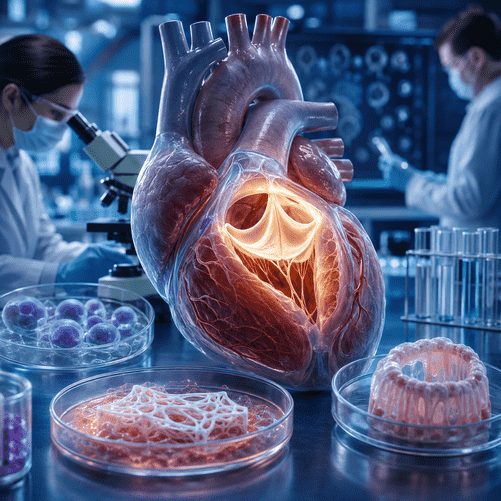
Australian researchers have created sophisticated three-dimensional heart valve tissue that closely reproduces key features of the human organ, opening a new route for studying disease, testing treatments and, eventually, developing replacement valves grown from a patient’s own cells.

Scientists in Australia have created human heart valve-like tissue from pluripotent stem cells, a development that could significantly improve the way researchers study heart valve disease and accelerate the search for regenerative treatments capable of repairing or eventually replacing damaged valves.
The research, led by the Murdoch Children’s Research Institute in Melbourne and published on August 11 in Cell Stem Cell, produced three-dimensional engineered tissues that reproduce important molecular, structural and mechanical characteristics of human heart valves. The researchers say the platform represents an important advance over simpler laboratory models because it more closely recreates the environment in which valve cells develop and function inside the body.
Heart valves perform an exceptionally demanding task. Four valves inside the human heart repeatedly open and close to ensure blood moves in the correct direction, operating billions of times over a lifetime while enduring constant mechanical stress.
When those valves become malformed, infected or damaged through ageing, blood flow can be disrupted and the heart can be forced to work harder. Around 28 million people worldwide are affected by heart valve disease, according to the Murdoch Children’s Research Institute. Existing treatment options remain limited, and damaged valves generally cannot be restored to normal function with medication alone.
For many patients, the ultimate solution is surgical repair or replacement.
That approach can be particularly difficult for children born with congenital heart defects. Artificial or biological replacement valves do not grow as a child grows, meaning younger patients may require repeated operations throughout their lives. Replacement valves can also bring other complications, including blood-clot risks and finite durability.
The new research attempts to address part of that problem by recreating human valve tissue directly in the laboratory.
Led by Dr Holly Voges and colleagues, the team directed human pluripotent stem cells — cells capable of developing into numerous specialised cell types — toward the cell populations required to form valve-like tissue. They then engineered those cells into a three-dimensional environment designed to encourage further maturation.
The resulting tissue displayed features considerably closer to actual human heart valves than conventional two-dimensional cell cultures.
This distinction matters because one of the persistent obstacles in cardiovascular research is the difficulty of obtaining and studying living human valve tissue, particularly during the early stages of disease. Animal models can provide useful information, but they cannot always reproduce human-specific biological processes.
A laboratory-grown human model could therefore allow researchers to observe how valve disease begins, identify the molecular signals responsible for tissue deterioration and test possible treatments under controlled conditions before moving into clinical trials.
The Australian team demonstrated that capability by exposing its engineered tissues to inflammatory proteins associated with rheumatic heart disease.
The tissues became stiffer and developed biological markers similar to those seen in diseased human valves, suggesting that the model can reproduce at least some of the processes that occur during inflammatory valve damage.
That finding could be particularly important for rheumatic heart disease, which develops following an abnormal immune response to repeated or inadequately treated infections with Streptococcus bacteria.
Although largely preventable, the disease remains a major cause of cardiovascular illness in lower-income regions and continues to disproportionately affect Indigenous communities in Australia. Because rheumatic heart disease is strongly shaped by human immune biology, developing realistic laboratory models has been especially difficult.
The immediate significance of the breakthrough is therefore not the creation of an implantable heart valve, but the creation of a more realistic research platform.
Scientists could use the engineered tissues to screen potential drugs, investigate why particular valve cells become damaged and evaluate whether regenerative therapies can restore normal tissue properties.
That could substantially accelerate research by allowing experiments to be conducted repeatedly and at scale without relying on scarce samples obtained during surgery.
But the longer-term implications are considerably more ambitious.
Professor Enzo Porrello, director of the Melbourne node of the Novo Nordisk Foundation Centre for Stem Cell Medicine, said the technology could ultimately contribute to the development of stem-cell-derived replacement valves capable of growing and adapting with a patient.
Such a possibility has long been one of the major goals of regenerative cardiology.
In principle, scientists could take cells from an individual patient, reprogram them into induced pluripotent stem cells and then use those cells to manufacture personalised cardiovascular tissue. Because the resulting tissue would originate genetically from the patient, it could potentially reduce immune rejection.
For children, an even more significant advantage would be the possibility of a living valve capable of growing alongside the body — potentially reducing the need for repeated replacement surgery.
That remains a long-term objective rather than an immediately available therapy.
The engineered tissues developed by the Melbourne team are research models, not clinical replacement valves ready for transplantation. Considerable work would still be required to establish whether a laboratory-grown valve could withstand the enormous mechanical forces generated by the human heart over decades.
Scientists would also have to demonstrate reliable manufacturing, vascular integration, long-term durability and safety before any stem-cell-derived valve could be implanted routinely in patients.
Nevertheless, the study reflects a wider transformation in biomedical research in which scientists are increasingly replacing simplified cell cultures with sophisticated three-dimensional human tissues.
Heart organoids, miniature kidneys, brain organoids and other engineered tissues are already allowing researchers to study human development and disease in ways that were difficult or impossible only a decade ago.
The new heart valve model extends that approach into an area of cardiovascular medicine where realistic laboratory systems have historically been particularly difficult to create.
The study also highlights a broader shift in regenerative medicine. Rather than using stem cells simply as replacement cells, researchers are increasingly learning how to reproduce entire tissue environments — including their structure, mechanical properties and interactions between multiple cell types.
That complexity is crucial because human organs do not function as isolated collections of cells. They respond continuously to physical forces, chemical signals and interactions with surrounding tissues.
Heart valves are a particularly striking example. Their biological behaviour is influenced not only by genetics but also by blood pressure, mechanical stretching, inflammation and changes in the extracellular matrix surrounding their cells.
Creating tissues that reproduce those conditions more accurately could allow scientists to investigate disease at a level of detail that conventional laboratory cultures cannot provide.
For patients, the implications will depend on what researchers discover using the new platform.
The most immediate advances may come from drug development rather than transplantation. Researchers could identify compounds capable of slowing inflammation, preventing tissue stiffening or promoting repair before valve deterioration becomes severe enough to require surgery.
Over time, however, the same technology may provide the foundation for something considerably more transformative: living replacement valves constructed from human cells and tailored to individual patients.
That prospect is still years away from clinical reality.
But by demonstrating that human stem cells can be organised into increasingly mature, disease-responsive valve tissue, the Melbourne researchers have brought regenerative cardiology another step closer to turning one of medicine’s most difficult structural problems into something that can be studied — and potentially repaired — in the laboratory.