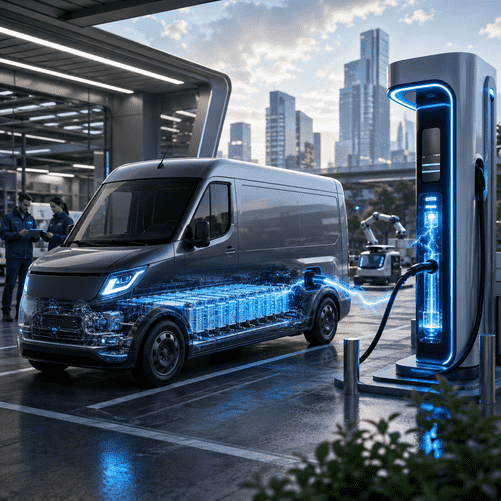
China’s CATL has unveiled an 8C battery capable of reaching a full charge in less than nine minutes, bringing electric delivery vehicles closer to the refuelling speed of conventional fleets and highlighting how rapidly battery technology is reshaping the economics of road transport.
The electric-vehicle industry has spent years attempting to eliminate two of the technology’s most persistent disadvantages: limited driving range and lengthy charging stops. China’s CATL now believes the second of those problems is approaching a decisive technological turning point.
The world’s largest battery manufacturers are increasingly moving beyond incremental gains in capacity and concentrating on something potentially more transformative — making an electric vehicle almost as quick to recharge as a petrol or diesel vehicle is to refuel.
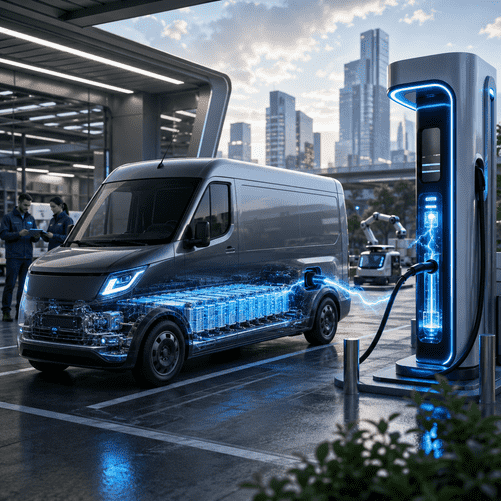
CATL’s latest demonstration of that ambition is the Tectrans II, an ultra-fast-charging battery developed specifically for light commercial electric vehicles such as delivery vans and small trucks.
According to CATL, the battery supports a peak 8C charging rate, allowing it to reach 80% state of charge in just six minutes and 48 seconds. A complete charge can be achieved in approximately eight minutes and 56 seconds under suitable conditions.
If deployed successfully at scale, that kind of charging performance could fundamentally alter the commercial argument surrounding electric fleets.
For private motorists, spending 20 or 30 minutes at a charging station may be an inconvenience. For a logistics company operating hundreds or thousands of vehicles, however, every minute a van remains connected to a charger instead of delivering goods represents lost productivity.
That distinction makes commercial transport an important test for next-generation battery technology.
CATL has designed the Tectrans II around precisely those operational pressures: fast charging, long service life, low-temperature capability and infrastructure designed to accommodate vehicles that may operate almost continuously.
The company says the battery carries a warranty of as much as 10 years or one million kilometres, a particularly important specification for vehicles accumulating far greater annual mileage than most passenger cars.
Achieving extreme charging speeds without destroying the battery is one of the central engineering challenges behind the technology.
When large amounts of electrical power are forced rapidly into conventional lithium-ion cells, resistance generates heat. Excessive temperatures can accelerate battery degradation, reduce capacity and, under extreme circumstances, create safety problems.
CATL says it has reduced the internal resistance of the Tectrans II cells to about half the industry average, limiting heat generation during high-power charging. The company also uses graphite particles modified through what it describes as atomic-level interface engineering to reduce the loss of active lithium and slow long-term deterioration.
The result illustrates how modern battery development is increasingly occurring at microscopic scales.
The EV battery race is no longer simply about placing more cells into a larger battery pack. Engineers are changing electrode structures, electrolytes, graphite surfaces, thermal-management systems and the internal pathways through which lithium ions travel.
CATL describes several techniques behind its broader fast-charging technology, including porous coatings that create more sites for lithium-ion exchange, isotropic graphite structures that allow ions to enter from multiple directions, high-porosity separators that shorten ion-transport distances and redesigned electrodes intended to accelerate charging while maintaining energy density.
These developments address a basic physical problem.
Charging a battery involves moving enormous numbers of ions between electrodes. The faster manufacturers can allow those ions to travel safely through the cell, the faster energy can be replenished. But accelerating the process without generating excessive heat, damaging materials or causing lithium plating requires sophisticated control over chemistry and internal cell architecture.
That is why an apparently simple figure such as a nine-minute recharge represents considerable engineering complexity.
Cold weather presents another obstacle.
Lithium-ion batteries generally charge more slowly at low temperatures because electrochemical reactions become less efficient. For electric commercial vehicles operating in northern Europe, North America or northern China, that can transform a manageable summer charging schedule into a much more difficult winter operation.
CATL says that even at minus 20 degrees Celsius, the Tectrans II requires only around two and a half minutes longer to reach a full charge than under normal conditions.
The company is pairing the battery with another increasingly important part of the EV technology race: infrastructure.
CATL has developed integrated stations combining high-power charging and battery swapping, with designs intended to serve both passenger cars and commercial vehicles. The company said in July that it planned to deploy 4,000 such stations across nearly 190 Chinese cities during 2026.
That strategy points to a broader truth about the next generation of electric vehicles. Better batteries alone will not eliminate charging anxiety.
A vehicle capable of accepting extraordinary quantities of electricity is useful only when a charging network can deliver that power.
As batteries move toward 6C, 8C and even higher charging rates, electricity infrastructure becomes part of the vehicle technology itself. Grid connections, transformers, stationary batteries, cooling systems and charging cables all have to cope with enormous instantaneous power demand.
This is one reason high-speed charging networks may increasingly incorporate their own large stationary battery packs. Those systems can gradually draw electricity from the grid and then discharge it rapidly when a vehicle arrives, reducing the peak load placed on local electricity infrastructure.
The technological shift is occurring against a rapidly expanding battery market.
The International Energy Agency reported that EV battery deployment reached approximately 1.2 terawatt-hours in 2025, nearly 30% higher than the previous year and more than seven times the level recorded in 2020. Electric vehicles accounted for more than 70% of worldwide battery deployment.
Costs are falling at the same time.
Average battery prices declined by approximately 8% during 2025, according to the IEA, helped by manufacturing improvements, changing battery chemistries and increasingly intense competition. Lithium-iron-phosphate batteries have become especially important and accounted for more than 55% of EV batteries deployed globally in 2025.
China sits at the centre of this transformation.
More than 80% of global lithium-ion battery manufacturing capacity was located in China at the end of 2025, while Chinese companies accounted for almost three-quarters of battery deployment in electric cars worldwide.
That manufacturing scale is now being combined with increasingly aggressive technological development.
Battery companies are simultaneously pursuing several different routes: ultra-fast lithium-ion charging, higher-density cell-to-pack architectures, sodium-ion batteries that reduce dependence on lithium, silicon-enhanced anodes and eventually solid-state batteries.
Not all of these technologies are competing directly with one another.
Different battery chemistries may ultimately be used for different vehicles. An inexpensive urban car may prioritise price and durability. A luxury EV may require maximum range. A delivery van may value extremely fast charging and long cycle life above everything else, while an electric truck could require still another combination of energy density, charging power and longevity.
The industry is therefore beginning to move away from the idea that one battery chemistry will dominate every vehicle category.
CATL itself describes this direction as increasingly demand-driven battery design, in which packs are optimised for specific operational requirements rather than relying on a universal architecture.
Commercial vehicles may prove one of the clearest demonstrations of that philosophy.
A delivery company does not necessarily need a van capable of travelling 1,000 kilometres continuously. What it may need instead is a vehicle that can travel several hundred kilometres, recharge in approximately the time required for a driver to take a short operational break and repeat that cycle reliably for hundreds of thousands of kilometres.
If batteries can achieve that combination at an economically viable cost, the argument for retaining diesel-powered urban delivery fleets becomes significantly weaker.
There are still important qualifications.
Charging figures announced by battery manufacturers generally represent optimal or controlled conditions, while real-world performance depends on battery temperature, charger capability, vehicle software, state of charge and electricity infrastructure. CATL’s Tectrans II figures are company claims and large-scale fleet deployment will provide the more meaningful test of durability and charging performance.
Infrastructure may prove the more difficult constraint.
A battery able to absorb extraordinary power does not automatically create a citywide network capable of supplying it. Building thousands of ultra-high-power charging points requires substantial investment, electrical-grid upgrades and careful management of peak demand.
Yet the direction of technological development is becoming increasingly clear.
For the first generation of modern EVs, manufacturers concentrated heavily on proving that electric cars could travel far enough. The next stage is increasingly about demonstrating that they can replenish energy quickly enough.
The difference is crucial.
When an EV can travel hundreds of kilometres and recover most of its usable energy in approximately the time required to buy a coffee, charging stops begin to resemble conventional refuelling rather than a fundamentally different form of vehicle operation.
And once that capability extends from expensive passenger cars into ordinary delivery vans and commercial fleets, ultra-fast charging stops being merely an impressive specification.
It becomes an economic technology.
CATL’s latest battery therefore represents something larger than another improvement in charging speed. The industry is moving toward a point where the defining question for electric vehicles may no longer be how long their batteries last on the road, but whether drivers will still notice the difference between charging one and filling a fuel tank.