British newlyweds Alexander Cromie and Marie Ebert were killed alongside their Greek pilot after a private helicopter crashed moments before landing on the island of Sifnos, with investigators examining evidence of a possible mechanical failure.

A honeymoon journey to one of Greece’s most picturesque islands ended in tragedy on Monday when a private helicopter carrying British newlyweds Alexander Cromie and Marie Ebert crashed shortly before landing on Sifnos, killing the couple and their pilot.
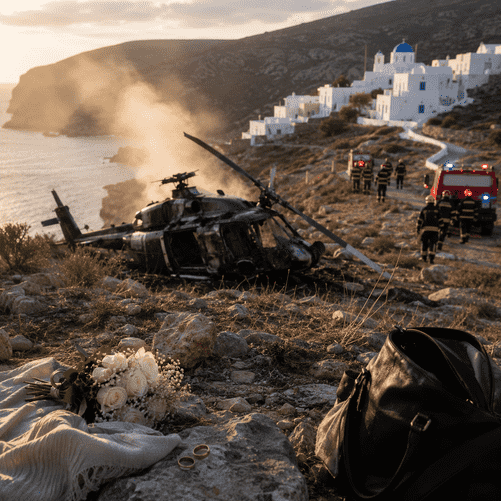
The aircraft went down near the Tholos area of the Cycladic island on August 17, only minutes before it was expected to arrive at the local heliport. The helicopter burst into flames after hitting the ground, scattering wreckage across the crash site and prompting an immediate emergency response from firefighters, medical personnel and local authorities.
Cromie, 31, and Ebert, 30, were travelling through Greece on their honeymoon. Their pilot was Greek national Giorgos Raikos, an experienced helicopter aviator with a background in the armed forces. All three occupants died in the accident.
Attention is now focusing on the final moments of the flight and, in particular, witness accounts describing an unusual noise coming from the aircraft shortly before it lost control.
Residents living near the crash site reported hearing a loud and abnormal mechanical sound as the helicopter approached the landing area. Sifnos deputy mayor Manolis Fountoulakis said testimony gathered locally suggested the aircraft may have suffered a technical problem while still airborne. Video footage from the area is also being examined as investigators attempt to reconstruct the helicopter’s final movements.
The possibility of a mechanical malfunction has consequently emerged as an important line of inquiry, although Greek authorities have not established an official cause and investigators are continuing to examine other potential factors.
The helicopter, reported to have been a Bell 206, had travelled from Markopoulo, southeast of Athens, towards Sifnos and was due to arrive at approximately 6.15pm local time. It crashed shortly before completing the flight.
Reports indicate that the weather at the time did not immediately appear severe enough to explain the accident, increasing scrutiny of the aircraft’s technical condition. Investigators are expected to assess maintenance records, flight information, meteorological conditions, witness testimony and any available video evidence before reaching conclusions about the sequence of events.
The aircraft came down close to residential properties, raising fears that the disaster could have caused further casualties on the ground. Residents described the impact and ensuing fire as particularly violent, with smoke visible from the surrounding area.
Emergency crews reached the site rapidly, while additional assistance was dispatched from the neighbouring island of Syros as authorities secured the area and began recovery operations.
News of the deaths prompted expressions of grief from the couple’s employers.
Cromie worked as a vice-president in private wealth solutions at Blackstone. The investment group said it was shocked by the deaths and paid tribute to a colleague who was highly regarded by those who worked with him. Ebert was employed by global consultancy Bain & Company, which also expressed its condolences and said its thoughts and support were with the families affected by the accident.
The British Foreign Office said it was in contact with Greek authorities and stood ready to provide consular assistance to the victims’ families.
For Sifnos, an island normally associated with whitewashed villages, secluded beaches and a flourishing summer tourism economy, the crash has brought sudden shock during one of the busiest periods of the year.
Private helicopter transfers have become increasingly visible across Greece’s island tourism sector, particularly among travellers seeking faster connections between Athens and destinations in the Cyclades. The geography of the archipelago and strong demand during the summer season have encouraged the growth of charter aviation alongside conventional ferry and commercial airline services.
The accident is therefore likely to draw scrutiny beyond the immediate circumstances of Monday’s crash, particularly regarding aircraft maintenance, private helicopter operations and aviation safety in a tourism market experiencing strong demand.
However, any wider conclusions will depend on the findings of the formal investigation.
For now, mechanical failure remains a suspicion rather than an established cause. Aviation investigators will need to determine whether a technical malfunction occurred, whether the pilot retained control of the aircraft during its final descent and whether any combination of mechanical, operational or environmental factors contributed to the disaster.
The investigation will ultimately attempt to explain a sequence that unfolded within seconds: a helicopter approaching its destination, witnesses hearing an unusual sound, the aircraft suddenly losing control and a routine island transfer ending in a fatal impact.
For the families of Alexander Cromie, Marie Ebert and Giorgos Raikos, however, the technical conclusions will come after an immeasurably personal loss — one made more poignant by the circumstances of a journey that was intended to celebrate the beginning of a married life together.