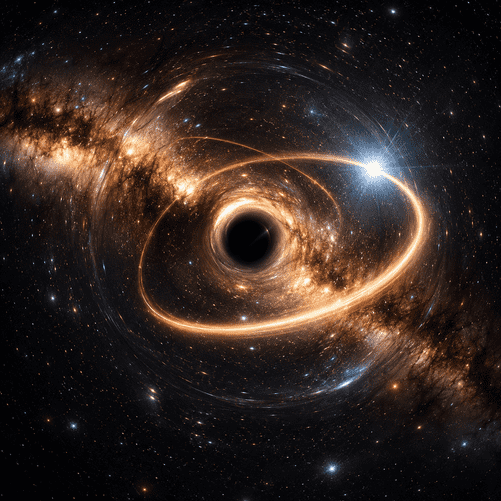
The newly identified star S301 races around the supermassive black hole at the centre of our galaxy at more than 8% of the speed of light, potentially giving scientists their best opportunity yet to measure how a black hole twists spacetime.

Astronomers have discovered the fastest known star in the Milky Way, an extraordinary object hurtling around the supermassive black hole at the centre of our galaxy at approximately 25,000 kilometres per second — more than 8% of the speed of light.
The star, designated S301, follows an exceptionally elongated orbit around Sagittarius A*, the roughly four-million-solar-mass black hole located about 26,000 light-years from Earth. At its closest approach, S301 comes within only about 12 times the distance between Earth and the Sun, closer to the black hole than any star previously observed.
It completes an entire orbit in just 8.7 years, an extraordinarily short period for a star circling a supermassive black hole. Researchers identified S301 using observations from the European Southern Observatory’s Very Large Telescope Interferometer in Chile, tracing the object through earlier data as its orbit gradually became clear.
The discovery is significant not simply because S301 has shattered a galactic speed record. Its extreme trajectory could transform one of the most difficult experiments in modern astrophysics: determining precisely how Sagittarius A* rotates.
According to Einstein’s general theory of relativity, a rotating black hole does not merely exert gravitational attraction. Its rotation should also drag the surrounding fabric of spacetime with it, subtly altering the paths of objects travelling nearby.
The phenomenon, known as frame dragging, is exceptionally difficult to measure around a supermassive black hole. Its effects become stronger close to the event horizon, but stars previously known to orbit Sagittarius A* generally remained too distant for astronomers to isolate the signal easily.
S301 changes that calculation.
Because it travels so close to Sagittarius A* and reaches such extraordinary velocities during its nearest approach, researchers believe its orbit should be measurably influenced by the black hole’s spin. Careful observations over the coming years could therefore reveal both the direction and speed of Sagittarius A*’s rotation.
That would provide scientists with a powerful new test of general relativity in one of the strongest gravitational environments accessible to astronomy.
The opportunity is particularly valuable because black holes themselves cannot be observed directly in conventional light. Astronomers instead study their properties by examining how nearby matter, radiation and stars behave under their immense gravitational influence.
Sagittarius A* has already played an important role in such experiments. Previous observations of another star, S2, showed that its orbit around the black hole exhibited the relativistic behaviour predicted by Einstein rather than following a perfectly closed Newtonian ellipse.
S301 now pushes that laboratory considerably closer to the black hole.
The newly discovered star appears to have around 1.5 times the mass of the Sun and roughly five times its luminosity. Despite approaching Sagittarius A* at astonishingly close range, calculations indicate that it remains far enough away to avoid crossing the event horizon and being consumed.
Its extreme orbit may also reveal something about the violent environment surrounding the galactic centre.
Researchers suspect S301 may once have belonged to a binary system containing two stars. When such a pair passes close to a supermassive black hole, enormous tidal forces can tear the system apart. One star can be thrown away at extreme velocity while the other becomes trapped in a tight orbit around the black hole.
This process, known as the Hills mechanism, provides a plausible explanation for both S301’s unusually elongated trajectory and the population of so-called hypervelocity stars travelling through the galaxy.
The discovery also highlights how rapidly observations of the Milky Way’s centre are improving.
The region surrounding Sagittarius A* is extraordinarily difficult to study because thick clouds of interstellar dust obscure it at visible wavelengths. Astronomers overcome the problem by observing in infrared wavelengths and combining light collected by multiple telescopes.
The Very Large Telescope Interferometer effectively connects separate telescopes to achieve extremely high angular resolution, allowing researchers to track stellar movements extraordinarily close to the black hole.
Astronomers have mapped the trajectories of roughly 50 stars within the dense stellar population around Sagittarius A*, although several hundred are believed to inhabit the region. S301 is approximately ten times closer to the black hole during its closest approach than the previous record holder.
Its next particularly important close passage is expected around 2031, when researchers hope increasingly precise measurements will expose the subtle distortion of its orbit produced by the rotating black hole.
If successful, the observations could provide the first direct stellar measurement of the spin of Sagittarius A*.
Knowing that spin would carry implications beyond simply describing the black hole. A black hole’s rotation contains clues about its history: whether it grew primarily by steadily consuming surrounding material or through mergers with other black holes can influence both the speed and orientation of its spin.
Understanding Sagittarius A* could therefore help astronomers reconstruct part of the evolutionary history of the Milky Way itself.
The discovery arrives during an unusually productive period for black-hole astronomy. Over the past decade, researchers have moved from studying these objects primarily through their indirect gravitational effects to imaging their immediate environments, detecting gravitational waves produced by black-hole mergers and performing increasingly precise tests of relativity near event horizons.
S301 adds another powerful instrument to that effort — not a telescope built on Earth, but a naturally occurring probe travelling through one of the most extreme gravitational laboratories in the universe.
At 56 million miles per hour, the star is moving fast enough to circle Earth more than 600 times in a single hour. Yet for astronomers, its greatest value is not its speed alone.
Every orbit of S301 carries information about the invisible object controlling its motion.
By watching the star race through the warped spacetime surrounding Sagittarius A*, scientists may finally be able to determine exactly how the black hole at the heart of our galaxy spins — and test whether gravity continues to behave as Einstein predicted when pushed close to its most extreme limits.