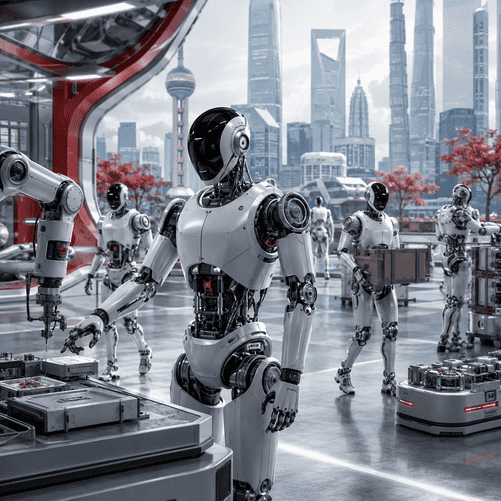
Chinese robotics companies say breakthroughs in artificial intelligence could soon allow machines to understand unfamiliar environments and perform complex tasks from simple spoken instructions, potentially transforming manufacturing, logistics and everyday work.

The global robotics industry may be approaching a turning point comparable to the arrival of ChatGPT, as advances in artificial intelligence begin to move humanoid machines beyond carefully programmed demonstrations and toward more flexible real-world work.
That was the message from Wang Xingxing, chief executive of Unitree Robotics, speaking at the World Robot Conference in Beijing on Thursday. Wang said the sector was moving closer to a “ChatGPT moment” in which robots could understand their surroundings, interpret natural-language commands and carry out a much wider range of tasks without requiring detailed programming for every action.
The comparison is significant. ChatGPT dramatically expanded public awareness of generative artificial intelligence by showing that software could perform a broad range of language tasks through a simple conversational interface. Robotics companies are now trying to achieve something similar in the physical world.
Instead of training a machine individually to walk across a warehouse floor, pick up a box or operate a tool, researchers want robots to develop more general models of how the physical world works.
Such systems are often described as embodied AI.
The goal is to combine vision, language models, spatial reasoning and motor control so that a robot can interpret a command such as “take these packages to the loading area” and independently determine how to navigate the room, identify the correct objects and complete the task.
That capability remains difficult, but progress is accelerating.
At the World Robot Conference, Chinese manufacturers displayed thousands of robotic products ranging from industrial machines and quadruped robots to humanoids capable of dancing, boxing, interacting with people and performing basic manipulation tasks. Unitree demonstrated humanoid models while other companies showcased robots designed for factories, services and personal assistance.
The demonstrations highlighted both the rapid pace of development and the limitations that remain.
Some machines can perform remarkably fluid movements under controlled conditions, yet everyday activities that humans perform almost effortlessly can still defeat them. One robot shown at the event struggled with the seemingly simple task of folding a shirt — a reminder that manipulating irregular objects remains one of robotics’ hardest technical problems.
Wang acknowledged that a truly general-purpose breakthrough may still be years away, estimating that major advances in robot intelligence could emerge within roughly two to ten years.
Even so, the economic stakes are already enormous.
China has positioned robotics as a strategic industry, investing heavily in humanoid machines as the country confronts rising labour costs and a shrinking working-age population. More capable robots could eventually take over repetitive, physically demanding or dangerous jobs in manufacturing, warehousing, construction and logistics.
China is also increasingly dominant in the emerging humanoid market. More than 40,000 humanoid robots were delivered in the first half of 2026, according to figures cited by Reuters, with Chinese manufacturers accounting for the overwhelming majority of global shipments.
That scale could give Chinese companies an important advantage.
Artificial intelligence improves through data, and physical robots generate enormous quantities of information about movement, objects and real-world environments. Companies capable of deploying thousands of machines may therefore collect more training data and improve their systems more quickly.
This creates a potential feedback loop: greater production lowers costs, lower costs encourage wider deployment, and wider deployment produces more data for increasingly capable AI models.
The comparison with the smartphone and electric-vehicle industries is difficult to ignore.
China used large-scale domestic manufacturing, extensive supply chains and intense competition among local companies to become a major force in both sectors. Beijing now appears to be pursuing a similar strategy in robotics.
But the next stage of competition is likely to focus less on mechanical engineering and more on software.
Modern humanoid robots already contain increasingly sophisticated motors, batteries, cameras and sensors. The greater challenge is building an artificial intelligence system capable of coordinating all of those components reliably in unpredictable environments.
Researchers are increasingly developing so-called world models — AI systems designed to create internal representations of physical environments and predict how actions will change them.
A robot equipped with such a system could theoretically understand that a glass may break if dropped, that a door needs to be opened before passing through it or that an object partly hidden behind another object still exists.
These capabilities sound elementary because humans learn them naturally from childhood. Teaching machines the same intuitive understanding of physics has proved considerably harder.
Large language models may help bridge that gap.
By combining language understanding with video, sensor information and robotic training data, developers hope to create machines capable of learning new tasks far more rapidly than traditional industrial robots.
The result could fundamentally alter how robots are deployed.
Today, most industrial robots operate in highly structured environments. They repeat precisely programmed movements — welding the same section of a vehicle, positioning components on an assembly line or moving products along a predetermined route.
Future humanoid machines could be considerably more adaptable.
A manufacturer might deploy the same robot to move materials in the morning, inspect equipment later in the day and reorganise a warehouse at night, simply by giving it new instructions.
That flexibility would make robots economically viable in many industries where traditional automation has been too expensive or inflexible.
The technology is also becoming a new front in strategic competition between China and the United States.
Washington has expressed growing concern over the security implications of advanced foreign-made humanoid and quadruped robots, particularly machines equipped with cameras, microphones and autonomous navigation systems. U.S.-China technology tensions could therefore increasingly extend beyond semiconductors and artificial intelligence software into physical robots.
For now, however, the industry remains somewhere between impressive demonstrations and widespread practical deployment.
Humanoid robots are expensive, battery life remains limited and machines are still significantly less efficient than human workers at many complex tasks.
The biggest technological hurdle is reliability.
A chatbot can occasionally produce an incorrect answer without causing physical damage. A robot operating beside workers, driving machinery or carrying heavy objects must behave correctly almost every time.
That requirement makes embodied AI substantially more difficult than purely digital artificial intelligence.
Yet the direction of travel is becoming increasingly clear.
Robots are beginning to acquire the same kind of general-purpose AI capabilities that transformed software over the past several years. If researchers succeed in combining those systems with reliable mechanical bodies, machines could become dramatically more capable without requiring engineers to program every movement individually.
That is what makes the idea of a robotic “ChatGPT moment” so important.
The breakthrough, if it arrives, may not simply produce better robots.
It could transform artificial intelligence from something people primarily interact with through screens into something capable of acting independently in the physical world — moving objects, operating equipment and performing work alongside humans.
And judging by the scale of investment and experimentation now visible in Beijing, China intends to be at the centre of that transformation.