Taipei’s proposed 18% increase would take annual military spending above NT$1 trillion for the first time, signalling resolve to Beijing while answering persistent U.S. calls for a stronger Taiwanese defence posture.

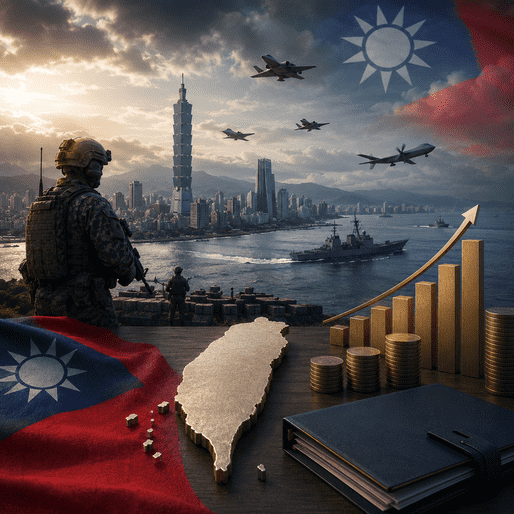
Taiwan has proposed its largest defence budget on record, pushing planned military spending for 2027 beyond the politically symbolic threshold of NT$1 trillion as the island seeks to accelerate its military modernisation amid intensifying pressure from China.
The government approved a proposed defence allocation of about NT$1.1225 trillion, or roughly US$31.4 billion, representing an increase of around 18% from the previous year under the government’s broader accounting methodology. The spending would lift Taiwan’s defence burden above 3% of gross domestic product for the first time, marking a significant shift in the island’s long-term security strategy.
President Lai Ching-te has presented the increase as an investment in deterrence rather than preparation for conflict, arguing that greater military capability is necessary to preserve peace in the Taiwan Strait. His government has sought to demonstrate that Taiwan is prepared to assume a larger share of the cost of its own defence while building forces capable of surviving and responding to a potential Chinese attack or blockade.
The proposal carries significance well beyond the budget numbers. For Beijing, it is another sign that Taipei intends to strengthen its ability to resist military coercion. For Washington, it addresses years of pressure on Taiwan to devote more resources to defence and to prioritise weapons designed specifically for an asymmetric conflict with the People’s Liberation Army.
Taiwan’s modernisation plans increasingly emphasise drones, missiles, mobile weapons systems, air defence and domestically developed submarines. Such capabilities are intended to make any attempt to invade or blockade the island considerably more difficult and costly, rather than trying to match China’s vastly larger military platform for platform.
Unmanned systems have become particularly important. U.S. officials have encouraged Taiwan to build what has sometimes been described as a dense defensive network of drones capable of complicating Chinese military operations around the island. American Institute in Taiwan Director Raymond Greene said in July that Taiwan needed a “hornet’s nest” of drones capable of strengthening deterrence and regional security.
The military build-up comes against a steadily more challenging strategic backdrop. China regards Taiwan as part of its territory and has never renounced the use of force to achieve what Beijing calls reunification. Taipei rejects Beijing’s sovereignty claim and maintains that the island’s future must be decided by its population.
Chinese military aircraft, warships and coast guard vessels have become an increasingly regular presence around Taiwan, while Beijing has repeatedly staged major exercises designed to demonstrate its ability to surround or isolate the island.
Taiwan recently completed its annual Han Kuang military exercises, which included scenarios involving a possible maritime blockade and disruptions to communications infrastructure. China sharply criticised the drills, describing them as provocative and accusing Taipei of encouraging public fears of war.
The proposed spending increase therefore has a dual purpose. Operationally, it provides resources for modernisation. Politically, it demonstrates Taiwan’s determination to strengthen its defences despite Chinese pressure.
It also sends an important message to Washington.
The United States remains Taiwan’s most important arms supplier and security partner despite maintaining no formal diplomatic relationship with Taipei. Successive U.S. administrations have urged Taiwan to increase military expenditure, arguing that American support must be accompanied by stronger domestic investment in defence.
For Taipei, moving defence spending above 3% of GDP helps reinforce the argument that Taiwan is not relying exclusively on American protection. That calculation has become increasingly important as burden-sharing has emerged as a central issue in U.S. security relationships around the world.
Yet approving the money could prove more difficult than announcing it.
President Lai’s Democratic Progressive Party does not control Taiwan’s legislature, where opposition parties hold the majority. Earlier this year, lawmakers approved only around two-thirds of a NT$1.25 trillion special defence package requested by the government, rejecting funding for some domestically produced drones and missiles while approving purchases of American weapons.
The political dispute highlighted a broader debate inside Taiwan over how rapidly defence spending should increase, how military procurement should be supervised and whether large expenditures are being allocated efficiently.
That tension is likely to return as lawmakers scrutinise the 2027 budget. Opposition parties have generally supported strengthening Taiwan’s defences but have also argued that large military allocations require greater oversight and clearer justification.
The broader challenge for Taiwan is therefore not simply spending more money, but ensuring that resources translate into usable military capability.
China’s defence budget and industrial base remain vastly larger, meaning Taiwan cannot expect to achieve conventional military parity. Its strategy instead depends increasingly on creating a force capable of dispersing quickly, surviving initial attacks and inflicting sufficiently heavy costs to make military action unattractive.
That explains Taipei’s emphasis on smaller mobile systems, precision missiles, drones, hardened infrastructure and resilient communications rather than relying predominantly on expensive conventional platforms.
Crossing the NT$1 trillion threshold consequently carries considerable symbolic weight. It signals that defence is moving closer to the centre of Taiwan’s fiscal priorities at a time when the security environment around the island is becoming more demanding.
For Beijing, the message is that military pressure is encouraging Taiwan to invest more heavily in deterrence rather than producing political accommodation.
For Washington, it is evidence that Taipei is responding to calls to shoulder a greater share of its own defence.
And for Taiwan itself, the record budget represents a strategic wager: that investing considerably more today can increase the cost of aggression enough to prevent a conflict tomorrow.