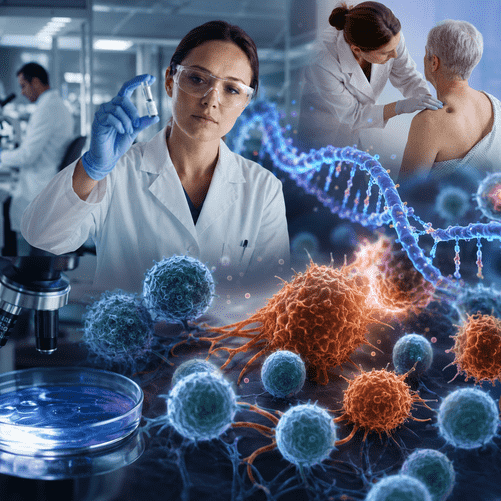
A late-stage trial from Moderna and Merck suggests a vaccine built from each patient’s own tumour can reduce the risk of melanoma returning or spreading, marking a potentially important turning point for personalised cancer medicine

A personalised mRNA cancer vaccine developed by Moderna and Merck has succeeded in a large Phase III clinical trial involving patients with high-risk melanoma, delivering one of the strongest indications yet that vaccines individually designed around a person’s tumour could become part of mainstream cancer treatment.
The experimental therapy, known as intismeran autogene, was given alongside Merck’s immunotherapy drug pembrolizumab, sold as Keytruda, to patients whose melanoma had already been surgically removed. According to results announced by the companies, the combination significantly extended the period in which patients remained free of cancer recurrence compared with pembrolizumab alone. It also significantly improved survival without the cancer spreading to distant parts of the body.
The development is particularly notable because it represents the first successful Phase III trial of an individually tailored mRNA-based cancer therapy. Researchers have pursued cancer vaccines for decades, but repeatedly struggled to produce sufficiently powerful and precise immune responses against tumours. The latest findings suggest that advances in genomic sequencing, artificial intelligence and mRNA manufacturing may finally be changing that equation.
Unlike conventional vaccines, intismeran is not designed to stop cancer from developing in healthy people. It is instead created after a patient has already been diagnosed and treated. Doctors obtain a sample of the removed tumour and sequence its genetic material, searching for mutations that distinguish the cancer cells from normal cells.
Those mutations can produce abnormal proteins known as neoantigens. Because neoantigens are specific to a tumour, they can potentially serve as biological fingerprints that allow the immune system to distinguish malignant cells from healthy tissue.
Using information extracted from each tumour, Moderna designs a unique mRNA treatment encoding as many as 34 of these neoantigens. Once injected, the mRNA instructs the patient’s cells to temporarily produce the selected molecular targets, effectively training immune cells to recognise and attack cancer cells carrying them.
The process amounts to manufacturing a different medicine for every patient.
That is what makes the experiment scientifically unusual. Traditional pharmaceuticals are generally identical regardless of who receives them. Intismeran, by contrast, is produced from the biological characteristics of an individual tumour, moving personalised medicine beyond selecting an existing drug and toward creating a new therapeutic product for each patient.
The Phase III INTerpath-001 study enrolled 1,137 patients with completely removed stage IIB to IV melanoma. Participants were randomly assigned to receive either intismeran plus pembrolizumab or pembrolizumab alone. The study met its primary endpoint of recurrence-free survival as well as a key secondary measure assessing distant metastasis-free survival.
Importantly, however, Moderna and Merck have not yet released the full numerical results from the Phase III trial. Detailed figures showing precisely how much the treatment reduced recurrence and metastasis are expected to be presented at a forthcoming medical meeting.
That means considerable caution remains warranted. The announcement establishes that the statistical goals of the trial were reached, but independent researchers will need the complete dataset to assess the magnitude of the benefit, potential adverse effects and whether certain groups of patients responded particularly well or poorly. Overall-survival data also remain immature, meaning researchers do not yet know whether patients receiving the vaccine ultimately live longer.
Earlier results nevertheless provide an indication of the technology’s potential. In the preceding Phase IIb study, combining the personalised vaccine with pembrolizumab was associated with a 49% reduction in the risk of recurrence or death and a 59% reduction in the risk of distant metastasis or death compared with pembrolizumab alone after extended follow-up.
Melanoma is particularly well suited to such an approach because the cancer frequently carries large numbers of genetic mutations, creating many potential neoantigens that the immune system can be trained to identify.
But the implications could stretch substantially further.
Researchers are studying similar personalised vaccines against several other tumour types, including lung, bladder and kidney cancers. The fundamental strategy—sequencing a tumour, identifying its distinctive mutations and creating an immune treatment specifically targeting them—could potentially be adapted across numerous forms of cancer.
That possibility is why some oncologists view the melanoma trial as more significant than a single advance in skin-cancer treatment. If the results withstand regulatory and scientific scrutiny, they could provide a powerful proof of principle for an entire class of personalised therapies.
The achievement also represents an important second act for mRNA technology.
Messenger RNA became internationally familiar through the rapid development of COVID-19 vaccines, but scientists had been experimenting with the platform for cancer therapy long before the pandemic. The technology allows researchers to provide cells with temporary genetic instructions without permanently changing their DNA, making it comparatively fast and flexible when scientists need to create highly specific biological targets.
Cancer may ultimately become one of its most consequential applications.
There are, however, substantial obstacles before personalised cancer vaccines could become widely available.
Manufacturing remains a major challenge. Each tumour must be collected and sequenced, promising neoantigens must be identified, and a unique vaccine must then be manufactured for the patient. That process can take weeks or months and is fundamentally more complicated than mass-producing millions of identical doses of a conventional vaccine.
Cost will also be critical. Building an individual medicine for every patient requires sophisticated laboratories, computational analysis and tightly controlled manufacturing. Even if the treatment proves highly effective, healthcare systems will have to determine whether production can be scaled affordably enough for broad clinical use.
Another unanswered question is how successfully the approach will translate to cancers carrying fewer mutations than melanoma. Tumours with fewer obvious neoantigens may provide the immune system with fewer distinctive targets, potentially making personalised vaccines less effective.
For now, scientists are therefore treating the Phase III success as a milestone rather than a final verdict.
Moderna and Merck are expected to discuss the results with regulators, potentially opening a path toward approval. If authorised, intismeran could become one of the first medicines to transform a patient’s tumour genome into a customised therapeutic vaccine.
The advance represents a striking convergence of several technologies that have matured independently over the past two decades: rapid genetic sequencing, computational tumour analysis, artificial intelligence, immunotherapy and mRNA production.
Together, they are beginning to make possible something that once belonged largely to the theoretical frontier of oncology—the ability to examine an individual cancer, identify exactly what makes it biologically unique, and manufacture a treatment designed specifically to teach that patient’s immune system how to find it.
The full Phase III results will determine how transformative intismeran ultimately proves to be. But the latest trial suggests personalised cancer vaccines have moved decisively beyond experimental promise and closer to becoming a practical new weapon against one of medicine’s most difficult diseases.