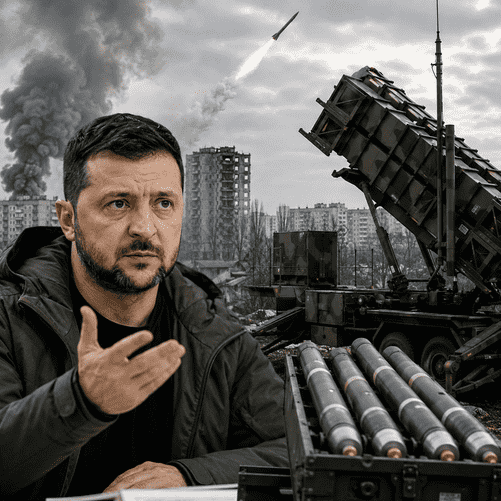
Former U.S. vice president Mike Pence says Zelenskyy is seeking additional Patriot interceptors as Russian strikes intensify and Kyiv races to protect its energy system before winter

Ukraine is intensifying its appeal for additional U.S.-made Patriot interceptor missiles as President Volodymyr Zelenskyy warns that dwindling air-defence stocks could leave cities and critical infrastructure dangerously exposed when winter arrives.
Former U.S. vice president Mike Pence said after discussions with Ukrainian officials that Zelenskyy had again emphasised the need for more Patriot missiles, underscoring growing concern in Kyiv that Russia could exploit shortages in interceptor stocks to mount sustained attacks on electricity generation, heating networks and other infrastructure during the colder months.
The appeal comes at an increasingly difficult moment for Ukraine’s air defences. Russian forces have stepped up missile and drone attacks, including a major assault on Kyiv on August 20 that killed civilians and struck residential and public infrastructure. Ukraine continues to intercept large numbers of drones and cruise missiles, but ballistic weapons remain particularly difficult to stop without Patriot systems.
Zelenskyy has put unusually precise figures on the scale of Ukraine’s requirements. Speaking to journalists on August 23, he said the Ukrainian air force estimates it needs around 360 Patriot missiles for the winter, while he had personally sought to secure roughly 300 as part of an emergency package. Global production, he noted, is limited, making such volumes difficult to obtain quickly.
Kyiv is not asking Washington simply to donate the weapons. Zelenskyy has repeatedly stressed that Ukraine is prepared to purchase additional interceptors and wants the United States and other partners to make the political decisions necessary to release them from existing inventories. He has suggested that even a relatively small percentage of U.S. stocks could have a significant effect on Ukraine’s ability to protect its population and energy infrastructure.
The urgency reflects a widening gap between Ukraine’s needs and available supplies. Zelenskyy said Ukraine received 675 relevant missiles during 2023 but only 364 in 2025, even as the scale and sophistication of Russian aerial attacks increased. Patriot interceptors are especially valuable because they are among Ukraine’s most effective defences against Russian ballistic missiles, which can reach their targets far faster than conventional cruise missiles.
The coming winter is central to Kyiv’s calculations. Russia has repeatedly targeted Ukraine’s power grid since the full-scale invasion began, attempting to damage electricity and heating systems during periods when civilian demand is at its highest. With interceptor inventories under pressure, Ukrainian officials fear another concentrated campaign against energy infrastructure could cause prolonged blackouts and heating shortages for millions of people.
Those concerns have gained urgency after the latest attacks. A Russian missile and drone barrage on Kyiv this week killed at least 16 people, injured dozens and damaged homes, industrial facilities, a school and a children’s hospital. Ukrainian air defences destroyed most incoming cruise missiles and drones, but ballistic missiles proved considerably harder to stop amid the Patriot shortage.
European governments are attempting to close part of the gap. French President Emmanuel Macron has agreed to accelerate deliveries of French air-defence equipment and interceptor missiles, while France and Italy are advancing the SAMP/T-NG system as another potential defence against ballistic threats. Germany has also agreed to provide hundreds of PAC-2 missiles in 2027 and 2028, although those deliveries will arrive too late to address Ukraine’s immediate winter requirement.
Pence’s intervention is politically significant because the decisive stocks remain largely dependent on the United States and allied countries operating Patriot batteries. His comments highlight the continuing debate in Washington over how much additional air-defence equipment can be transferred without placing unacceptable pressure on American inventories.
That debate has become more complicated as demand for advanced missile defence has grown globally. Conflicts and security concerns in Europe and the Middle East have forced governments to reassess their own stockpiles, while manufacturers face the challenge of increasing production of sophisticated interceptors that cannot be produced rapidly enough to satisfy every requirement simultaneously.
For Ukraine, however, the issue is increasingly measured not in procurement cycles but in weeks. Zelenskyy has argued that additional Patriot missiles could affect both the military balance and diplomatic calculations by denying Moscow the ability to use ballistic strikes as leverage against the Ukrainian population.
France and other European partners are now pushing for broader cooperation on missile defence, while the Coalition of the Willing is preparing further discussions on how to reinforce Ukraine as diplomatic efforts to end the war remain stalled.
The strategic stakes extend beyond the battlefield. Protecting power stations, substations, hospitals and densely populated cities through winter is critical to Ukraine’s economic resilience and public morale. Major damage to the electrical grid could also trigger additional displacement and place further pressure on European countries already hosting millions of Ukrainian refugees.
For Zelenskyy, the argument to Washington is therefore straightforward: Ukraine possesses Patriot launchers, crews and the willingness to pay, but without enough interceptor missiles the systems cannot perform their most important function.
As summer moves toward autumn, the question is becoming increasingly urgent. Ukraine is preparing for another winter of Russian bombardment, but this time its ability to withstand that campaign may depend less on acquiring new air-defence batteries than on securing enough missiles to keep the batteries it already has firing.