Ukrainian president rejects calls for elections during the war with Russia, arguing that security risks, displacement and political divisions make a national vote dangerously destabilising

Ukrainian President Volodymyr Zelenskyy has delivered one of his strongest warnings yet against holding elections while the country remains at war with Russia, arguing that a national vote under current conditions could deepen political divisions and threaten the cohesion of the state.
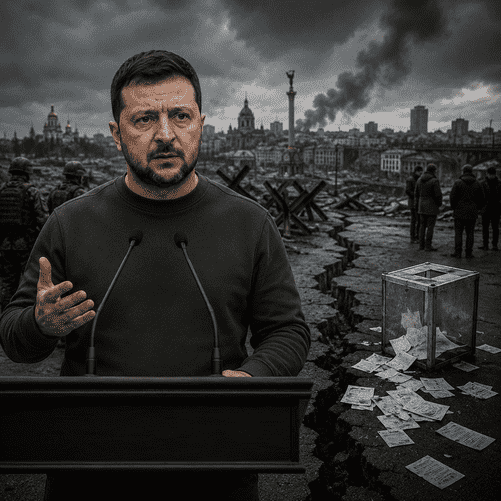
Speaking during a briefing with journalists on Saturday, with his comments made public on Sunday, August 23, Zelenskyy described wartime elections as an extraordinary risk for a country still fighting a large-scale invasion. “Elections right now are a tsunami for the state that will split Ukraine,” he said, adding that pursuing a vote during active hostilities could ultimately prove destructive for the country.
His intervention follows an unexpected call for elections from former defence minister Mykhailo Fedorov, who was dismissed in July and has since emerged as one of the most visible sources of political pressure on the government. Fedorov argued that Ukraine should develop a legal and secure mechanism allowing citizens to vote even during a prolonged war, saying democratic processes should not effectively be suspended indefinitely because of Russia’s invasion.
Zelenskyy rejected that argument, insisting that the practical and security obstacles remain enormous. Millions of Ukrainians are displaced abroad or within the country, hundreds of thousands of troops are serving in the armed forces, and substantial areas of Ukrainian territory remain under Russian occupation. Organising voting across those groups while protecting polling stations, electoral infrastructure and communications from Russian attacks would present unprecedented logistical difficulties.
Ukraine has not held national elections since martial law was imposed following Russia’s full-scale invasion in February 2022. Ukrainian legislation prevents elections from taking place under martial law, meaning a vote would require major legal and political changes as well as credible security arrangements. Zelenskyy’s original presidential term expired in May 2024, but he has remained in office under Ukraine’s wartime constitutional framework.
Public opinion also appears cautious about an immediate election. A recent Kyiv International Institute of Sociology survey cited by Reuters found that 57% of Ukrainians favour holding elections only after hostilities have ended, highlighting continued public concern over the risks of campaigning and voting during wartime.
The dispute nevertheless marks an important shift in Ukrainian politics. For much of the war, serious political competition was largely subordinated to the need for national unity. Fedorov’s dismissal and subsequent criticism of the government have begun to challenge that consensus, exposing tensions over corruption, military management, government accountability and the future of Ukraine’s democratic institutions.
Fedorov’s removal from the defence ministry triggered public demonstrations, although even some of those who supported him reportedly rejected his proposal for wartime elections. His political intervention has therefore created a complicated challenge for Zelenskyy: pressure is growing for greater accountability and political renewal, while broad resistance remains to introducing a potentially divisive electoral campaign during active combat.
The Kremlin has already seized on the dispute. Moscow has repeatedly questioned Zelenskyy’s legitimacy because presidential elections were not held after his term expired, while Kyiv argues that Russian aggression itself has made normal democratic processes impossible. Kremlin spokesman Dmitry Peskov recently portrayed Fedorov’s election proposal as evidence of growing divisions within Ukraine’s political leadership.
For Kyiv, that information dimension is particularly sensitive. Ukrainian officials and analysts have long warned that a national election would offer Moscow opportunities to exploit political disagreements, disseminate disinformation and interfere with public debate while the country remains under military pressure.
Zelenskyy’s argument is therefore based not simply on electoral logistics but on wartime political cohesion. He warned against creating deeper divisions between civilians and members of the armed forces and said his priority remained ending the war while preserving Ukraine’s independence and sovereignty.
The controversy is unfolding as Ukraine continues to confront intense Russian military pressure and serious shortages in air-defence ammunition. Zelenskyy has renewed appeals to Western partners for additional Patriot interceptor missiles, while European allies are discussing further measures to strengthen Ukraine’s defences. Kyiv is also watching Russian military preparations closely, with Zelenskyy warning that Moscow could consider mobilising hundreds of thousands of additional soldiers.
The broader political question is unlikely to disappear. Ukraine’s democratic institutions have become central to its argument that the war is not merely about territory but about the country’s political independence and European future. At the same time, prolonged martial law inevitably raises difficult questions about when ordinary democratic competition can safely resume.
For Zelenskyy, the immediate answer remains clear: elections should follow conditions in which Ukrainians can vote freely and securely rather than become another arena in which the war is fought. His warning underscores the increasingly difficult balance facing Kyiv—preserving democratic legitimacy while avoiding political fragmentation at a moment when Russia continues to exert enormous military and psychological pressure on the country.