The Spanish prime minister summons the country’s top national-security body after weeks of opposition pressure, as thousands of migrants remain stranded in the North African enclave and questions persist over Madrid’s handling of the border emergency

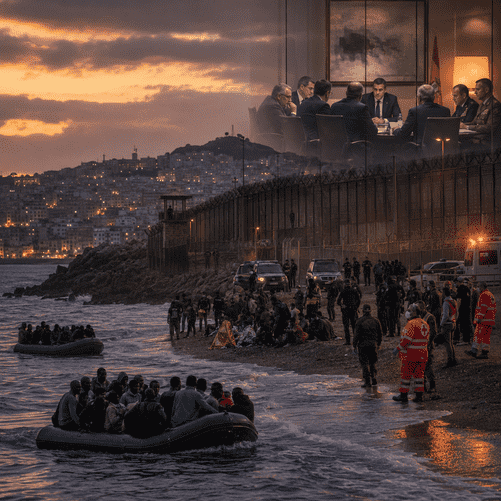
Spanish Prime Minister Pedro Sánchez has convened an extraordinary meeting of the National Security Council to address the continuing migration crisis in Ceuta, nearly four weeks after tens of thousands of people crossed into the Spanish enclave from neighbouring Morocco.
The meeting, scheduled for Tuesday, comes 26 days after the mass crossings of July 30 and 31 and follows weeks of criticism from opposition parties and local officials who argued that Spain’s highest-level national-security coordination body should have been activated much earlier. Sánchez had already chaired separate ministerial coordination meetings on August 7 and August 17, but not the full National Security Council.
The distinction has become politically significant because the council brings together senior officials from across the government, defence and intelligence establishment and is designed to coordinate responses to threats with implications extending beyond a single ministry.
Its intervention now underscores the extent to which the Ceuta emergency has evolved from a border-management problem into a wider political, humanitarian and security challenge for Sánchez’s government.
The crisis began when an extraordinary number of migrants entered Ceuta from Morocco over two days at the end of July. Spain’s Interior Ministry initially estimated that approximately 72,000 people had crossed, although the central government’s representative in Ceuta, Miguel Ángel Pérez Triano, said on Monday that the total had exceeded 80,000. Most subsequently returned to Morocco, but several thousand remain in the enclave.
Conditions remain difficult. Estimates suggest that more than 5,000 migrants are still in Ceuta, including large numbers of minors, while reception facilities have struggled to accommodate everyone. Thousands have at different stages slept in improvised shelters or outdoors while officials work through identification, asylum and return procedures.
The government has opened temporary reception facilities, including sites at Loma Margarita and Loma Colmenar capable of accommodating around 1,800 people, and has promised additional capacity. Yet officials acknowledge that the enclave remains far from normality.
The humanitarian pressures have been particularly acute for children and women. Spain recently reversed an earlier position and agreed that 500 unaccompanied minors could be transferred from Ceuta to the mainland, reflecting mounting concern about overcrowding and conditions in the enclave. Reports of sexual harassment and assault among vulnerable migrants have added urgency to demands for safer accommodation and stronger policing.
At the same time, Sánchez is under growing pressure over the speed and structure of the government’s response.
The conservative People’s Party has demanded the deployment of additional immigration officials and round-the-clock processing to accelerate returns. PP spokesperson Borja Sémper argued on Monday that the situation could not be managed according to ordinary administrative procedures because of its exceptional scale.
The timing of the National Security Council meeting has therefore become part of the political controversy. Critics have accused Sánchez of waiting too long before convening the body, despite the scale of the initial border breach and the subsequent strain on Ceuta’s infrastructure.
The government, however, can point to repeated coordination efforts since the crisis began. Sánchez brought senior ministers together on August 7 and again on August 17 to review security, identification procedures and humanitarian assistance. Madrid has repeatedly said that all necessary state resources would be deployed to restore normality.
Tuesday’s meeting is likely to address a broader range of questions, including border security, accommodation, the processing of migrants who remain in the enclave, cooperation with Morocco and the intelligence picture preceding the crossings.
That final issue has become increasingly sensitive.
Political debate has intensified over whether Spanish intelligence and national-security institutions had adequate warning of the possibility of a mass movement toward the border. El País reported that questions remain over what information was available to the National Intelligence Centre before the crisis. An official national-security assessment published months earlier had already warned of increasing migratory pressure and the potential for disinformation to exacerbate social tensions.
Morocco’s role is another politically delicate element.
Madrid continues to describe Rabat as a reliable partner on migration, and Interior Minister Fernando Grande-Marlaska has defended the bilateral relationship. But the speed and scale of the late-July crossings inevitably raised questions about how so many people were able to reach and breach one of the European Union’s most sensitive external borders in such a short period.
Ceuta’s geographic and political position makes the crisis especially difficult to contain. The Spanish territory sits on the North African coast and shares a land frontier with Morocco, making it simultaneously a local border, an EU external frontier and a recurring flashpoint in relations between Madrid and Rabat.
The crisis has also exposed divisions inside Europe.
Several European governments have criticised Spanish migration policies, arguing that regularisation programmes may create incentives for irregular migration. Former EU foreign-policy chief Josep Borrell, by contrast, has accused much of Europe of responding to the Ceuta emergency in a disproportionate manner and failing to show sufficient solidarity with Spain.
The political stakes for Sánchez are therefore considerable. His government must demonstrate that it can restore order in Ceuta while complying with asylum law and child-protection obligations, maintain cooperation with Morocco without appearing dependent on Rabat, and persuade European partners that the crisis is a shared external-border challenge rather than a problem created solely by Spanish policy.
The National Security Council meeting will not by itself resolve those tensions. But its convening signals that Madrid now formally regards the Ceuta emergency as an issue requiring the highest level of state coordination.
For Sánchez, the more difficult question is why it took almost a month to reach that point.
With thousands of migrants still awaiting a resolution, local services under pressure and political scrutiny intensifying in Madrid, the government is entering the next phase of the Ceuta crisis with less room for delay — and with substantially greater expectations that Tuesday’s meeting will produce concrete results.