Demand for collectible designer pieces is surging as increasingly knowledgeable consumers search by season, runway look and creative director — transforming secondhand fashion from bargain hunting into a sophisticated investment market

Luxury fashion is developing a new kind of consumer: one who knows not only which designer they want, but the year, collection, fabric and sometimes even the precise runway look they are searching for.
New data from the luxury resale market suggests that secondhand shopping is entering a markedly more sophisticated phase, as consumers increasingly treat designer clothing and accessories as collectible objects rather than simply discounted alternatives to new luxury goods.
According to The RealReal’s latest resale analysis, demand for vintage pieces — defined as items at least 15 years old — has risen 432 per cent since 2020. At the same time, shoppers are becoming dramatically more precise in how they search for fashion online, using terms such as specific Chanel seasons, archival Prada fabrics or individual runway looks rather than simply entering the name of a luxury house.
The shift points to a broader transformation taking place across the luxury industry. After years in which major brands relied heavily on relentless price increases, scarcity and frequent product launches, a growing group of consumers appears increasingly interested in fashion history, provenance and individuality.
For these shoppers, the question is no longer merely whether an item carries a famous label. What matters is which period of that label it represents.
Collections created by influential designers such as Phoebe Philo, Nicolas Ghesquière and Marc Jacobs have become particularly attractive to younger consumers who may have been children — or not yet born — when the clothes first appeared on the runway. Pieces from the late 1990s and early 2000s are now being rediscovered as cultural artefacts of distinctive creative eras.
The trend is changing the traditional definition of vintage luxury.
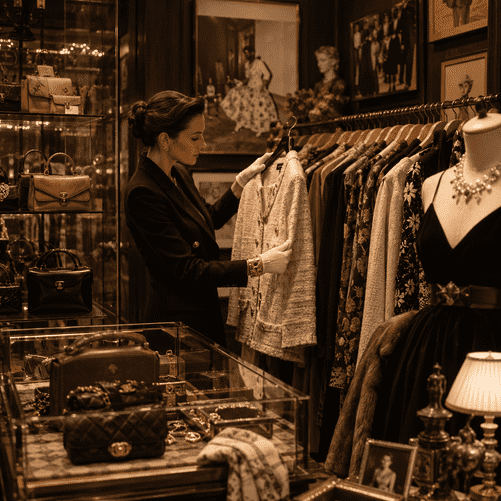
For decades, the market concentrated heavily on universally recognizable objects: Hermès Birkin bags, Chanel flap bags, Rolex watches and established haute couture. Increasingly, however, collectors are hunting for less obvious pieces whose value derives from design history, rarity and association with a particular creative director.
A discontinued handbag, an overlooked runway coat or a dress from a designer’s early collection can suddenly become highly desirable once fashion audiences rediscover its historical significance.
Social media has accelerated that process. Online archives, runway-video platforms and fashion-focused accounts have given younger consumers unprecedented access to decades of collections that were previously familiar mainly to editors, stylists and collectors.
A shopper can now identify a dress from a 2003 runway show, research the designer who created it and begin searching resale platforms for the exact piece within minutes.
Kristen Naiman, chief brand officer at The RealReal, told Vogue that the increasing specificity of customer searches demonstrates a fundamental change in how people approach fashion. Buyers are developing what she described as greater fluency in style while simultaneously pursuing pieces that offer a sense of singularity.
That desire for individuality comes at an important moment for the luxury industry.
After years of aggressive price increases, some consumers have begun questioning whether newly manufactured luxury products still justify their cost. Luxury prices rose dramatically during the first half of the decade, while economic uncertainty and slower growth placed greater pressure on aspirational shoppers.
Some brands are consequently experimenting with more accessible pricing. Gucci, for example, has reduced the price of selected newer products, while companies including Burberry and Coach have developed broader price ladders designed to maintain access to entry-level luxury consumers.
Resale offers an alternative proposition.
Instead of paying an increasingly high price for a product available in boutiques around the world, consumers can purchase an older piece that may be rarer, more distinctive and potentially capable of retaining — or increasing — its value.
That last consideration is becoming increasingly important.
Almost half of consumers surveyed in connection with The RealReal’s analysis now consider potential resale value when purchasing new luxury products, according to Vogue. Fashion, in other words, is increasingly being evaluated with some of the logic traditionally associated with watches, jewellery, art and collectible cars.
Handbags remain at the centre of this emerging investment mentality.
Certain models have maintained strong secondary-market prices for years, but buyers are increasingly searching beyond the most obvious icons. Previously overlooked designs can appreciate rapidly when cultural attention shifts or when a new creative director revives interest in a fashion house’s archives.
Chanel provides a particularly clear example. Interest surrounding Matthieu Blazy’s creative direction has encouraged consumers to revisit earlier Chanel collections, contributing to renewed attention toward archival bags and garments. Styles such as the Chanel Cerf tote have attracted new interest, while Saint Laurent’s older Y bag is among the designs benefiting from fashion’s appetite for rediscovery.
Creative-director appointments can therefore affect not only sales of future collections but the value of decades-old products already circulating through secondary markets.
That represents a significant change for luxury companies.
Historically, brands largely lost control of a product economically once it left a boutique. Today, the secondary market can influence perceptions of desirability in the primary market itself. A handbag that retains 80 or 90 per cent of its purchase price may appear more attractive to a customer than one that quickly loses most of its value.
The relationship works in reverse as well. When a forgotten archival design suddenly becomes fashionable again, it can generate renewed interest in the house that originally produced it.
The economic performance of resale platforms suggests that this behaviour is becoming significant rather than remaining a niche enthusiast activity.
The RealReal reported that gross merchandise value increased 22 per cent year on year in the second quarter of 2026, while revenue increased 17 per cent. The company recorded approximately $2.1 billion in gross merchandise value during 2025 and says more than 50 million items have been sold through its platform over its history.
Its growth provides another indication that luxury resale is gradually moving closer to the mainstream fashion economy.
Sustainability also remains part of the attraction. Buying previously owned clothing extends the useful life of garments and accessories and provides an alternative to the rapid production-and-disposal cycle associated with much of contemporary fashion.
But the newest phase of resale appears to be driven by something more complex than environmental consciousness alone.
Consumers increasingly want objects with histories.
That preference is visible elsewhere in contemporary culture, from renewed demand for analogue cameras and vinyl records to enthusiasm for vintage furniture and mechanical watches. Against a digital landscape characterized by algorithms, infinite reproduction and increasingly convincing artificial imagery, evidence of age and physical history can itself become desirable.
Even imperfection is gaining value. The RealReal previously reported rising sales of luxury goods classified in “fair” condition, suggesting that visible wear is no longer necessarily considered a defect. For some buyers, patina and signs of use reinforce the sense that an object is authentic, individual and connected to another era.
Fashion houses are beginning to confront the implications.
If consumers increasingly prefer a 20-year-old handbag to a newly released one, brands must compete not merely against rival designers but against their own archives.
That could encourage a greater emphasis on craftsmanship, longevity and recognizable design. Products capable of remaining desirable for decades may become more commercially valuable than items engineered primarily around short-term seasonal trends.
It could also change how designers approach heritage.
Fashion houses have always mined their archives, but the rise of sophisticated resale shoppers means consumers can immediately compare a contemporary reinterpretation with the original product that inspired it — and often purchase the original instead.
The result is a luxury market becoming unusually conscious of its own history.
At the same time, fashion knowledge itself is becoming a form of status.
Knowing that a handbag is Chanel is relatively easy. Recognizing its season, designer, production period and relationship to a particular runway collection requires considerably greater cultural fluency.
That knowledge allows consumers to distinguish themselves even when recognizable logos are absent.
The trend therefore fits with a broader movement away from overt luxury signalling. Instead of conspicuous branding, status can increasingly come from possessing something rare enough that only other knowledgeable observers recognize its significance.
For the luxury industry, this emerging “fashion archivist” consumer presents both an opportunity and a challenge.
Resale platforms benefit because increasing sophistication encourages repeated searches, collecting and trading. Luxury houses benefit when strong secondary-market prices reinforce perceptions of quality and desirability.
But brands whose products fail to retain cultural or financial value could face uncomfortable comparisons with competitors whose archives continue appreciating decades after their original release.
The most important shift may ultimately be psychological.
Luxury consumers are no longer necessarily thinking of wardrobes as collections of disposable seasonal purchases. Increasingly, they are approaching them as evolving portfolios — buying, holding, reselling and replacing pieces according to cultural relevance and market value.
In that world, the hottest luxury item of 2026 may not have been designed this year at all.
It may have been waiting in someone’s wardrobe for two decades.