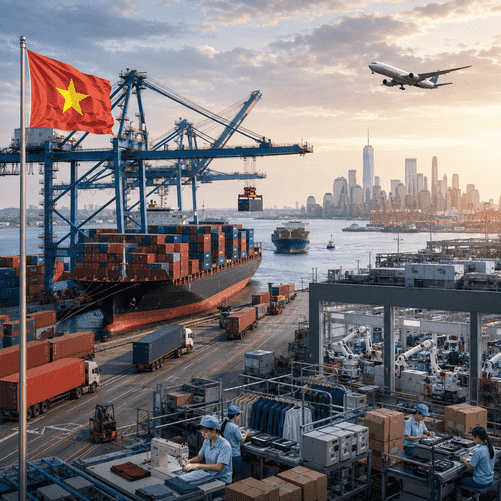
U.S. tariffs aimed at reshaping global commerce have accelerated a manufacturing shift away from China, propelling Vietnam to the top of America’s trade-deficit rankings.

Vietnam has quietly become one of the most consequential winners from the latest transformation of global trade. In the first half of 2026, the Southeast Asian country recorded a trade surplus of roughly $114 billion with the United States, surpassing not only Mexico and Taiwan but also China, long the dominant source of America’s merchandise trade imbalance.
The milestone is remarkable for an economy considerably smaller than those of the other major U.S. trading partners. Yet it reflects a shift that has been developing for years: manufacturers have steadily expanded production in Vietnam as companies seek alternatives to China, diversify supply chains and reduce exposure to higher U.S. tariffs.
That process has accelerated under President Donald Trump’s renewed tariff strategy. Although the administration has presented higher import duties as a mechanism for encouraging production to return to the United States, one of the clearest consequences has instead been a redirection of manufacturing within Asia. According to estimates cited by The Wall Street Journal, the effective U.S. tariff rate on Chinese imports stood at about 23.2% in June, compared with a global average near 7%, while Vietnam’s effective rate was substantially lower at approximately 6.5%.
The difference has created powerful incentives for multinational companies to move production or sourcing away from China. Apple, Nike and Lululemon are among the prominent companies that have expanded their Vietnamese supply chains during the past decade. Electronics manufacturers, footwear producers, textile companies and furniture makers have followed similar strategies, transforming Vietnam into one of the world’s most important alternative manufacturing bases.
The impact is increasingly visible in U.S. import statistics. American imports from Vietnam reached approximately $123 billion during the first six months of 2026, an increase of around 40% from the previous year, according to the figures reported by the Journal. Vietnam is now the fifth-largest supplier of goods to the United States, even though Mexico and Canada remain substantially larger exporters overall.
What makes Vietnam’s trade surplus particularly large is the imbalance in the relationship. American consumers purchase enormous quantities of Vietnamese-made electronics, furniture, footwear, clothing and other manufactured goods, while Vietnam imports comparatively fewer products from the United States.
For Vietnamese policymakers, the manufacturing boom represents a major economic opportunity. The country has spent decades integrating itself into international supply chains, attracting foreign direct investment and developing industrial zones capable of supporting global companies. South Korean electronics giant Samsung has made Vietnam one of its most important manufacturing centers, while other technology groups and contract manufacturers, including Foxconn, have expanded operations there.
The result is a manufacturing ecosystem that increasingly resembles the export-oriented model that powered China’s industrial ascent during previous decades. Vietnam combines relatively low labor costs with improving infrastructure, participation in numerous international trade agreements and geographic proximity to China’s vast network of suppliers.
However, Vietnam’s growing importance in U.S. trade is also attracting greater scrutiny from Washington. American officials have raised concerns that some Chinese products may be routed through third countries—including Vietnam—to avoid higher U.S. tariffs.
Washington recently estimated that tariff evasion through transshipment could cost the United States between $19 billion and $26 billion annually, with goods originating largely in China moving through third countries before entering the American market. Vietnam’s government has said it will work constructively with the United States to address those concerns and preserve stable bilateral trade relations.
The issue highlights an increasingly difficult challenge for U.S. trade policy. Tariffs can reduce imports directly from one country, but they do not necessarily eliminate the underlying demand for inexpensive manufactured goods. Companies may instead relocate factories, reorganize sourcing networks or shift final assembly to countries facing lower tariff barriers.
Vietnam illustrates that dynamic particularly clearly. Policies designed to reduce American dependence on Chinese manufacturing have undoubtedly encouraged diversification, but much of that production has migrated not to factories in the United States, but to another rapidly industrializing Asian economy.
For Hanoi, the transformation brings both opportunity and risk. Greater access to the American market could sustain investment, employment and economic growth for years. At the same time, an increasingly large bilateral trade surplus could make Vietnam a more prominent target of future U.S. tariff measures or negotiations demanding greater purchases of American goods.
The emergence of Vietnam as the country with the largest trade surplus with the United States therefore represents more than a statistical curiosity. It illustrates how profoundly global supply chains can adapt to government policy—and how attempts to redraw international trade relationships often produce consequences far beyond their original objectives.
China may be losing part of its traditional manufacturing dominance in the American market, but the demand that supported it has not disappeared. Increasingly, the label replacing “Made in China” on products entering U.S. ports reads “Made in Vietnam.”