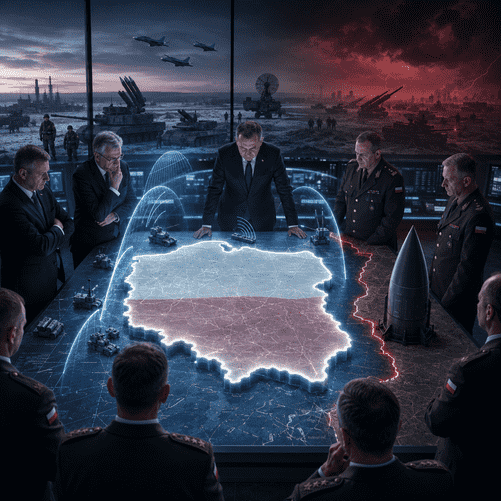
Warsaw says it wants a stronger U.S. military presence and full participation in NATO’s nuclear deterrence strategy, but rules out stationing allied nuclear warheads on Polish territory.

Poland has ruled out hosting allied nuclear weapons on its territory, drawing a clear boundary around the country’s rapidly expanding defence posture even as concerns grow over Russian military pressure on NATO’s eastern frontier.
Speaking at NATO headquarters in Brussels on Thursday, Polish Deputy Defence Minister Paweł Zalewski said Warsaw remains firmly committed to the alliance’s nuclear deterrence strategy but does not believe that participation requires nuclear warheads to be physically stationed inside Poland.
“No — that is what I would like to say very clearly and openly. Poland does not want to have nuclear warheads on its territory,” Zalewski told reporters when asked whether a future expansion of the U.S. military presence in the country could include nuclear capabilities.
The statement is significant because Poland has emerged as one of NATO’s most heavily armed and strategically important members since Russia’s invasion of Ukraine fundamentally altered Europe’s security landscape.
Warsaw has dramatically increased defence spending, expanded its armed forces and invested heavily in new weapons systems, while repeatedly calling for a stronger and more permanent American military presence along NATO’s eastern flank.
Yet Zalewski sought to distinguish between supporting NATO’s nuclear umbrella and physically hosting the weapons themselves.
“We want to participate in NATO nuclear deterrence, which does not mean having nuclear warheads on our territory,” he said.
That distinction places Poland firmly inside NATO’s nuclear strategy while avoiding a potentially provocative deployment that Moscow would almost certainly portray as a major escalation.
The issue has become increasingly sensitive as Russia continues to place pressure on NATO’s eastern members. Earlier this month, NATO condemned recent violations of Polish and Romanian airspace, saying Russia bore responsibility for incidents that demonstrated an increasing willingness to accept military risk. The alliance said it was continuing to strengthen integrated air and missile defences from the Baltic region to the Black Sea.
For Poland, geography makes the security question particularly acute. The country borders Russia’s heavily militarised Kaliningrad exclave and Belarus, one of Moscow’s closest allies, while also serving as a critical logistical corridor for Western military support to Ukraine.
Warsaw therefore occupies one of the most exposed positions within NATO.
Polish leaders have responded by pursuing one of Europe’s most ambitious conventional military modernisation programmes, seeking larger land forces, modern aircraft, advanced air defences, long-range strike capabilities and greater interoperability with American troops.
Rather than nuclear deployment, the government appears to be placing greater emphasis on strengthening that conventional deterrent and securing a long-term U.S. military commitment.
Zalewski said Poland is particularly interested in expanding the permanent American military presence in the country as Washington conducts a broader review of its force posture in Europe.
The Pentagon announced a six-month assessment of U.S. deployments in Europe in June. According to reporting cited by Reuters, the process is expected to produce several strategic options for U.S. Defense Secretary Pete Hegseth by early November.
Warsaw is watching that review closely.
Earlier this year, U.S. President Donald Trump surprised NATO allies by raising the possibility of permanently deploying an additional 5,000 American troops to Poland. Zalewski described that proposal as an important starting point for discussions over the future American presence in the country.
For Poland, additional U.S. forces could provide many of the deterrent benefits Warsaw seeks without requiring nuclear weapons to be based on Polish soil.
The approach also reflects a broader debate within NATO over how the alliance should divide responsibilities between the United States and its European members.
Zalewski referred to what he described as the Pentagon’s emerging concept of “NATO 3.0”, in which European countries assume greater responsibility for conventional defence while the United States maintains a crucial supporting role, including the strategic nuclear guarantee underpinning the alliance.
Such a model would fit closely with Poland’s current defence trajectory.
Warsaw has repeatedly argued that Europe must build stronger conventional armed forces capable of responding rapidly to aggression, while maintaining the transatlantic link with Washington as the ultimate guarantor of NATO security.
The nuclear dimension nevertheless remains politically sensitive.
NATO’s deterrence posture is based partly on American nuclear weapons deployed in several European allied countries under long-standing nuclear-sharing arrangements. The exact operational details are deliberately restricted, but participating states contribute aircraft, infrastructure and personnel to the alliance’s nuclear mission while the weapons themselves remain under U.S. control.
Poland has previously shown interest in deeper involvement in NATO’s nuclear planning, particularly as Russia has increasingly used nuclear rhetoric during its confrontation with the West.
Russia’s own deployment of tactical nuclear weapons in Belarus has further intensified the discussion. From Warsaw’s perspective, that development placed Russian-controlled nuclear capabilities closer to Polish territory and reinforced arguments for stronger NATO deterrence.
Nevertheless, Zalewski’s remarks indicate that the Polish government currently sees a difference between responding to that threat and mirroring it.
Hosting nuclear warheads could potentially increase Poland’s strategic importance within NATO, but it could also make the country an even more prominent target in Russian military planning and trigger a severe political confrontation with Moscow.
Warsaw appears instead to favour a deterrence architecture built around conventional military strength, American forces, integrated NATO air and missile defence and the wider nuclear umbrella provided by the alliance.
That position does not represent a retreat from Poland’s increasingly assertive defence policy. On the contrary, the country remains among the strongest advocates for NATO reinforcement along its eastern frontier.
But it demonstrates that Warsaw is attempting to calibrate that reinforcement carefully.
Poland wants more troops, more weapons and stronger guarantees — but, at least for now, not nuclear warheads.
As NATO continues adjusting its military posture in response to Russia, Poland’s position illustrates the delicate balance facing eastern European governments: strengthening deterrence enough to convince Moscow that allied territory cannot be attacked successfully, while avoiding steps that could unnecessarily accelerate an already dangerous nuclear confrontation.
For Warsaw, the preferred answer appears to be clear: build one of Europe’s strongest conventional militaries, deepen the American military commitment and remain fully protected by NATO’s nuclear umbrella — without bringing the bomb itself onto Polish soil.