From cult Simson mopeds to memories of community and stability, the Alternative for Germany is turning symbols of the former communist East into political currency as it seeks a historic breakthrough in Saxony-Anhalt.

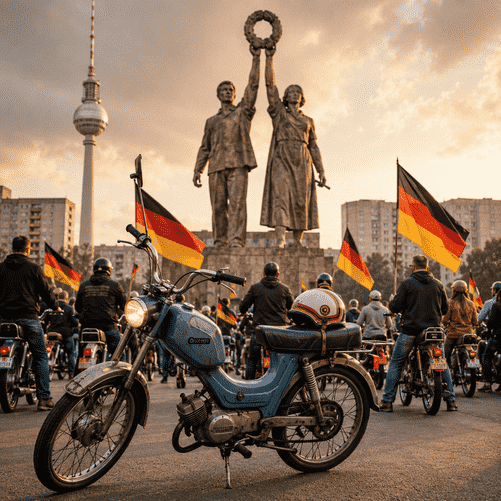
A convoy of vintage mopeds rolling through eastern Germany might ordinarily look like a gathering of enthusiasts celebrating one of the region’s most recognizable pieces of industrial heritage. Increasingly, however, the unmistakable machines have become part of a much larger political story.
The far-right Alternative for Germany, or AfD, has embraced the Simson moped as a potent symbol in its campaign across the former East Germany, combining regional nostalgia, cultural identity and dissatisfaction with the political establishment as it pushes toward potentially historic electoral gains.
The strategy has become particularly visible in Saxony-Anhalt, which holds a state election on September 6. Recent polling has placed the AfD at around 40 percent or higher, giving the party a realistic possibility of becoming the dominant force in the state and potentially producing Germany’s first AfD-led regional government.
Leading the campaign is Ulrich Siegmund, the AfD’s candidate for state premier. At rallies and specially organized Simson gatherings, Siegmund has presented himself less as a conventional politician than as a representative of an eastern German identity that, according to the party’s message, has been overlooked by decision-makers in Berlin.
At one recent campaign event in Quedlinburg, thousands of people gathered as Siegmund led a procession of Simson motorcycles and mopeds. Similar imagery has become increasingly common in AfD campaigning, pairing German national symbols with reminders of everyday life in the former German Democratic Republic.
The Simson is especially effective because it carries meanings far beyond transportation.
Produced in the eastern German city of Suhl, the motorcycles and mopeds became ubiquitous during the communist era. Cars were often expensive and difficult to obtain in East Germany, while Simsons offered relatively inexpensive mobility, particularly for young people. Models such as the Schwalbe, S50 and S51 remain enormously popular decades after German reunification and have developed a thriving collector and enthusiast culture.
For many eastern Germans, a Simson evokes adolescence, independence, friendships and family memories rather than communist ideology. That distinction is central to the political appeal.
The AfD is not openly campaigning for the restoration of the East German state. Instead, it is tapping into what Germans often call Ostalgie — nostalgia for aspects of life in the former East — and combining those memories with a broader message that something valuable was lost during reunification and the decades that followed.
That sentiment can include memories of stronger local communities, greater social predictability, affordable housing, stable employment and a slower pace of social change. Such recollections frequently coexist with recognition of the GDR’s authoritarian government, surveillance apparatus and restrictions on political freedom.
AfD campaign rhetoric selectively emphasizes the former.
Siegmund has repeatedly spoken about recovering an “old, safe Germany,” while campaign events have incorporated East German cultural references, including the former GDR anthem and Simson rallies. German public broadcaster ARD has described the approach as a deliberate attempt to connect contemporary political grievances with idealized memories of the past.
The message resonates particularly strongly in regions that continue to struggle with the economic and demographic consequences of reunification.
More than three decades after the collapse of communism, significant differences remain between eastern and western Germany. Many eastern communities have experienced population decline, the departure of younger workers and the disappearance of industries that once provided stable employment. Corporate headquarters, major financial institutions and senior positions in national organizations remain disproportionately concentrated in the West.
For voters who believe eastern Germany has been treated as a peripheral region rather than an equal partner in reunification, the AfD offers an explicitly confrontational answer.
Its leaders argue that mainstream parties have ignored eastern concerns while imposing policies on migration, climate, energy and social issues that do not reflect local priorities. Whether voters agree with the party’s prescriptions or not, the narrative has helped transform regional frustration into electoral support.
The strategy appears to be working particularly well among younger eastern Germans — a generation with little or no direct memory of communist rule.
Polling cited by Reuters indicates that AfD support among 18- to 34-year-olds in the region has risen sharply, from roughly a quarter of voters to around 40 percent. That suggests East German nostalgia is no longer simply the preserve of people who lived through the GDR. Cultural symbols such as Simsons have been inherited by younger generations and transformed into expressions of regional identity.
This paradox is one of the more striking features of the AfD’s campaign. Young voters who never experienced the political repression, shortages or restrictions of communist East Germany can nevertheless identify strongly with objects and traditions associated with it.
The Simson therefore functions less as a symbol of socialism than as a symbol of “the East” itself.
That appropriation has generated fierce controversy because the history of the manufacturer extends far beyond the communist period.
The company traces its origins to brothers Löb and Moses Simson, members of a Jewish family who established an industrial enterprise in Suhl during the 19th century. After the Nazis came to power, the family was dispossessed of the business and forced to flee Germany. The factory later passed through different ownership structures before eventually becoming a major East German manufacturer after the Second World War.
Descendants of the Simson family have strongly objected to the brand’s association with the AfD. They argue that seeing the name of a Jewish family persecuted by the Nazis used in the political imagery of a far-right party represents a profound distortion of its history.
The controversy illustrates a broader battle over historical memory in modern Germany: who owns cultural symbols, and whether objects associated with everyday East German life can legitimately be incorporated into partisan politics.
For the AfD, the answer appears straightforward. The party has continued using Simson imagery and has also campaigned on regulatory issues important to owners of the mopeds, including rules governing imported vehicles and their permitted speeds. In August, the party claimed credit after federal authorities moved toward easing restrictions affecting some reimported Simson motorcycles.
The cultural campaign is occurring against the backdrop of an increasingly consequential political contest.
Saxony-Anhalt has about 2.2 million residents and has become one of the clearest examples of the AfD’s strength in eastern Germany. Recent surveys suggest the party could approach or even surpass the threshold required for an outright majority, although polling remains fluid ahead of the September vote.
Such a result would mark a watershed moment in German politics.
Mainstream parties have traditionally maintained a political “firewall,” refusing to form governing coalitions with the AfD. But if the party wins enough seats to govern independently, that strategy could face its greatest test yet.
The implications would extend far beyond Saxony-Anhalt. Control of a state government would give the AfD greater influence over education, policing, cultural policy and Germany’s federal institutions, while demonstrating that the party can translate protest support into executive power.
For Chancellor Friedrich Merz and his Christian Democratic Union, the election therefore represents more than another regional contest. A major defeat in eastern Germany could intensify debates inside the CDU over how to confront the AfD and whether the current policy of political isolation remains sustainable.
Yet the symbolism of the Simson campaign may ultimately reveal more about the AfD’s rise than polling numbers alone.
The party is succeeding not simply by promising different policies but by offering a narrative of belonging. It tells voters that their memories, frustrations and regional identities have been dismissed — and that voting AfD represents a way of reclaiming them.
In that narrative, a small East German moped becomes something much larger: a machine carrying memories of youth, independence and community into a highly polarized political present.
As Saxony-Anhalt prepares to vote, the question is whether that combination of nostalgia and discontent will be powerful enough to carry the AfD across one of the most consequential thresholds in Germany’s postwar political history.