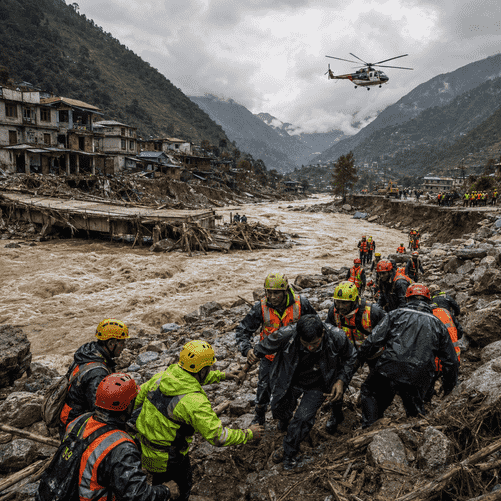
Hundreds have been confirmed dead and more than 1,500 people remain unaccounted for after a catastrophic Himalayan flash flood devastated communities along the Nepal-Tibet border.

Rescue teams are continuing an increasingly desperate search for survivors after one of the most destructive floods to strike the Himalayan region in recent years left hundreds dead and more than 1,500 people missing across Nepal and neighboring Tibet.
The disaster struck on Wednesday after what authorities and scientists believe was a major glacier collapse high in the mountains, unleashing a violent surge of water, ice, mud and debris through valleys along the Nepal-China frontier. Entire settlements were overwhelmed within minutes, while roads, bridges and sections of critical infrastructure were swept away.
The casualty figures have risen rapidly as rescue teams reach previously inaccessible areas. Early reports put the number of confirmed deaths at around 490, but more recent figures indicate the toll has climbed substantially, with hundreds more feared trapped beneath debris or carried downstream. Nepal has reported the overwhelming majority of fatalities, while authorities in Tibet have also confirmed deaths and hundreds of people missing.
The scale of the missing-persons crisis is particularly alarming. Nepalese authorities have reported close to 1,000 people unaccounted for, while more than 550 are missing in Tibet. Many are foreign tourists and pilgrims who had travelled through the region toward Mount Kailash and other Himalayan destinations. Citizens from more than 30 countries are believed to be among those still missing.
Thousands of rescuers, including soldiers, police officers and emergency personnel, have been deployed across the affected region. Helicopters are transporting injured survivors to Kathmandu and other medical centres, while ground teams are searching riverbanks, collapsed buildings and vast fields of mud and debris.
Their work, however, has been complicated by the continuing threat of further flooding. A large lake formed by landslide debris upstream began overflowing on Friday, forcing rescue operations in some areas to be temporarily suspended and prompting new evacuation warnings along the Bhotekoshi and Trishuli river systems. Officials fear that a sudden breach could generate another destructive surge downstream.
Damage to transportation networks has made the emergency response even more difficult. Dozens of bridges have reportedly been destroyed, while extensive sections of mountain roads have been washed away or blocked by landslides. Some remote settlements remain reachable only by helicopter or on foot.
Hospitals in Kathmandu and surrounding districts are treating scores of injured survivors while also receiving bodies recovered from the disaster zone. Identifying the dead has proved difficult in some cases because victims were carried considerable distances by the floodwaters, separating them from their belongings and communities. Families have gathered at hospitals, emergency centres and government offices searching for information about missing relatives.
The international dimension of the disaster has added another layer of complexity. Hundreds of missing foreigners include pilgrims, tourists and workers from countries including India, the United States, Britain, Canada, Australia, Malaysia, Ukraine and several European and Asian nations. Governments and diplomatic missions are attempting to determine the whereabouts of their citizens as casualty lists continue to change.
Humanitarian agencies are warning that the impact extends well beyond the immediate death toll. The Red Cross estimates that tens of thousands of people urgently require assistance, including displaced families and children whose homes, schools and local health facilities have been damaged or destroyed. International relief operations are beginning to mobilize as the scale of the catastrophe becomes clearer.
The suspected glacial origin of the disaster is also intensifying concerns about the vulnerability of Himalayan communities to climate-related hazards. Scientists have repeatedly warned that rising temperatures are destabilizing glaciers and increasing the number and size of glacial lakes across the region. When natural ice or debris dams collapse, they can release enormous quantities of water with little warning.
Such events, known as glacial lake outburst floods, can move rapidly through narrow mountain valleys, carrying boulders, sediment and infrastructure for many kilometres downstream. In heavily populated river corridors, the consequences can be catastrophic.
For Nepal, the disaster is now shifting from an immediate rescue emergency into what is likely to become a prolonged humanitarian and reconstruction effort. Thousands of people have already been rescued, but with so many still missing and further flooding possible, authorities are warning that the final toll may rise considerably.
For families waiting for news, the search continues hour by hour. Across the shattered valleys of the Nepal-Tibet frontier, rescue teams are working through unstable terrain and unpredictable weather in the hope that pockets of survivors may still be found beneath the debris.