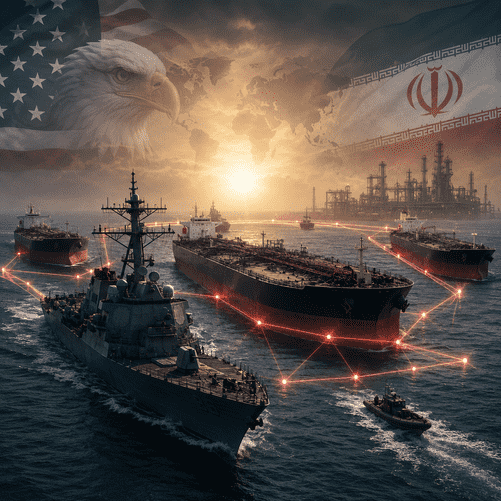
A U.S.-led naval blockade and widening sanctions campaign have sharply reduced Iranian crude exports, signaling a strategic shift by the Trump administration from large-scale military strikes toward sustained economic pressure.

The confrontation between the United States and Iran is entering a new phase, with Washington increasingly relying on economic isolation rather than sustained large-scale military action to force Tehran back toward negotiations.
At the center of the strategy is Iran’s most important source of foreign revenue: oil.
Months of U.S. naval operations around the Strait of Hormuz, combined with tightening sanctions and threats against countries and financial institutions that continue doing business with Tehran, have dramatically reduced Iran’s ability to move crude onto international markets. Iranian officials themselves have acknowledged that oil exports have been brought close to a standstill, while outside assessments point to a severe loss of government revenue.
The campaign marks a significant change in emphasis for President Donald Trump’s administration. After months of direct military confrontation beginning in February, Washington is now presenting economic pressure as the principal instrument for weakening Iran and extracting political concessions.
Treasury Secretary Scott Bessent has described the emerging policy as an unprecedented effort to isolate the Iranian economy. The administration has dubbed the initiative “Operation Economic Outcast,” combining the blockade with tougher financial restrictions and the threat of secondary sanctions against governments, companies and banks that continue facilitating Iranian trade.
The objective is straightforward: deprive Tehran of the revenue it needs to finance government operations, sustain its military capabilities and support its regional network of allies.
Oil is the obvious target. For decades, crude exports have provided Iran with its most important stream of hard currency. Even under previous rounds of U.S. sanctions, Tehran developed elaborate mechanisms to maintain sales, particularly to China, using intermediaries, ship-to-ship transfers, shell companies and vessels operating within what has become known as the “shadow fleet.”
The naval blockade has made those methods considerably more difficult.
Washington’s control over key maritime routes has sharply restricted Iranian tankers while allowing U.S.-protected traffic from other Gulf producers to resume gradually through parts of the Strait of Hormuz. Commercial shipping remains far below pre-war levels, but American officials argue that Iran’s ability to use the waterway as leverage is weakening.
The economic consequences inside Iran are becoming increasingly visible.
Inflation has accelerated dramatically, the rial has lost substantial value and purchasing power has deteriorated across the country. One recent estimate cited by Axios projected Iranian inflation at nearly 69 percent in 2026, while the International Monetary Fund has forecast a severe contraction in economic output.
For ordinary Iranians, those figures translate into rapidly rising prices for food, housing and imported goods. Businesses face shortages of foreign currency and difficulty acquiring components from abroad, while the government must manage falling oil revenues alongside the enormous costs associated with the conflict.
The Trump administration appears to believe that sustained pressure could ultimately produce what military strikes have so far failed to achieve: sufficient internal economic strain to convince Tehran that a negotiated settlement is preferable to prolonged confrontation.
Trump said this week that Washington was not currently engaged in talks with Iran, emphasizing instead the campaign to weaken its economy until Iranian leaders demonstrate a willingness to negotiate on terms acceptable to the United States.
Yet whether economic warfare will produce that outcome remains far from certain.
Iran has decades of experience operating under international sanctions and has constructed a sophisticated parallel trading system. Chinese buyers remain particularly important, accounting for the overwhelming majority of Iranian crude exports in recent years. Tehran has also increasingly relied on yuan-denominated transactions, barter arrangements, offshore oil storage, cryptocurrency and networks of shell companies to evade restrictions on conventional banking.
Washington’s next challenge may therefore be political rather than military.
To close the remaining loopholes, the United States would have to increase pressure on countries that continue trading with Iran. China poses the greatest dilemma. Sanctioning major Chinese banks or companies involved in Iranian oil purchases could significantly strengthen the blockade’s effectiveness, but it could also provoke a wider confrontation between Washington and Beijing and disrupt other areas of the global economy.
India, Turkey, Iraq and the United Arab Emirates are also under scrutiny because of their commercial relationships or role in regional trade networks. The United States has warned that entities continuing to facilitate Iranian transactions could face secondary sanctions, potentially forcing governments and businesses to choose between access to the American financial system and continued commerce with Tehran.
That possibility gives Washington considerable leverage. The dollar’s dominant role in international finance means that even governments opposed to U.S. policy may hesitate to expose their banks and major corporations to American penalties.
But economic pressure also carries significant risks.
Analysts warn that if Tehran concludes its economy is being deliberately strangled with no realistic diplomatic exit, Iranian leaders may respond by escalating militarily rather than conceding.
Iran retains missiles, drones and other asymmetric capabilities capable of threatening Gulf energy facilities, shipping infrastructure and U.S. military positions. Any renewed attacks on regional oil installations could send global crude prices sharply higher and impose significant costs on the same governments supporting Washington’s campaign.
The Strait of Hormuz remains central to that calculation.
Before the conflict, roughly a fifth of global petroleum consumption passed through the narrow waterway separating Iran from Oman. Traffic has since fallen dramatically, although limited commercial movements have resumed under military protection. Recent shipping data cited by ABC News showed traffic averaging only a fraction of its pre-war level.
That disruption explains why developments around Iran continue to influence global oil markets even as Washington shifts away from heavy military operations. Brent crude was trading around $90 a barrel on August 28, with markets balancing the risk of renewed escalation against expectations that an economic rather than kinetic confrontation could reduce immediate threats to Gulf infrastructure.
There are also costs for Washington.
Maintaining the naval presence required to enforce the blockade is consuming substantial military resources. Reporting based on Pentagon documents indicates that the Iran campaign has placed significant strain on the U.S. Navy’s budget, forcing officials to redirect funds and raising concerns about long-term readiness if operations continue without additional congressional financing.
That financial pressure gives the administration another incentive to replace intensive military operations with sanctions, financial enforcement and maritime interdiction.
Six months into the conflict, however, the underlying strategic problem remains unresolved.
Iran has been badly weakened economically but has not capitulated. Its leadership still controls the country, retains significant military capabilities and appears convinced that enduring economic hardship may ultimately prove preferable to accepting Washington’s demands. Reuters described the broader conflict this week as a costly stalemate in which both sides believe time could eventually strengthen their negotiating position.
For the Trump administration, the wager is that Iran’s economic limits will be reached first.
The battlefield has therefore moved increasingly from missile sites and military bases to ports, tanker routes, banking networks and international supply chains. Instead of attempting to destroy Iran’s capabilities outright, Washington is trying to make sustaining them economically impossible.
Whether that strategy forces Tehran toward compromise or provokes another round of military escalation may determine the next stage of a conflict that has already transformed the security and energy landscape of the Middle East.