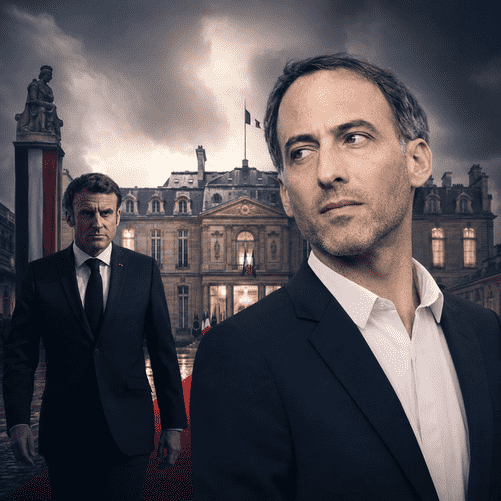
Olivier Faure’s surprise challenge transforms France’s center-left primary into a potentially bruising contest, complicating Raphaël Glucksmann’s attempt to emerge as the main alternative to the country’s political extremes

Raphaël Glucksmann’s effort to position himself as the leading center-left candidate for the French presidency has encountered an unexpectedly formidable obstacle after Socialist Party leader Olivier Faure entered the party’s primary, threatening to turn an anticipated coronation into a politically dangerous internal battle.
Glucksmann, the 46-year-old European Parliament lawmaker and co-founder of the Place Publique movement, formally declared his candidacy for the 2027 presidential election on August 23. Although he is not a member of the Socialist Party, he agreed to compete in its autumn primary in an attempt to secure the organizational machinery, financial resources and political legitimacy of France’s historic social-democratic party.
Until recently, that strategy appeared relatively safe.
Glucksmann had emerged as one of the strongest figures among France’s moderate left, particularly after leading the Socialist–Place Publique list to roughly 14% of the vote in the 2024 European elections. Opinion polling has also suggested that he may be better placed than many other left-wing politicians to appeal beyond the traditional Socialist electorate.
But Faure’s decision to challenge him has altered the equation.
Faure turns a formality into a contest
The Socialist first secretary announced over the weekend that he would participate in the primary, setting up what is increasingly being viewed as a direct contest between the party establishment and the more electorally expansive political project represented by Glucksmann.
The rivalry was already visible during the Socialist Party’s summer gathering in Blois on August 28 and 29, where the two men appeared increasingly like opposing contenders rather than partners preparing for a common campaign. Le Monde described them as the two principal favorites in the forthcoming contest.
Faure should not be underestimated.
He has led the Socialist Party for more than eight years and has survived repeated internal challenges, ideological battles and leadership crises that might have ended the careers of less resilient politicians.
One Socialist parliamentarian reportedly compared him to the seemingly indestructible protagonist of Highlander, describing Faure as a political survivor who repeatedly emerges from internal confrontations still standing.
That ability to navigate the Socialist Party’s complicated internal alliances could prove particularly important in a primary where party activists, established networks and local political organizations are likely to carry considerable influence.
For Glucksmann, whose political strength has developed largely outside the traditional Socialist apparatus, the contest therefore presents a very different challenge from a national election campaign.
A candidate attempting to redefine the French left
Glucksmann has sought to build a political identity that combines traditional social-democratic themes with environmentalism, European integration and strong support for Ukraine.
His campaign has emphasized ecological investment, industrial sovereignty, redistribution and greater taxation of very large inheritances while remaining firmly pro-European and rejecting political cooperation with Jean-Luc Mélenchon’s hard-left La France Insoumise.
That positioning has allowed him to present himself as an alternative both to the radical left and to President Emmanuel Macron’s economically liberal centrism.
He has also made environmental policy one of the defining themes of his presidential bid, promising what he has described as an ambitious ecological transformation during the first 100 days of a future administration.
The strategy is designed to assemble a coalition stretching across Socialists, moderate environmentalists, pro-European progressives and voters who previously supported Macron but are now searching for a new political home.
Yet the same positioning has created vulnerabilities inside the Socialist primary.
The battle over class and identity
Glucksmann’s opponents have increasingly attempted to portray him as a candidate disconnected from working-class France.
His background as the son of philosopher André Glucksmann, his intellectual career, his European political profile and his relationship with prominent French television journalist Léa Salamé have contributed to an image that rivals have sought to characterize as metropolitan and elite.
Socialist MP Philippe Brun, himself a primary candidate, has attacked Glucksmann as representative of an affluent urban political class, while former presidential candidate Ségolène Royal has publicly portrayed him as excessively favored by the media.
Faure appears likely to make class politics a central part of his own campaign.
He has sought to emphasize his connections to middle- and working-class voters, implicitly drawing a contrast with Glucksmann’s more cosmopolitan profile.
The distinction could become important inside a Socialist electorate that remains deeply divided over the direction the French left should take after more than a decade of electoral decline.
One faction believes the party must rebuild its traditional working-class and lower-middle-class base.
Another argues that the left can only return to national power by assembling a broader coalition of progressive urban voters, environmentalists, professionals and moderate former Macron supporters.
The Glucksmann-Faure contest increasingly represents a confrontation between those two approaches.
An already crowded field
The primary itself is becoming increasingly unpredictable.
Besides Glucksmann and Faure, several Socialist politicians have either declared themselves or signaled potential candidacies.
Former presidential candidate Ségolène Royal has entered the political conversation once again, while Socialist lawmakers including Philippe Brun and Jérôme Guedj have emerged as possible competitors.
Businessman and media investor Mathieu Pigasse has also reportedly considered entering the contest.
Meanwhile, Saint-Ouen mayor Karim Bouamrane has indicated that he intends to pursue his own presidential ambitions without participating in the Socialist primary, illustrating how fragmented the broader center-left landscape remains.
That fragmentation represents one of the greatest strategic problems facing the French left.
Even if Glucksmann wins the Socialist primary, there is no guarantee that all progressive candidates will rally behind him.
Jean-Luc Mélenchon remains an independent force with a substantial electoral base, while other politicians may continue their campaigns outside the Socialist-led process.
Hollande waits in the wings
There is another complication: François Hollande.
The former French president has not entered the primary and has indicated that he will decide later whether to attempt an extraordinary political comeback.
According to current reporting, Hollande is expected to clarify his intentions toward the end of the year.
His presence creates another layer of uncertainty for Glucksmann.
Hollande remains one of the most recognizable figures on the French center-left and retains substantial influence among Socialist officials, even though his presidency between 2012 and 2017 ended with historically low approval ratings.
A successful Glucksmann primary campaign could therefore still be followed by another internal struggle if Hollande concludes that the eventual nominee lacks sufficient momentum.
The possibility reinforces a broader paradox surrounding the French left: almost every effort to create unity seems capable of producing another candidate.
The Le Pen factor
The internal maneuvering is taking place against the backdrop of a presidential election increasingly dominated by the strength of the nationalist right.
Marine Le Pen continues to lead many first-round voting-intention surveys, while the broader Rassemblement National movement remains deeply entrenched across large sections of the electorate.
Glucksmann has explicitly framed his candidacy as an attempt to prevent the presidency from falling to the far right.
That argument represents one of his strongest political assets.
His supporters contend that he could potentially attract moderate voters in a second-round contest who might be reluctant to support Mélenchon or another more radical left-wing candidate.
But reaching that second round would require navigating an extraordinarily fragmented first-round field.
Candidates from the nationalist right, conservative Republicans, Macron’s political successors, the Socialist center-left and the Mélenchon-aligned left are all competing for overlapping sections of the electorate.
In such an environment, even relatively small divisions can prove decisive.
A primary with consequences beyond the Socialist Party
The approaching Socialist primary therefore matters far beyond the internal politics of one party.
For Glucksmann, defeat would probably end his presidential ambitions before the national campaign reaches its decisive phase.
For Faure, victory would represent a dramatic transformation from party manager to serious presidential contender.
For the Socialist Party, the contest will determine whether it continues to function primarily as an independent political force or becomes the institutional foundation for a broader progressive coalition.
And for the French left more generally, the primary could determine whether it enters the 2027 presidential election with a credible candidate capable of competing for the second round — or once again fragments into rival political camps.
Glucksmann still enters the contest with significant advantages.
He possesses national visibility, a growing campaign infrastructure, substantial support among pro-European voters and a political profile that extends beyond the Socialist Party’s traditional base.
But Olivier Faure possesses something equally important: intimate knowledge of the party whose endorsement Glucksmann now needs.
That is why a politician previously seen mainly as an internal Socialist survivor has suddenly become one of the most consequential figures in the presidential race.
For Glucksmann, the road to the Élysée Palace may ultimately depend not on defeating Marine Le Pen, Jean-Luc Mélenchon or a candidate from the Macronist center.
First, he has to survive his own side.