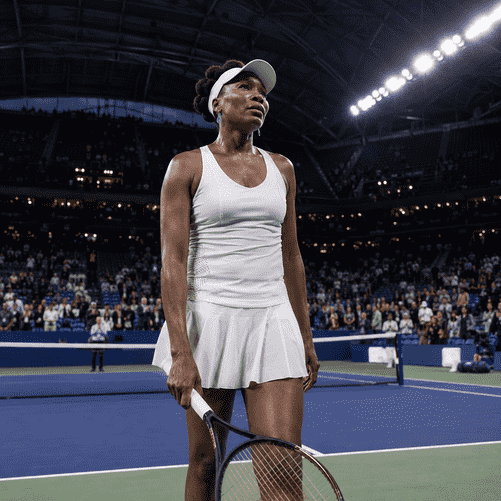
The 46-year-old tennis icon pushed Sofia Kenin deep into the night at Arthur Ashe Stadium, but a dramatic second-set collapse ended her singles campaign after the latest-starting match in tournament history

Venus Williams’ latest U.S. Open appearance ended in the early hours of Monday morning, after a match that began later than any other in the tournament’s history and stretched well beyond 2 a.m. inside Arthur Ashe Stadium.
The 46-year-old American was beaten 6-2, 7-6(6) by fellow wildcard Sofia Kenin in a first-round contest that did not begin until 12:13 a.m., after Novak Djokovic’s five-set defeat by Argentina’s Mariano Navone pushed the evening schedule deep into the night.
Despite the extraordinary hour, several thousand spectators remained inside the stadium to watch Williams, whose relationship with the U.S. Open stretches back nearly three decades.
She first played the tournament in 1997 and has been associated with Flushing Meadows for virtually the entire life of Arthur Ashe Stadium itself.
The atmosphere therefore carried something of a retrospective quality.
Williams is no longer the dominant athlete who won the U.S. Open in 2000 and 2001, but she remains one of the most recognizable figures in the sport and one of the players most closely connected to modern American tennis.
Kenin takes control early
Once play finally began, however, nostalgia quickly gave way to competition.
Kenin, the 2020 Australian Open champion, settled into the match more effectively and broke Williams early in the first set.
Both players initially struggled to establish rhythm, perhaps unsurprisingly given the circumstances. Williams produced several double faults, while her timing from the baseline fluctuated as the opening games unfolded.
Kenin nevertheless maintained greater consistency.
She repeatedly pressured Williams’ second serve and controlled enough of the longer rallies to build a decisive advantage, taking the opening set 6-2.
For Williams, the challenge was familiar.
Her first serve could still produce moments of authority, and when she stepped inside the baseline her groundstrokes retained the power that helped define an era.
But sustaining that level point after point proved more difficult.
Williams finds another gear
The second set was dramatically different.
Williams began moving more aggressively, striking the ball earlier and finding cleaner contact from both wings.
The crowd responded immediately.
Even after midnight, Arthur Ashe Stadium generated the kind of energy that has accompanied Williams throughout much of her career in New York.
She broke Kenin and increasingly began dictating rallies, forcing her younger opponent onto the defensive.
Kenin, herself a former Grand Slam champion, remained composed enough to stay close, but Williams’ level continued to rise as the set moved toward a tiebreak.
For several minutes, it appeared that the match might extend into a third set — and potentially much deeper into the morning.
Williams surged ahead in the breaker and created a series of opportunities to force a decider.
At one stage she held a 6-2 advantage.
Across the closing phase of the set, she accumulated seven set points.
She converted none of them.
Seven chances disappear
The collapse was sudden.
Kenin saved one set point, then another.
Williams missed opportunities that had seemed within reach only moments earlier.
The momentum shifted almost completely.
Kenin won six consecutive points from 2-6 down in the tiebreak, eventually closing out the match and ending Williams’ singles campaign shortly after 2 a.m.
For Williams, the finish was particularly painful because the second set had contained some of her strongest tennis of the night.
She had created enough chances to extend the contest but was unable to convert them when the pressure reached its highest point.
Kenin later acknowledged the difficulty of playing against Williams in such an unusual environment, while also admitting that nerves had affected her at times.
The victory sends Kenin into the second round, where she is scheduled to face top-ranked American Jessica Pegula.
A record that raises scheduling questions
The match immediately revived debate over late-night scheduling at Grand Slam tournaments.
Williams was openly critical of the circumstances.
She described the evening as extraordinary and acknowledged that beginning a match after midnight made it difficult to establish normal competitive rhythm.
The issue has become increasingly prominent across professional tennis.
Night sessions generate valuable television audiences and allow tournaments to showcase major stars under stadium lights, but long preceding matches can push later contests into hours normally associated with recovery rather than elite competition.
Players have repeatedly questioned whether contests beginning near or after midnight are appropriate from either a competitive or player-welfare perspective.
The U.S. Open has experimented with scheduling adjustments in recent years, but the Williams-Kenin match demonstrated how difficult the problem remains when an earlier marquee match unexpectedly runs long.
Djokovic’s five-set defeat to Navone was precisely such a scenario.
Because that contest occupied Arthur Ashe Stadium far longer than expected, the women’s match that followed was pushed into record territory.
Another early exit, but not an ordinary one
Statistically, the defeat extends a difficult sequence for Williams.
It marked her sixth consecutive first-round exit at the U.S. Open and continued a long stretch without a singles victory at Grand Slam level.
She has not won a major singles match since Wimbledon in 2021.
But evaluating Williams purely through recent results misses much of what makes her continued presence significant.
At 46, she was competing in her 96th Grand Slam main draw and making a record 26th main-draw appearance at the U.S. Open.
Her career spans multiple generations of champions.
She played against Martina Hingis and Lindsay Davenport at the beginning of her career, shared tennis’ biggest stages with her sister Serena for more than two decades, and is now competing against players who grew up watching both sisters redefine the women’s game.
That longevity is almost unprecedented in modern professional tennis.
The wildcard debate
Williams’ place in the draw had also generated discussion before the tournament began.
Currently ranked far outside the elite, she required a wildcard to enter the singles event.
Critics argued that such invitations could instead be used to give younger American players opportunities to compete at Grand Slam level.
Tournament officials defended the decision, pointing to Williams’ extraordinary history at Flushing Meadows and her continued ability to attract spectators.
The late-night crowd offered strong evidence for that argument.
Thousands remained inside Arthur Ashe Stadium well after midnight despite the postponement, waiting specifically to see Williams take the court.
Very few players ranked outside the world’s top 500 could produce a comparable response.
Williams remains an event in herself.
A relationship with New York stretching back decades
Her history at the U.S. Open began in remarkable fashion.
Williams reached the final on her tournament debut in 1997 at the age of 17, losing to Martina Hingis.
Three years later she won her first U.S. Open title, defeating Davenport in the final.
She successfully defended the championship in 2001, beating Serena in one of the most historically significant Grand Slam finals of the modern era.
Those achievements formed part of a career that eventually produced seven major singles titles, Olympic gold medals and numerous doubles championships.
Williams also played an important role in the campaign that ultimately resulted in equal prize money for men and women at Wimbledon.
Her influence therefore extends well beyond wins and losses.
She belongs to a small group of athletes whose careers changed the commercial and cultural dimensions of their sport.
The Williams sisters have another chapter left
Her tournament is not necessarily finished.
Venus is expected to compete in doubles alongside Serena Williams, giving New York another opportunity to see one of tennis’ most famous partnerships reunited.
The sisters dominated women’s doubles for years, winning 14 Grand Slam titles together and three Olympic doubles gold medals.
Serena’s own return to competitive tennis has already generated extraordinary attention during this year’s tournament.
A doubles appearance alongside Venus would therefore carry considerable emotional weight regardless of how far they progress.
For Venus, it also offers an immediate opportunity to move beyond the disappointment of the singles defeat.
No announcement about the future
Williams declined to turn the night into a farewell.
She did not announce retirement and did not give a definitive indication about whether she plans to return to the U.S. Open again.
That ambiguity has become characteristic of the later stages of her career.
Rather than formally closing the door, Williams has continued to compete selectively whenever fitness and circumstances allow.
The approach makes every appearance feel potentially significant without necessarily being final.
That was particularly true early Monday morning.
The scoreboard recorded another first-round loss.
But the scene inside Arthur Ashe Stadium told a more complicated story.
Thousands of spectators had remained inside one of the world’s largest tennis arenas until after 2 a.m. to watch a 46-year-old wildcard ranked far outside the sport’s elite.
They stayed because the player on court was Venus Williams.
And even after nearly three decades at the U.S. Open, that name still carries enough weight to keep New York awake.