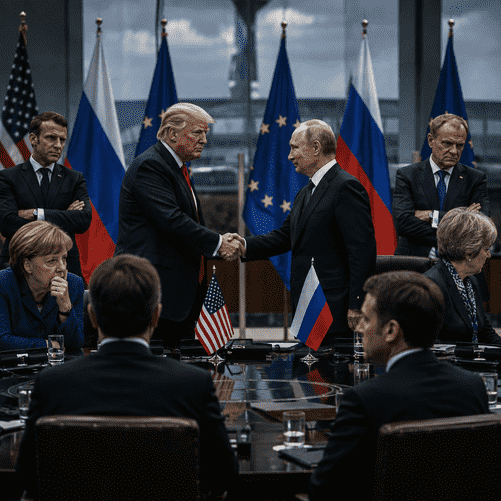
Moscow’s first in-person appearance at a G20 finance gathering since the invasion of Ukraine has exposed sharp differences between the Trump administration and European governments over whether engagement risks becoming normalization.

Russia’s return to a high-level G20 gathering has reopened a sensitive divide between Washington and its European allies, with officials from several European governments pushing back against any suggestion that Moscow’s international isolation should end while its war against Ukraine continues.
Russian Finance Minister Anton Siluanov attended the G20 finance ministers and central bank governors meeting in Asheville, North Carolina, on August 31, marking his first in-person appearance at such a gathering since Russia launched its full-scale invasion of Ukraine in 2022. His presence represented a significant departure from the diplomatic treatment Moscow faced at previous G20 meetings, when Western governments sought to isolate Russian representatives or limit political engagement.
The invitation came under the United States’ presidency of the G20 and immediately generated unease among European delegations.
German Finance Minister Lars Klingbeil was among those opposing any appearance of a return to normal relations with Russia. European officials stressed that Moscow remains subject to extensive sanctions and that Russia’s continuing military campaign in Ukraine makes political normalization unacceptable. Germany is also supporting preparations for further restrictive measures against Moscow.
The disagreement was visible as well as diplomatic.
European officials declined to take part in the traditional G20 “family photo” alongside Siluanov, according to Reuters, an unusually public gesture designed to distinguish participation in multilateral discussions from political rehabilitation of Russia.
Yet Washington’s position is more complicated than a straightforward rapprochement.
U.S. Treasury Secretary Scott Bessent held a bilateral meeting with Siluanov on the sidelines of the summit, but reportedly told the Russian minister that Moscow should expect no broader economic relief or financial agreement until the war in Ukraine ends.
That distinction appears central to the Trump administration’s approach: Russia may be brought back into direct diplomatic and economic discussions, but the United States says that participation should not automatically translate into sanctions relief.
For European governments, however, the symbolism matters.
Since 2022, diplomatic isolation has formed an important component of the broader Western strategy toward Moscow. Sanctions have targeted Russian banks, companies, energy revenues and individuals, while European governments have gradually attempted to reduce economic dependence on Russia.
Allowing senior Russian officials to resume participation in prominent international forums risks, in the European view, weakening that pressure before Moscow has fundamentally altered its conduct in Ukraine.
Britain demonstrated the competing approach on the same day by announcing tougher penalties against sanctions violations and new efforts to disrupt financial networks accused of helping Russia circumvent restrictions. The British government doubled the potential maximum financial penalty for certain sanctions breaches and intensified scrutiny of networks allegedly assisting Moscow.
The contrast highlights an increasingly difficult question confronting Western governments: whether direct engagement with Russia is a necessary component of diplomacy or whether such contacts risk signalling that Moscow can gradually regain international legitimacy without first ending the war.
The Trump administration appears more willing than many European capitals to test the first approach.
Europe remains deeply wary of the second.
The dispute also comes at a time when transatlantic relations are under pressure on several fronts. Washington has been urging European allies to assume greater responsibility for their own defence, while a Pentagon review of U.S. troop deployments has created uncertainty over America’s future military posture on the continent.
At the same time, the United States wants European support for increased economic pressure against Iran, making cooperation inside the G20 particularly important. Yet bringing Russia back into the room while asking Europe to maintain unity against other geopolitical rivals has complicated that effort.
For Moscow, simply attending carries diplomatic value.
Russia remains a G20 member, but its participation had become politically constrained after the invasion. Siluanov’s presence in North Carolina demonstrates that Moscow can again engage directly with some of the world’s largest economies in one of the most important forums for international financial coordination.
Whether that marks the beginning of a broader diplomatic reintegration remains uncertain.
Washington insists economic concessions remain tied to an end to the Ukraine war. European governments, meanwhile, appear determined to ensure that renewed dialogue does not become normalization by default.
The episode therefore reveals a widening strategic difference across the Atlantic.
The disagreement is no longer simply over how much pressure should be applied to Russia. It is increasingly about when — and under what conditions — Russia should be allowed back into the institutions and diplomatic spaces from which it has been largely isolated since 2022.