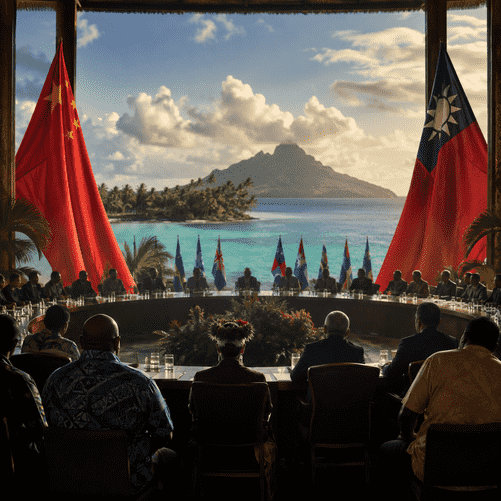
A gathering intended to address climate resilience and regional development has instead demonstrated how strategically important the Pacific islands have become to Beijing, Taipei and Western powers.

A ceremonial gathering in the Pacific might once have attracted little attention outside the region. In 2026, almost every diplomatic gesture in the island states is interpreted through the growing strategic contest involving China, Taiwan, the United States, Australia and their partners.
That tension became visible again at the Pacific Islands Forum summit in Koror, Palau.
China issued warnings after Taiwanese representatives participated in events surrounding the gathering, while Taipei accused Beijing of attempting to undermine regional cooperation. Palau, one of the remaining countries maintaining formal diplomatic relations with Taiwan, defended the participation.
The disagreement may appear procedural.
It is actually part of a much wider contest for influence.
The Pacific contains some of the world’s smallest countries by population, but their geographic positions give them enormous strategic importance. Scattered across millions of square kilometres of ocean, island states occupy territory close to critical shipping routes and military operating areas.
During the Second World War, many of these islands became strategically decisive precisely because of their geography.
Today, that geography matters again.
China has dramatically increased its diplomatic, economic and security engagement with Pacific governments. Beijing has financed infrastructure, offered development assistance and expanded political relationships across the region.
Taiwan has simultaneously fought to preserve its remaining diplomatic allies.
Only a limited number of governments maintain official relations with Taipei rather than Beijing, and several Pacific states have switched recognition in recent years.
Every diplomatic relationship therefore carries symbolic weight.
Palau’s position is particularly important.
The country maintains relations with Taiwan while also being closely associated with the United States through a Compact of Free Association. Under that arrangement, Washington has significant defence responsibilities and strategic access.
China consequently views Palau through a broader geopolitical lens.
Taiwan’s presence at the regional summit therefore triggered an immediate reaction from Beijing. Chinese officials warned of unspecified consequences and questioned the appropriateness of Taiwanese participation. Taipei countered that it had long-standing relationships in the region and accused Beijing of applying pressure to Pacific governments.
Pacific leaders have increasingly expressed frustration with being treated as pieces on a geopolitical chessboard.
Their priorities frequently differ from those of larger powers.
Climate change remains the dominant existential issue for many island states. Rising seas threaten coastal communities, while ocean warming affects fisheries and extreme weather can devastate infrastructure.
Economic development is another concern.
Small island economies frequently depend heavily on tourism, fisheries, foreign aid and imported fuel. Their geographic isolation makes transportation and infrastructure unusually expensive.
Governments therefore welcome investment.
But infrastructure projects can create strategic consequences.
Ports, telecommunications systems, undersea cables and airports all possess potential military or intelligence value in addition to their civilian uses.
China’s growing role has prompted Australia, the United States, Japan and New Zealand to increase engagement.
Washington has reopened embassies, negotiated defence agreements and expanded development programs. Australia remains one of the region’s largest aid providers and has intensified security cooperation with several governments.
The result is a diplomatic competition in which relatively small countries suddenly possess considerable negotiating leverage.
Some Pacific leaders have used that position skillfully.
Rather than aligning completely with one side, governments can obtain infrastructure, climate assistance and economic support from several competing partners.
The Taiwan issue complicates this strategy because Beijing generally insists that countries accepting diplomatic relations with China sever formal ties with Taipei.
Taiwan therefore competes not simply for influence but for diplomatic survival.
Each recognition switch reduces the number of countries formally treating Taiwan as a sovereign state.
For Beijing, the issue is fundamental.
The Chinese government considers Taiwan part of China and opposes any international activity it believes suggests separate statehood.
This explains why even relatively modest diplomatic events can provoke strong reactions.
The Pacific Islands Forum is especially sensitive because Taiwan participates as a development partner while China holds dialogue-partner status.
The regional organisation itself therefore reflects the unresolved diplomatic architecture surrounding Taiwan.
The latest dispute also shows how difficult it has become to keep geopolitical rivalry separate from other regional challenges.
Pacific governments want discussions centred on climate financing, fisheries management, disaster resilience and economic development.
Instead, meetings increasingly attract competition among major powers.
Recent disagreements have already complicated efforts to reach common regional positions on security issues, including Chinese missile activity in the Pacific.
Regional unity is consequently becoming harder to maintain.
But the Pacific states are not passive participants.
Leaders repeatedly emphasise that outside powers should engage according to regional priorities rather than imposing their own agendas.
That message deserves attention.
The strategic competition unfolding across the Pacific will probably intensify during the coming decade. Military infrastructure, telecommunications networks, mineral resources and maritime access will become increasingly important.
But the countries at the centre of that competition will continue to pursue their own interests.
Palau’s summit offered a reminder that international politics is no longer shaped only in Washington, Beijing, Brussels or Moscow.
Some of the most consequential diplomatic struggles are increasingly taking place in small island nations scattered across the world’s largest ocean.