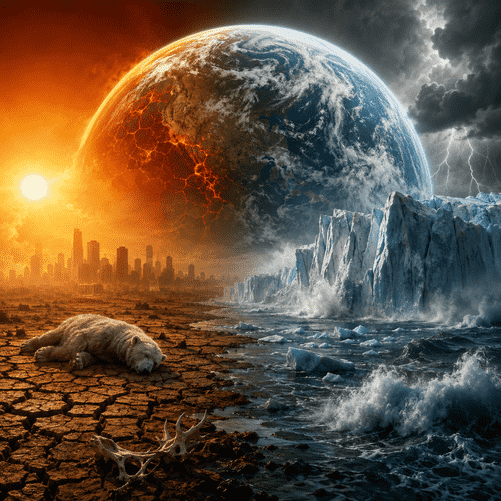
A major new assessment says overshooting the Paris climate threshold is effectively unavoidable, shifting the debate from whether 1.5°C can be protected to how quickly temperatures can eventually be brought back down.

The international climate debate has entered an uncomfortable new phase. For years, the central diplomatic objective was to prevent average global temperatures from exceeding 1.5 degrees Celsius above pre-industrial levels. A new United Nations assessment now concludes that at least some overshoot of that threshold is effectively unavoidable.
The implications extend far beyond environmental policy.
According to reporting on the new UN Environment Programme assessment, the world is now likely to experience warming of at least around 1.8°C even under an ambitious pathway, while current policies could produce substantially higher temperatures.
That difference may appear small on paper.
It is not.
Climate systems respond dramatically to fractions of a degree. Additional warming increases the probability and severity of heatwaves, droughts, wildfires, extreme rainfall, glacier loss and coastal flooding. Agricultural systems become more difficult to manage, while cities must spend increasing amounts on cooling, drainage, water management and resilient infrastructure.
Perhaps the most important change in the report is conceptual.
For nearly a decade, 1.5°C served as both a scientific threshold and a political rallying point. Governments repeatedly pledged to “keep 1.5 alive.” The new assessment implies that the more realistic goal may now be limiting the duration and magnitude of the overshoot.
That would require the world to reach net-zero greenhouse-gas emissions and eventually remove substantial quantities of carbon dioxide from the atmosphere.
Carbon removal could include natural methods such as reforestation and restoration of degraded ecosystems, alongside technologies designed to capture carbon directly from industrial facilities or from ambient air. But climate scientists repeatedly caution that removal cannot substitute for cutting emissions at their source.
The mathematics are unforgiving.
Carbon dioxide accumulates in the atmosphere. Every additional year of high emissions adds to the stock already present, meaning delays today must be compensated by faster reductions later.
The consequences are already visible.
Recent extreme-weather disasters have demonstrated how interconnected climate risks have become. In the Himalayas, catastrophic flooding linked to a glacier collapse recently killed hundreds of people in Nepal and Tibet, while thousands more were displaced or left missing. Authorities have been monitoring unstable lakes upstream because further collapses could trigger additional floods.
Glacial regions are especially vulnerable.
As temperatures rise, ice retreats and meltwater can accumulate behind unstable natural barriers made of rock and sediment. When those barriers fail, immense quantities of water can surge downstream with little warning.
The danger extends across the Himalayas, Andes, Alps and other mountainous regions.
Sea-level rise presents another long-term challenge. Even if global temperature increases were halted, oceans would continue responding for decades because heat already stored in the climate system expands seawater and melts land-based ice.
Small island states have consequently become some of the strongest advocates for aggressive climate action.
For countries such as Palau, Tuvalu and the Maldives, climate change is not primarily a future environmental issue. It is a question of infrastructure, freshwater availability, coastline protection and ultimately national territory.
The financial dimension is equally significant.
Developing countries argue that they face enormous adaptation costs despite contributing comparatively little to historical greenhouse-gas emissions. Protecting cities from flooding, redesigning agriculture, reinforcing electricity networks and building climate-resistant infrastructure can require billions of dollars.
Insurance markets are also reacting.
As extreme weather becomes more frequent, insurers increasingly reassess whether certain properties or regions can remain economically insurable. Higher premiums can affect mortgage markets and property prices even before physical climate damage occurs.
Food security represents another risk.
Crop yields depend heavily on predictable seasonal conditions. Heat stress can reduce productivity, while changes in rainfall increase irrigation requirements. Fisheries are affected by warming oceans and changes in marine ecosystems.
The resulting economic effects do not remain local.
A drought affecting grain production in one region can influence global commodity prices. Extreme heat can reduce electricity generation or labour productivity. Floods can interrupt semiconductor production or major shipping routes.
Climate change is therefore increasingly treated as a macroeconomic and national-security issue rather than a purely environmental one.
The most politically difficult question is how governments respond to the new reality.
Acknowledging that 1.5°C is likely to be temporarily exceeded could create two very different reactions.
The first is fatalism: if the target has already been missed, governments may conclude that aggressive climate policies are pointless.
Scientists argue precisely the opposite.
There is an enormous difference between warming of 1.8°C, 2.3°C and 3°C. Every tenth of a degree avoided reduces the probability of catastrophic outcomes.
The second possible reaction is therefore acceleration.
Governments could expand renewable electricity, nuclear power, energy storage and electricity grids while improving energy efficiency. Industrial processes such as steel and cement production could move toward lower-carbon technologies.
Transportation remains another major target, particularly aviation, shipping and road transport.
Yet technological progress alone cannot determine the outcome.
Political coordination remains essential because climate change is a collective-action problem. One country’s emissions contribute to a global atmospheric system, while the benefits of reducing those emissions are shared internationally.
That makes climate diplomacy uniquely difficult.
The latest UN warning therefore represents more than another environmental report.
It marks a change in the world’s relationship with the Paris Agreement’s most famous number.
The task is no longer simply to defend 1.5°C.
It is to prevent the overshoot from becoming permanent — and to ensure that an already warmer world remains manageable.