The 35-year-old former salesman has turned warmth, local identity and polished campaigning into powerful political weapons as Germany’s AfD closes in on a potentially historic victory in Saxony-Anhalt.

Ulrich Siegmund does not look or sound like the stereotype many Germans associate with the country’s radical right.
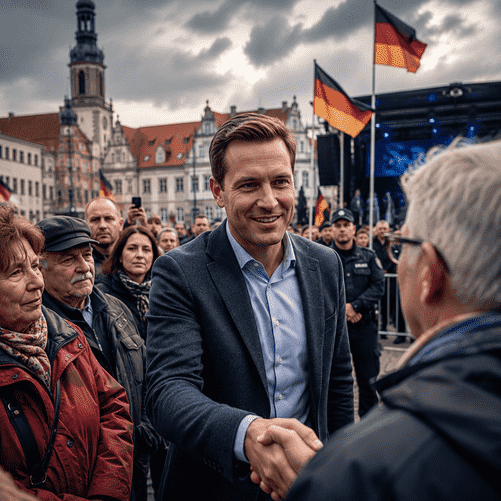
He smiles frequently. He jokes with voters. He poses for photographs, shakes hands in market squares and speaks in an uncomplicated language of family, community and belonging. His campaign events can resemble local festivals more than ideological rallies, and his social-media appearances are carefully constructed to present him as energetic, approachable and optimistic.
Yet behind the polished presentation stands one of the most consequential political campaigns Germany has witnessed in decades.
Siegmund, 35, is the Alternative für Deutschland’s lead candidate in the eastern state of Saxony-Anhalt, where voters go to the polls on September 6. Recent surveys have put the AfD above 40%, making it the clear frontrunner and raising the possibility that a party classified as far-right by state intelligence authorities could lead a German regional government for the first time in the postwar era.
What makes Siegmund particularly important is not simply his popularity. It is the political method behind it.
Where some of the AfD’s most prominent figures have built their reputations through confrontation, provocation and deliberately incendiary rhetoric, Siegmund has developed a different formula: presenting highly controversial policies through the language and appearance of conventional retail politics.
The result is a politician who may offer one of the clearest indications yet of how Germany’s radical right intends to expand beyond its traditional protest electorate.
The Salesman Becomes the Politician
Before emerging as one of the AfD’s rising figures, Siegmund studied business psychology and worked in sales, including selling fragrances and air-freshening products. He later entered politics and eventually became co-chair of the AfD parliamentary group in Saxony-Anhalt.
The commercial background is apparent in his campaigning.
Siegmund has treated political communication almost as a consumer product. His image is disciplined, visually consistent and relentlessly positive. Rather than presenting himself primarily as an angry outsider, he increasingly casts himself as a competent local man offering voters a practical alternative to a political establishment that, he argues, has stopped listening to them.
His supporters see authenticity.
His opponents see sophisticated packaging.
At rallies, Siegmund speaks about wanting his “beautiful, old, safe Germany” back and repeatedly invokes the concept of Heimat — homeland, home and belonging — a culturally powerful term in German politics.
It is a message particularly effective in eastern Germany, where economic and demographic anxieties remain intertwined with dissatisfaction over the consequences of reunification.
Saxony-Anhalt has about two million inhabitants and continues to struggle with some of Germany’s weakest economic indicators. A significant share of the population has experienced decades of population decline, industrial restructuring and the migration of younger workers towards western Germany.
The AfD has transformed those frustrations into political capital.
Siegmund, however, has given that strategy a younger and considerably more marketable face.
A Softer Style, Not Necessarily Softer Politics
The contrast between Siegmund’s manner and the policies promoted by his party is striking.
The AfD’s programme for Saxony-Anhalt proposes an aggressive tightening of migration policy, including expanded deportations and restrictions on protections for refugees. It advocates ending benefits for some Ukrainian refugees and strongly opposes recruiting workers from what the party describes as culturally incompatible societies.
The party also proposes substantial changes to education.
Its regional programme includes separating some refugee pupils from mainstream classrooms and introducing major changes to the way German history, national identity and social issues are taught. Proposals include restricting LGBTQ+ symbols in schools and advancing a more explicitly nationalist interpretation of German culture and history.
The AfD has additionally targeted cultural institutions and public broadcasting, while calling for a reversal of elements of Germany’s green-energy transition.
On foreign policy, the Saxony-Anhalt branch advocates restoring closer economic relations with Moscow and reviving imports of Russian energy — positions that have become particularly controversial amid heightened tensions between Germany and Russia.
Siegmund generally delivers these positions without the combative theatricality associated with figures such as Björn Höcke, the AfD leader in neighbouring Thuringia.
That difference matters.
Höcke has twice been convicted for using a prohibited Nazi slogan. Siegmund, by contrast, often presents essentially radical political demands in a conversational style that can sound closer to a discussion at a neighbourhood meeting than a far-right rally.
This has made him a potentially more effective political communicator.
Instead of moderating the underlying programme, Siegmund appears to be moderating its presentation.
Saxony-Anhalt as a Political Laboratory
The significance of Sunday’s election extends far beyond the state itself.
The AfD has never governed one of Germany’s 16 federal states. Mainstream parties have maintained what Germans call the Brandmauer — the firewall — under which they refuse to form governing coalitions with the party.
That firewall has helped keep the AfD outside executive power even as its electoral support has grown.
Saxony-Anhalt could test how durable that system remains.
Polls showing the AfD at roughly 40% to 43% have placed it well ahead of Chancellor Friedrich Merz’s Christian Democratic Union in the state. Depending on how smaller parties perform, an exceptionally strong AfD result could produce an extraordinarily complicated coalition arithmetic — or potentially put Siegmund within reach of governing.
The consequences would not be purely symbolic.
German states exercise substantial authority over policing, education, cultural policy and sections of public administration. State governments also participate in the Bundesrat, the upper chamber of Germany’s federal legislature, giving regional administrations influence over national legislation.
An AfD-led state administration would therefore provide the party with something it has never previously possessed: an opportunity to demonstrate how its programme functions when translated from opposition rhetoric into actual government.
Party strategists openly see Saxony-Anhalt as a possible model.
Siegmund himself has spoken about demonstrating that the AfD can govern effectively, potentially transforming a regional victory into a platform for future national expansion.
The Extremism Question
Hovering over the campaign is the question of extremism.
The AfD branch in Saxony-Anhalt has been classified by the state’s domestic intelligence service as a confirmed right-wing extremist organisation. Authorities have cited ethnonationalist ideas and positions they regard as incompatible with Germany’s democratic constitutional order.
Siegmund rejects the far-right label.
His supporters similarly argue that descriptions of the party as extremist are used by political opponents to delegitimise voters who have legitimate concerns over migration, energy costs, security and declining trust in established institutions.
Critics answer that focusing on Siegmund’s personable style risks obscuring the substance of the programme he represents.
That tension may be precisely what makes his candidacy so politically significant.
Radical parties traditionally face a problem when attempting to move from opposition into government: the confrontational language that energises their core supporters can frighten the broader electorate they need to win power.
Siegmund appears to be offering the AfD a solution.
He does not necessarily ask voters to become more radical.
Instead, he presents the party’s radicalism as increasingly ordinary.
A Campaign Built Around Normality
Walk through Siegmund’s campaign and there is little of the deliberately intimidating aesthetic historically associated with Europe’s extreme right.
There are families, selfies, merchandise and carefully produced online videos. Supporters wear shirts featuring his image. Campaign material increasingly revolves around Siegmund personally rather than simply the AfD logo.
This personalisation resembles modern populist campaigning elsewhere.
The politician becomes the product.
Complex policy questions are translated into emotionally direct promises: cheaper energy, safer streets, fewer migrants, more respect for local communities and freedom from bureaucratic interference.
Siegmund’s principal political skill may therefore be his ability to separate tone from substance.
The tone is optimistic.
The programme is transformative.
And that combination is proving considerably harder for Germany’s mainstream parties to counter than the openly confrontational far-right politics of previous generations.
More Than a Regional Election
For Chancellor Friedrich Merz and Germany’s established parties, Saxony-Anhalt presents a much larger problem than the possible loss of a single regional government.
An AfD victory would demonstrate that the party can move beyond permanent opposition and persuade a substantial portion of voters that it represents a plausible governing alternative.
It could also strengthen those within the AfD who believe the party should prioritise professional campaigning and carefully controlled communication rather than ideological moderation.
That distinction is crucial.
Siegmund’s rise does not necessarily represent a softer AfD.
It could represent a more electorally sophisticated one.
The smiling candidate shaking hands in village squares therefore carries significance far beyond his age or personal biography. Behind his informal manner stands a political project that seeks profound changes to migration, education, culture, energy policy and Germany’s relationship with Russia.
On September 6, voters in Saxony-Anhalt will decide whether that project moves closer than ever before to executive power.
Whatever the result, Ulrich Siegmund has already demonstrated something that Germany’s political establishment is likely to study closely: hard-line politics do not always arrive shouting.
Sometimes they arrive smiling.