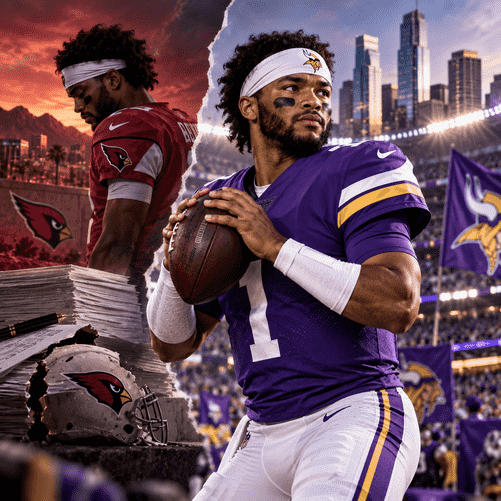
The Vikings have named Kyler Murray their starting quarterback after Arizona paid heavily to move on, giving Minnesota a former No. 1 pick with considerable upside and remarkably little financial risk

Kyler Murray was once one of the NFL’s most expensive investments. Now, the Minnesota Vikings are betting that one of football’s most costly disappointments can become one of its best bargains.
Minnesota has named Murray its starting quarterback for the 2026 season after signing the former Arizona Cardinals star to a one-year deal following his release in March. The arrangement is unusual not because Murray lacks pedigree, but because the Vikings are receiving a quarterback once valued at more than $230 million while Arizona continues to absorb most of the financial consequences of his previous contract.
For Minnesota, it is the kind of asymmetrical wager NFL teams rarely get the opportunity to make.
If Murray rediscoveres the form that once made him one of the league’s most dynamic young quarterbacks, the Vikings could have secured a legitimate starter for a fraction of his previous cost. If the experiment fails, Minnesota can move on with minimal long-term damage.
Arizona, by contrast, is paying a substantial price simply to have Murray play somewhere else.
The Cardinals released him despite approximately $36.8 million in guaranteed compensation still owed for 2026. His departure leaves nearly $47 million counting against Arizona’s salary cap this season, with another roughly $7 million scheduled to remain on the books next year.
That extraordinary financial imbalance is what makes Murray’s arrival in Minnesota one of the NFL’s most intriguing reclamation projects.
From cornerstone to casualty
The trajectory is striking.
Arizona selected Murray with the first overall pick in the 2019 NFL Draft, convinced that his combination of arm strength, mobility and improvisational ability could transform the franchise.
His rookie season justified much of that optimism.
Murray passed for 3,722 yards and 20 touchdowns, won the Associated Press Offensive Rookie of the Year award and quickly established himself as one of the league’s most dangerous dual-threat quarterbacks.
Arizona eventually rewarded him with a five-year, $230.5 million contract extension, briefly making him one of the highest-paid players in professional football.
At that moment, Murray appeared to be the Cardinals’ long-term answer at the sport’s most important position.
Then the trajectory changed.
A torn ACL late in the 2022 season interrupted his development, and subsequent seasons were marked by injuries, coaching changes and inconsistent results.
In 2025, Murray appeared in only five games. He completed 110 of 161 passes for 962 yards, six touchdowns and three interceptions while also leading Arizona with 173 rushing yards through the first five weeks.
By the end of the season, the Cardinals had reached a remarkable conclusion: paying Murray tens of millions of dollars not to play for them was preferable to continuing the relationship.
That is how a $230 million franchise quarterback reached the open market while still in his twenties.
Minnesota sees opportunity where Arizona saw an ending
The Vikings viewed the same situation differently.
Minnesota did not need Murray to justify a massive new contract. It simply needed to determine whether the athletic ability that made him a No. 1 draft pick could still be recovered.
That distinction changes everything.
Murray arrived in Minnesota with 87 career starts, more than 20,000 passing yards and 121 touchdown passes. His career completion percentage of 67.1% is the best in Cardinals history among qualifying quarterbacks, while his 92.2 passer rating demonstrates that his career has hardly been the unmitigated failure suggested by the enormous dead-money figure attached to his departure.
The Vikings also offer Murray something Arizona increasingly could not: a fresh offensive environment built around one of the league’s most highly regarded quarterback coaches.
Kevin O’Connell, himself a former NFL quarterback, has developed a reputation for creating passer-friendly schemes and helping quarterbacks rebuild their careers.
That reputation is central to Minnesota’s calculation.
The Sam Darnold blueprint
The Vikings have seen this strategy work before.
In 2024, Minnesota signed Sam Darnold, another former high draft pick whose career had stalled after disappointing stops elsewhere.
Under O’Connell, Darnold produced a dramatic revival as the Vikings won 14 games. He subsequently left Minnesota and eventually helped Seattle win the Super Bowl.
That experience appears to have influenced the organization’s willingness to take another chance on a quarterback whose reputation has fallen faster than his underlying talent.
Murray presents an even more intriguing case.
Unlike many traditional reclamation projects, he has previously demonstrated elite-level traits at the NFL level.
At his best, Murray combines explosive acceleration with the ability to throw accurately from unusual platforms, extend plays outside structure and threaten defenses both vertically and horizontally.
Few quarterbacks can reproduce those attributes.
The question is whether Minnesota can restore them consistently.
Justin Jefferson changes the equation
Murray will also be playing with something he rarely enjoyed in Arizona: one of the NFL’s most dominant receivers.
Justin Jefferson gives Minnesota a weapon capable of transforming a quarterback’s options on virtually every passing down.
Jefferson has already spoken positively about Murray, describing him as a “phenomenal quarterback” as the Vikings prepare for the season.
For Murray, the opportunity is obvious.
He enters an offense featuring an elite receiver, an experienced offensive coaching staff and considerably less financial pressure than he carried in Arizona.
For the first time in years, he is not being evaluated as the quarterback who must justify a $230 million contract.
He simply has to play well enough to win football games.
That may prove psychologically and tactically significant.
J.J. McCarthy pushed down the depth chart
Murray’s arrival also reflects Minnesota’s uncertainty surrounding J.J. McCarthy.
The Vikings selected McCarthy in the first round of the 2024 draft with the expectation that he could become the organization’s long-term quarterback.
But his development has been disrupted by injuries.
After missing his rookie season, McCarthy started 10 games in 2025 and went 6-4, but further ankle, concussion and hand problems complicated his progression. He has since fallen to third on Minnesota’s quarterback depth chart, although team officials insist he remains part of their long-term plans.
Murray therefore gives the Vikings something valuable: time.
Minnesota does not have to rush McCarthy back into the starting role simply because of his draft status.
Instead, the Vikings can allow the younger quarterback to continue developing while asking Murray to carry the offense.
If Murray succeeds, Minnesota becomes immediately more competitive.
If he struggles, McCarthy remains available as a future option.
Almost no financial downside
The financial structure is what makes the move particularly compelling.
Because Murray remains entitled to substantial guaranteed money from Arizona, Minnesota was able to acquire him cheaply.
The Cardinals are effectively subsidising their former quarterback’s attempt to revive his career with another NFC franchise. The Vikings themselves have acknowledged that most of Murray’s 2026 compensation will be covered by Arizona.
In a league governed by a hard salary cap, that represents an enormous competitive advantage.
Starting quarterbacks routinely consume tens of millions of dollars in annual cap space.
Minnesota can instead deploy resources elsewhere on the roster while receiving a player who once commanded franchise-quarterback money.
That leaves the Vikings with one of the most attractive risk-reward equations in football.
The downside is limited.
The upside could be enormous.
A changing quarterback market
Murray is also part of a broader NFL trend.
Teams are increasingly willing to absorb enormous amounts of dead salary-cap money to escape quarterback contracts that no longer match performance.
Once those players are released, another franchise can acquire them at drastically reduced cost.
The Denver Broncos famously followed that path when they released Russell Wilson and absorbed a massive financial loss while Pittsburgh signed him cheaply.
The same dynamic is now appearing again.
Miami reportedly absorbed roughly $99 million in dead money after moving on from Tua Tagovailoa, who subsequently landed in Atlanta as another low-cost reclamation candidate.
It creates an unusual secondary market for quarterbacks.
The original team absorbs the financial damage.
The next team receives the potential upside.
Murray’s last great opportunity?
For Murray himself, Minnesota may represent the most important season of his career.
He turns 29 having already experienced nearly every possible stage of an NFL quarterback’s life cycle: first overall pick, Rookie of the Year, Pro Bowler, franchise saviour, $230 million investment, injured star and expensive casualty.
Now comes the rehabilitation phase.
Success in Minnesota could dramatically reshape how his career is remembered.
A productive season would demonstrate that Arizona’s problems were not entirely Murray’s responsibility and could position him for another substantial contract.
Failure would reinforce the Cardinals’ decision and raise serious questions about whether he can still function as a long-term NFL starter.
Murray understands the opportunity.
A childhood Vikings supporter, he described arriving in Minnesota as a full-circle moment and said the fit felt natural when the opportunity emerged.
The perfect modern NFL gamble
The Vikings are not betting that Kyler Murray will become the player Arizona once believed was worth $230.5 million.
They do not need him to.
They are betting that there remains enough of that player to win games inside a better offensive structure.
That is a dramatically lower bar — and an extraordinarily inexpensive one.
Arizona has already absorbed most of the economic consequences of Murray’s decline. Minnesota now gets to test whether the football consequences can be reversed.
For the Cardinals, Murray represents one of the most expensive failed quarterback investments in recent NFL history.
For the Vikings, he represents almost the opposite.
A former No. 1 overall pick.
A proven NFL starter.
An elite athlete.
A quarterback paired with Justin Jefferson and Kevin O’Connell.
And, crucially, a player whose former team is still paying most of the bill.
Minnesota does not need Kyler Murray to become a $230 million quarterback again.
At the price the Vikings are paying, they simply need him to look like one.