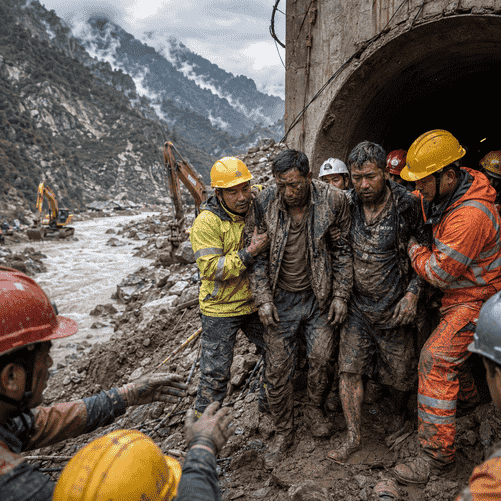
The dramatic tunnel rescue offers a rare moment of hope as Nepal confronts more than 1,250 deaths, thousands missing and widespread destruction across its Himalayan hydropower regions

Two workers have been pulled alive from a hydropower tunnel in Nepal nine days after catastrophic floods swept through the country’s northern border region, offering a remarkable sign of hope amid one of the deadliest natural disasters in Nepal’s recent history.
The men were rescued on Friday from the Upper Trishuli 3A Hydropower Station, where they had been trapped deep underground since August 26 after a devastating surge of water, rock, ice and mud tore through the Trishuli river valley.
They were identified as Sanjay Shah, a mechanical foreman, and Kabir Maharjan, a mechanical supervisor. Rescue teams reached them approximately 170 metres inside the tunnel before providing emergency assistance and extracting them to safety. Both men were subsequently airlifted to Kathmandu for medical treatment.
Their survival after more than a week underground has astonished rescue workers and given renewed urgency to operations aimed at finding hundreds of other people believed to remain trapped inside tunnels and infrastructure damaged by the floods.
According to Nepalese authorities, the disaster has killed at least 1,252 people, while approximately 4,200 remain unaccounted for. Nearly 12,000 people have been rescued, but the scale of the missing-person crisis means the final death toll could rise substantially as operations reach areas that have been inaccessible for days.
The disaster began on August 26 in the mountainous region near Nepal’s border with Tibet. Authorities and scientists believe the flooding was triggered by the collapse of glacial material in the upper reaches of the river system, unleashing a massive mixture of water, mud, rock and debris downstream.
The torrent struck communities with extraordinary force, destroying homes, roads, schools, bridges and power infrastructure while burying large areas under sediment.
Hydropower facilities were among the hardest-hit installations.
At least a dozen projects were affected, and officials believe hundreds of workers may have been caught inside tunnels associated with the power stations. Some estimates suggest at least 900 workers were initially believed trapped or missing across several hydropower projects along the river system.
The rescue of Shah and Maharjan therefore carries significance far beyond the survival of two individuals.
For days, emergency teams had been confronting enormous quantities of mud and collapsed material blocking tunnel entrances. Heavy machinery, specialist equipment and controlled excavation have been used to reach underground sections where survivors might still be located.
International tunnel-rescue specialists from India, China and South Korea have joined Nepalese forces, working alongside the Nepal Army and other emergency services. Drones, helicopters, excavation equipment and specialist rescue systems have also been deployed.
The discovery of two living workers suggests that some tunnel sections may have contained air pockets capable of sustaining trapped people for considerably longer than rescuers initially feared.
That possibility has transformed the atmosphere surrounding the search.
What had increasingly become an operation focused on recovering bodies has again become, at least in some locations, a race to find survivors.
Reports from rescue personnel have indicated that possible sounds have been detected from inside parts of the tunnel network, raising hopes that additional workers could remain alive. Authorities have nevertheless warned that conditions underground remain extremely dangerous, with unstable debris, flooding, limited ventilation and the risk of further collapses complicating every stage of the operation.
The wider humanitarian picture remains severe.
Entire settlements along the affected valleys have been damaged or destroyed, while tens of thousands of people have been displaced. Communications and transport networks have been severed in some mountainous areas, making it difficult for authorities to establish the full scale of casualties.
Foreign nationals are also among the missing. Nepal’s Foreign Ministry said approximately 590 citizens of 34 countries remained unaccounted for as of September 3, underscoring the international dimension of the disaster.
The flood has also exposed Nepal’s vulnerability to extreme events in the Himalayas, where climate change is contributing to rapid glacial retreat and increasing concern about glacial lake outburst floods and other high-altitude hazards.
Nepal’s steep terrain compounds those risks. Rivers descending from the Himalayas can transform suddenly into destructive torrents, carrying enormous quantities of sediment and debris into valleys where settlements, roads and hydropower projects are frequently concentrated.
The country has invested heavily in hydropower as a cornerstone of its economic development and energy strategy. But the disaster has demonstrated the exposure of that infrastructure to increasingly unpredictable mountain hazards.
Damage estimates are already running into billions of dollars, with power facilities, transport infrastructure and thousands of homes affected.
For families waiting for news of missing relatives, however, the economic consequences remain secondary to the search for survivors.
The rescue of Shah and Maharjan has provided a rare moment of relief.
Images of the men being transported for treatment quickly became a symbol of endurance in a country where rescue workers have spent more than a week recovering bodies from collapsed buildings, flooded valleys and buried infrastructure.
Nine days after the catastrophe, the possibility that people can still be found alive has changed expectations.
Emergency crews are continuing to clear tunnel entrances, search underground chambers and examine areas where workers may have found shelter from the initial flood.
The odds become more difficult with every passing day, but the extraordinary survival of two men deep beneath the devastated Trishuli valley has demonstrated that the search cannot yet be considered over.
Amid thousands of missing people and a national tragedy still unfolding, their rescue has given Nepal something increasingly scarce since the floods began: hope.