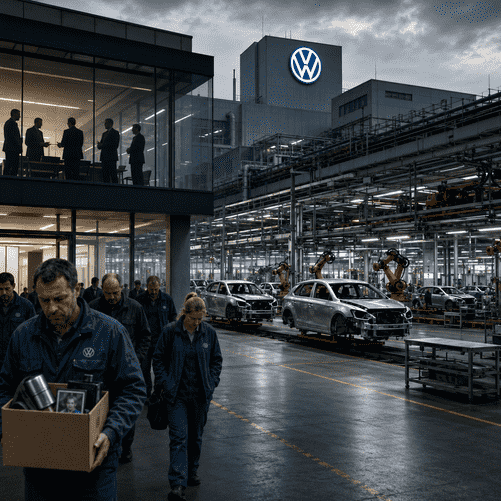
Europe’s largest carmaker plans to eliminate around 100,000 positions by 2030, dramatically reduce its model range and rethink the future of several German factories as it battles Chinese competition, weaker demand and rising costs

Volkswagen has approved one of the most far-reaching restructurings in the history of the global automotive industry, agreeing to eliminate a further 50,000 jobs as Europe’s largest carmaker attempts to restore competitiveness in a market increasingly shaped by Chinese manufacturers, shifting consumer demand and mounting trade pressures.
The additional reductions come on top of roughly 50,000 positions already targeted across Volkswagen Group companies, meaning that around 100,000 jobs could ultimately disappear by the end of the decade. That represents approximately 15% of the group’s workforce of more than 650,000 employees worldwide.
Volkswagen’s supervisory board approved the package on Thursday, September 3, ending a period of tense negotiations between management, employee representatives and the German state of Lower Saxony, one of the company’s largest shareholders.
Chief executive Oliver Blume described the unanimous approval as a decisive step in Volkswagen’s transformation, arguing that the company must become significantly leaner, faster and less complex if it is to compete successfully in the next generation of the automotive industry.
The workforce reductions form part of Volkswagen’s broader “Future Plan 2030”, which reaches far beyond headcount. The group intends to streamline its model portfolio by as much as 50%, concentrate investment on the most commercially attractive segments and drastically reduce the number of equipment combinations offered to customers.
Volkswagen says configuration complexity could fall by as much as 75%. In one example provided by the company, more than 2,300 different seat configurations could eventually be reduced to roughly 100, illustrating the scale of the simplification being considered. By producing larger volumes of fewer models and sharing more technology across brands, management hopes to reduce development expenditure, manufacturing costs and organisational duplication.
The overhaul could have particularly significant consequences for Volkswagen’s enormous manufacturing network in Germany. The company has acknowledged that its European production capacity currently exceeds market demand by more than 500,000 vehicles.
As a result, the long-term future of factories in Emden, Zwickau, Hanover and Neckarsulm is uncertain. Volkswagen says future vehicle allocations cannot presently be guaranteed for the four locations between 2031 and 2034, although alternative industrial uses for the plants are being examined.
The restructuring illustrates the scale of the crisis confronting Germany’s automotive establishment. For decades Volkswagen benefited from strong European demand, extensive manufacturing capacity at home and extraordinary growth in China. Each of those pillars is now under pressure.
Chinese manufacturers have become formidable competitors not only in their domestic market but increasingly in Europe, particularly in electric vehicles. Companies such as BYD have combined competitive prices with rapidly improving battery technology, software and vehicle design, putting pressure on traditional European manufacturers.
Volkswagen, meanwhile, has suffered declining sales and profitability in China while confronting slower-than-expected electric-vehicle demand in parts of Europe. US tariffs have added another layer of financial pressure. The group reported a substantial deterioration in earnings during the first half of 2026, reinforcing management’s argument that incremental cost reductions would no longer be sufficient.
The company had already embarked on a major labour reduction programme before the latest announcement. Since late 2024, Volkswagen, Audi, Porsche and software subsidiary CARIAD have agreed plans to eliminate around 50,000 positions in Germany by 2030, largely through voluntary departures and early-retirement arrangements. Around 37,000 agreements had already been signed before the latest restructuring was approved.
The new programme effectively doubles the scale of Volkswagen’s employment restructuring.
Labour representatives had resisted more aggressive proposals, particularly measures that could have resulted in abrupt factory closures or compulsory redundancies. The eventual agreement therefore represents a compromise: management receives broad authority to reduce costs and simplify Volkswagen’s industrial structure while unions retain influence over how reductions are implemented.
Daniela Cavallo, Volkswagen’s powerful chief employee representative, has acknowledged the need to address the group’s structural problems while insisting that employees should not carry the entire burden of the transformation. The government of Lower Saxony also supported the final agreement after negotiations designed to prevent a more damaging confrontation between management and labour.
Financial markets initially welcomed the outcome. Volkswagen shares rose sharply after the restructuring received board approval, reflecting investor expectations that the programme could finally address some of the group’s longstanding cost disadvantages and complicated corporate structure.
Yet reducing costs is only one part of Volkswagen’s challenge.
The group controls a vast collection of brands including Volkswagen, Audi, Porsche, Škoda, SEAT, Cupra, Bentley and Lamborghini. That scale has historically provided enormous purchasing and engineering advantages, but it has also created overlapping products, platforms, management structures and development programmes.
Future Plan 2030 seeks to consolidate many of those systems. Technology platforms, software architectures and vehicle-development programmes are expected to become increasingly standardised across brands, allowing Volkswagen to concentrate investment on technologies that can be deployed across millions of vehicles.
The company also intends to review its portfolio of corporate holdings and businesses, potentially reducing it by around one-third as activities judged insufficiently important to Volkswagen’s core strategy are sold or reorganised.
For Germany, however, the restructuring carries consequences far beyond Volkswagen itself.
The company sits at the centre of an enormous European industrial ecosystem involving component manufacturers, engineering firms, logistics companies and specialist suppliers. Large reductions in Volkswagen production or employment could therefore spread through regional economies heavily dependent on the automotive industry.
The situation is particularly sensitive because Germany is simultaneously attempting to manage the transition from combustion-engine vehicles to electric mobility while protecting an industrial sector that has been one of the country’s principal sources of exports, skilled employment and technological influence.
Volkswagen’s decision is therefore more than a corporate cost-cutting exercise. It represents one of the clearest indications yet that the balance of power in the global automotive industry is changing.
Chinese manufacturers are expanding abroad, electric vehicles are transforming traditional production methods, software is becoming increasingly important to vehicle competitiveness and protectionist trade policies are reshaping global supply chains.
Volkswagen’s response is to become smaller, simpler and more concentrated.
Whether that transformation will be sufficient remains uncertain. Eliminating tens of thousands of jobs and hundreds of product configurations can significantly reduce costs, but Volkswagen must simultaneously develop vehicles capable of competing with increasingly sophisticated Chinese rivals while maintaining the engineering reputation and brand strength that have defined the company for generations.
For Volkswagen, Future Plan 2030 amounts to a wager that sacrificing scale and complexity today will preserve the company’s competitiveness tomorrow.
For Germany’s automotive industry, it may also mark the beginning of a much broader restructuring.