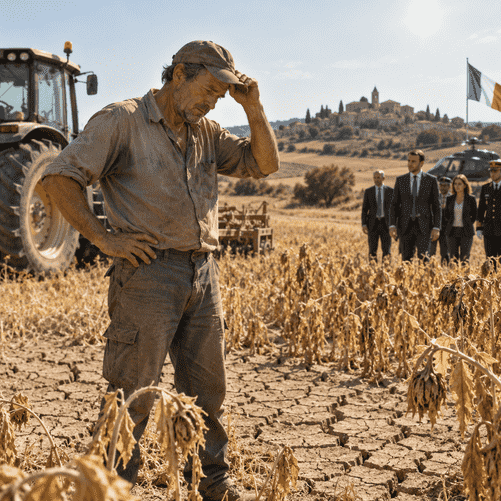
After a summer of record heat and severe water shortages, Paris is rushing emergency support to thousands of farms facing crop losses, depleted livestock feed and mounting financial pressure.

France has unveiled an emergency agricultural support package worth more than €1 billion as the government attempts to contain the economic fallout from one of the most punishing summers experienced by the country’s farming sector in recent years.
Agriculture Minister Annie Genevard announced the measures on September 4, describing them as a substantial national response to the prolonged drought and successive heatwaves that have damaged crops, scorched pastureland and placed tens of thousands of farms under severe financial strain.
The intervention comes after months of unusually high temperatures and persistent water shortages across large parts of France. Farmers have reported major losses in cereals, vegetables, livestock feed and other agricultural production, while pasture conditions deteriorated sharply in several regions.
The scale of the damage is significant. Agricultural representatives estimate total losses across the country could exceed €10 billion, while between 30,000 and 35,000 farms are believed to be experiencing serious financial difficulties. France’s livestock and arable farming sectors alone are each estimated to have suffered losses exceeding €5 billion.
Under the government plan, approximately €520 million will be directed through France’s national agricultural solidarity compensation system, which provides financial support for losses caused by exceptional climatic events. The funds are intended to accelerate compensation for farmers whose production has been severely disrupted by drought and extreme heat.
A further €235 million will be allocated to a recovery fund designed to help farms resume production. The money can be used for essential inputs including seeds, seedlings and animal feed — expenses that have become increasingly difficult for farmers to cover after months of declining output and rising operating costs.
Additional measures include reductions in land taxes on agricultural property, social-security assistance and continued fuel support, with the government seeking to ease short-term cash-flow pressure before the winter months.
For livestock farmers, the shortage of forage has become particularly acute. With pastureland burned by prolonged heat and insufficient rainfall, many producers have been forced to begin using winter feed reserves months earlier than normal or purchase additional feed at elevated prices.
Vegetable growers have also experienced exceptionally difficult conditions. Producers in parts of western France have reported severe losses in crops including cauliflower, peas and lettuce, with even irrigated fields struggling under repeated heatwaves. In some cases, young plants failed to survive despite access to water, raising concerns not only about current harvests but also future planting cycles.
The crisis has moved beyond agriculture and is beginning to affect France’s broader economic outlook. The Finance Ministry estimates that drought and extreme heat during the summer could reduce French economic growth by approximately 0.1 percentage points in 2026, primarily because of lower agricultural revenues. The government’s official full-year growth forecast currently remains at 0.7 percent.
For President Emmanuel Macron’s government, the package also arrives at a politically delicate moment. Prime Minister Sébastien Lecornu has described agriculture as one of the government’s principal priorities for the autumn, while simultaneously attempting to maintain strict control over public spending ahead of the 2027 presidential election.
Agricultural organisations have nevertheless warned that the €1 billion package may be insufficient.
Arnaud Rousseau, president of France’s powerful FNSEA farmers’ union, has estimated the industry’s overall losses at more than €10 billion. Other farming representatives have argued that at least €2 billion in immediate assistance may ultimately be required to prevent widespread financial failures.
There are also disagreements over how compensation will be distributed. France’s national solidarity insurance mechanism was reformed in 2023, but critics argue that its structure provides stronger protection to farmers who have purchased private insurance. Only about one-fifth of French agricultural businesses currently have such coverage, according to figures reported by Le Monde.
The dispute highlights a larger challenge confronting European agriculture: increasingly severe weather conditions are turning what were once considered exceptional events into recurring operational risks.
France is not alone. Drought and extreme temperatures have also severely disrupted maize production in Hungary and Romania, contributing to expectations that European Union maize production could fall to its lowest level in almost two decades.
For France — the European Union’s largest agricultural producer — the consequences are particularly significant. Agriculture remains central not only to rural employment and domestic food supply but also to the country’s trade position and political identity.
The emergency package therefore represents both financial relief and an attempt to prevent the current weather crisis from developing into a deeper structural agricultural downturn.
Yet the longer-term question remains unresolved. Emergency compensation may allow vulnerable farms to survive the winter, but increasingly frequent droughts and heatwaves are forcing policymakers to reconsider how French agriculture manages water, crop selection, irrigation, insurance and climate resilience.
Debate is already intensifying over whether public funding should focus primarily on compensating farmers after climate-related disasters or increasingly finance adaptation before those disasters occur. Agricultural historians and environmental groups have argued that farmers seeking to transition toward more resilient or ecological production methods continue to receive inadequate institutional and financial support.
For producers currently facing depleted fields and uncertain harvests, however, the immediate concern is considerably simpler: liquidity.
After months of extreme weather, many farms must now purchase feed, seeds and other inputs while simultaneously absorbing sharply reduced revenues. The government’s €1 billion intervention is intended to prevent that temporary financial squeeze from becoming a wave of bankruptcies.
Whether it will be enough will depend not only on the speed with which the money reaches farms, but also on what happens to France’s weather in the months ahead.
With climate volatility increasingly shaping European agriculture, the French drought of 2026 may ultimately prove less an isolated emergency than a warning of the economic conditions farmers will be expected to navigate with growing regularity.