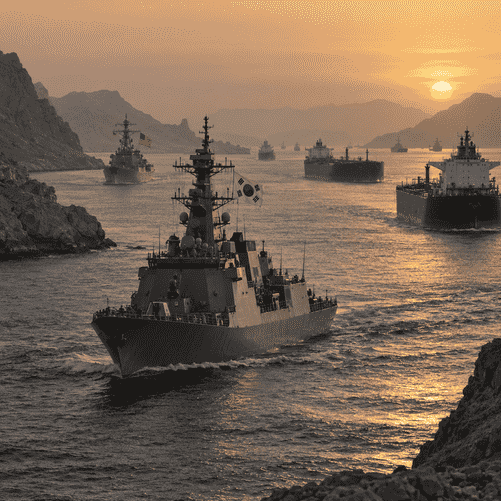
Reports of preparations for a naval deployment have intensified scrutiny of South Korea’s Middle East strategy, but President Lee Jae Myung’s office insists that no final decision has been taken.

South Korea is pushing back against reports that it is preparing to send military forces to the Strait of Hormuz, even as the government acknowledges that a range of possible contributions is under review amid growing pressure from the United States.
The dispute over Seoul’s intentions has exposed the increasingly difficult position facing President Lee Jae Myung’s administration as it tries to balance its alliance with Washington, its dependence on Middle Eastern energy supplies and strong domestic reluctance to become more deeply involved in the conflict with Iran.
South Korean media reports have suggested that the government has begun examining the legal and parliamentary steps required for a possible deployment, potentially involving a naval support vessel, maritime patrol aircraft or mine-clearing capabilities.
The presidential office, however, has sought to temper those claims.
Officials say military and non-military options are being examined but stress that no final decision has been made on whether South Korean forces will be dispatched to the region. Reuters reported that Seoul is considering several forms of assistance aimed at protecting freedom of navigation, while any deployment would have to satisfy domestic legal requirements and, depending on its form, could require approval from the National Assembly.
The distinction is politically significant.
Seoul wants to demonstrate to Washington that it is taking the security crisis in the Gulf seriously without creating the impression that South Korea has already committed itself to direct military involvement.
That balancing act has become more difficult as the Trump administration intensifies pressure on allies to contribute more visibly to operations surrounding the Strait of Hormuz.
The strategically critical waterway has become one of the central flashpoints of the prolonged confrontation between the United States and Iran. Renewed military exchanges between Washington and Tehran in early September have further destabilised the region, while restrictions on shipping through Hormuz continue to disrupt energy markets and commercial traffic.
For South Korea, the stakes are unusually high.
More than 60 percent of the country’s crude oil imports normally pass through or are closely connected to the Strait of Hormuz, making the waterway vital to South Korea’s industrial economy and energy security. Before the current conflict, the Middle East supplied roughly 70 percent of South Korea’s crude oil and about one-fifth of its liquefied natural gas, according to reporting by the Financial Times.
A prolonged disruption therefore carries direct economic consequences for Seoul.
South Korea is one of the world’s leading manufacturing economies, with energy-intensive industries ranging from petrochemicals and steel to shipbuilding, semiconductors and automobiles. Sustained instability in Gulf shipping routes can feed rapidly into higher import costs, inflationary pressures and weaker industrial competitiveness.
The government consequently has a strong national interest in restoring safe commercial navigation.
But protecting that interest militarily is considerably more complicated.
Reports indicate that possible South Korean contributions could include a naval logistics ship, maritime surveillance aircraft or specialised mine-clearing units. Such assets could support international operations without placing South Korea at the centre of offensive combat against Iran.
That distinction appears to be increasingly important to Seoul.
The presidential office has described combat participation, non-combat assistance and search or support missions as general categories being considered rather than confirmed plans, emphasising that “nothing has been decided” concerning the country’s actual contribution.
A limited maritime mission could provide South Korea with a diplomatic compromise.
It would allow Seoul to demonstrate solidarity with the United States and other partners while presenting the deployment domestically as an operation designed primarily to protect commercial shipping rather than participate directly in the war.
South Korea has historical precedent for such an approach.
In 2009 it created the Cheonghae naval unit to protect vessels from piracy off Somalia and in the Gulf of Aden. In 2020, Seoul expanded the unit’s operational area to include waters around the Strait of Hormuz, but deliberately kept the mission separate from the US-led maritime coalition operating in the region.
That arrangement allowed South Korea to cooperate on maritime security while retaining a degree of political distance from Washington’s confrontation with Tehran.
The current crisis is considerably more dangerous.
The United States and Iran have engaged in direct military exchanges, and Washington has intensified its economic and naval pressure on Tehran. A US blockade has drastically reduced Iranian oil exports through the region, while Iran has responded by threatening or restricting maritime traffic through Hormuz.
Any South Korean warship operating in that environment would therefore enter a theatre where the distinction between maritime protection and participation in a broader military campaign could become blurred.
That risk is one reason why public opinion in South Korea remains cautious.
A recent Gallup Korea survey cited by Reuters found that 55 percent of respondents opposed sending a South Korean warship to the region.
Domestic political resistance could complicate any attempt by Lee’s government to secure parliamentary support.
The president already faces a challenging political environment, and critics could argue that deployment would expose South Korean personnel to unnecessary risk while drawing the country into a conflict far removed from the Korean Peninsula.
Supporters of a mission, by contrast, are likely to emphasise both alliance responsibilities and economic self-interest.
South Korea depends heavily on the United States for its security architecture against North Korea. Washington maintains tens of thousands of troops on the Korean Peninsula, and successive US administrations have pressed Seoul to shoulder a greater proportion of collective defence responsibilities.
The Hormuz debate therefore extends beyond the Middle East.
For Washington, South Korea’s response may serve as a test of how far one of America’s most important Asian allies is willing to contribute to security challenges outside its immediate neighbourhood.
For Seoul, however, that expectation raises a sensitive strategic question: whether participation in US operations far from the peninsula could consume diplomatic and military resources needed closer to home.
The United States itself is already experiencing strain from its prolonged Middle Eastern deployments. American forces, warships and air-defence units have remained heavily committed to the region, with military planners confronting concerns about personnel fatigue, maintenance and the diversion of resources from Asia.
That makes Washington’s desire for additional allied participation understandable from a military perspective.
It also explains why Seoul may face sustained pressure rather than a single diplomatic request.
The bilateral relationship has additional complications.
President Donald Trump has previously criticised South Korea over trade and defence burden-sharing, and the two governments have also negotiated large South Korean investment commitments in the United States. Analysts have interpreted the Hormuz issue as part of a broader pattern in which Washington increasingly links economic, security and alliance expectations.
For the Lee administration, visibly rejecting a US request could therefore create consequences beyond Middle Eastern policy.
Yet automatically accepting it would carry its own costs.
South Korea has maintained diplomatic and commercial relationships with Iran for decades. Although sanctions and geopolitical tensions have greatly reduced bilateral trade, Seoul has historically attempted to preserve communication with Tehran and avoid becoming identified exclusively with Washington’s Iran policy.
A military deployment could make that neutrality harder to sustain.
South Korean officials are therefore exploring what appears to be a carefully calibrated middle ground: contributing to freedom of navigation without formally joining offensive operations against Iran.
Coordination with countries including the United States, Britain and France is reportedly part of the discussions.
Such cooperation could involve surveillance, logistics, escort duties or mine countermeasures — missions that would allow Seoul to argue that its primary objective is maintaining international shipping rather than confronting Iran militarily.
But even a non-combat deployment would not eliminate the risks.
Ships operating near Hormuz could still become vulnerable to drones, missiles, mines or accidental escalation. Rules of engagement would need to define how South Korean forces should respond if attacked and whether they could participate in collective defensive operations involving US or European forces.
Parliamentary scrutiny would therefore be unavoidable.
Opposition lawmakers are likely to demand clarity over the size of any deployment, its duration, command structure, mission and potential exposure to combat.
The government must also determine whether existing legislation allows the mission or whether explicit National Assembly authorisation would be required.
These questions help explain why Seoul has resisted reports suggesting the deployment is effectively a done deal.
At present, the most important fact is that South Korea is considering its options rather than committing to one.
The distinction may sound procedural, but it reflects the core political challenge confronting the Lee administration.
South Korea has compelling reasons to help stabilise the Strait of Hormuz. Its economy depends heavily on energy flowing through the region, its principal military ally is demanding greater burden sharing and continued disruption of Gulf shipping presents a direct national economic risk.
At the same time, joining a military operation could deepen tensions with Iran, expose South Korean forces to combat and provoke significant opposition at home.
Seoul’s eventual decision will therefore reveal more than its Middle East policy.
It will demonstrate how South Korea intends to navigate an increasingly transactional alliance with Washington while preserving enough strategic independence to protect its own diplomatic, economic and security priorities.
For now, the government’s message is deliberately cautious: the options are real, the discussions are continuing, but deployment has not yet been decided.