Jennifer Lawrence’s new Paris look captures a broader shift in women’s hair toward softer fringes, face-framing movement and polished styles that do not demand a dramatic chop.

The bob may have dominated salon conversations for much of the past two years, but autumn 2026 is beginning with a different proposition: change your hair without sacrificing its length.
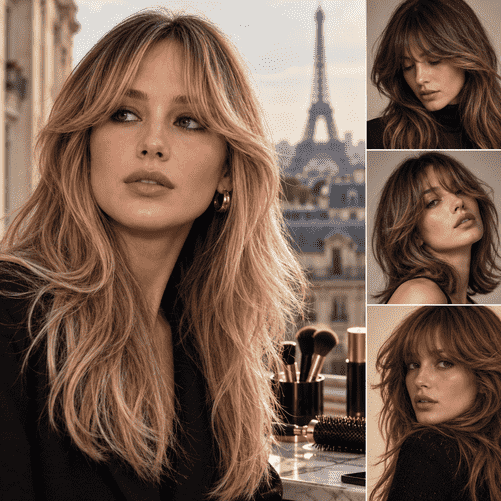
The clearest example arrived in Paris this week, where Jennifer Lawrence appeared with a new set of “butterfly bangs,” a softly layered fringe created by celebrity hairstylist Chris Appleton. The look debuted as Lawrence attended the LVMH Prize ceremony at the Fondation Louis Vuitton and immediately placed a new variation of bangs at the centre of the season’s haircut conversation.
Unlike a blunt fringe, butterfly bangs are deliberately airy. The shortest pieces sit closer to the brows while longer sections open outward toward the cheekbones, creating a shape that resembles wings around the face. The effect is softer than a traditional curtain bang and less visually heavy than the straight-across fringes that periodically return to fashion.
That distinction matters because it reflects one of the clearest directions emerging in women’s hair for autumn: low-risk transformation.
Rather than completely changing length or committing to aggressively structured shapes, many of the season’s most visible cuts rely on face-framing layers, adaptable fringes and movement. Recent trend forecasts from stylists have highlighted wispy bangs, side-swept fringes, layered cuts, soft shags and bob-pixie hybrids as major directions heading into autumn.
Lawrence’s haircut fits neatly into that movement.
It is also the latest stage in a continuing experiment with fringe. Last autumn she adopted a feathered, Jane Birkin-inspired bang, while earlier this year she wore lighter “U bangs.” Her new butterfly version is more open through the centre and more strongly shaped around the cheekbones, producing a softer transition into her long hair.
The timing is significant.
Hair trends often become more structured as summer ends, but the autumn 2026 mood is not moving toward severe precision. Instead, leading stylists are describing a more refined version of natural-looking hair: polished, glossy and intentional, but still capable of moving.
Vogue’s wider 2026 hair forecast identifies sleekness, healthy shine, natural texture and personalised styling as defining themes, with side parts, bouncy blowouts and subtle references to the 1990s and early 2000s appearing repeatedly.
That creates an interesting contradiction.
Women increasingly want hair that looks carefully considered, but they do not necessarily want it to look as though it required hours of styling.
Butterfly bangs answer that demand particularly well. They create a recognisable change around the face while leaving most of the haircut untouched. They can be styled with volume for a glamorous finish, parted more openly for a relaxed effect or gradually blended into longer layers if the wearer decides to grow them out.
For salons, that versatility could make the cut commercially important.
A dramatic pixie or sharply cropped bob can be transformative, but it requires commitment. A softer fringe offers a faster way to refresh an existing hairstyle while maintaining enough length to remain flexible.
That preference for versatility is appearing elsewhere in the season’s haircut trends.
The bixie, a hybrid between a bob and pixie, remains one of 2026’s most prominent short cuts. Its appeal comes from deliberately avoiding the rigid geometry of a classic bob: it is longer around the edges than a pixie, textured, easy to tuck behind the ears and capable of looking either polished or deliberately undone.
At the opposite end of the spectrum, longer cuts are becoming softer rather than more elaborate.
The clavi-cut — positioned around the collarbone or slightly below it — has gained attention because its light layers and face-framing pieces create movement without forcing women into dramatically shorter hair. Stylists have also promoted longer, “lived-in” lengths that prioritise healthy ends and subtle shaping rather than heavily layered silhouettes.
The common denominator is adaptability.
After years of highly identifiable social-media hairstyles — wolf cuts, extreme curtain bangs, glass bobs and heavily layered butterfly cuts among them — the current direction appears less concerned with creating a haircut that immediately announces its trend name.
Instead, the emphasis is moving toward personalisation.
A fringe can be heavier or lighter depending on hair density. Layers can begin at the cheekbone, jaw or collarbone depending on face shape. Short cuts can retain enough length to change texture or direction. Even the revived side part is being treated less as a rigid beauty rule than as another tool for adjusting proportions.
That may explain why bangs are returning so strongly.
They offer perhaps the simplest way to change the architecture of a hairstyle without altering everything else.
Fringes can shorten the apparent length of the face, draw attention toward the eyes, soften a high forehead or emphasise cheekbones depending on their construction. Yet unlike major changes in overall length, they allow the rest of the hair to remain familiar.
For autumn 2026, stylists are experimenting with virtually every variation: Birkin bangs, baby bangs, curtain fringes, side-swept bangs and softer blended versions.
Butterfly bangs sit at the most accessible end of that spectrum.
They are essentially designed to avoid some of the drawbacks traditionally associated with getting a fringe. Because the sides are already long and blended into the surrounding hair, the grow-out process can be less awkward. The centre can also be worn more open, reducing the sense of commitment created by a dense straight fringe.
They work particularly naturally with longer hair, where the extended pieces can merge into layers around the face.
Lawrence wore hers with long, softly waved blonde hair, allowing the fringe to become the focal point without making the overall hairstyle appear radically different.
The styling also reflects another important beauty shift: the continuing move away from hair that appears excessively manufactured.
Autumn forecasts are favouring touchable texture, soft blowouts and movement over stiff finishing. Even when hair is polished, the desired effect increasingly resembles effortless luxury rather than perfect symmetry.
The same principle is influencing colour.
Stylists are forecasting warmer, richer shades — espresso brunettes, chocolate tones, copper and beige or golden blondes — alongside gloss treatments designed to make hair appear healthier rather than dramatically processed.
The result is a broader aesthetic that might best be described as quiet luxury for hair.
It is not minimalism in the sense of doing nothing. Cuts are carefully shaped, colours are dimensional and finishes are glossy. But the technical work is intended to disappear into the final result.
Hair should look expensive without looking complicated.
That philosophy fits neatly with current fashion.
Autumn 2026 collections are embracing richer fabrics, stronger silhouettes and a renewed sense of romance, from velvet and leather to draping, lace and Art Deco influences. Hair is responding by becoming slightly more sophisticated while resisting excessive formality.
A soft fringe worn with a tailored jacket, for example, creates precisely that balance: structured clothing contrasted with relaxed movement around the face.
Celebrity transformations will inevitably accelerate the trend.
Haircuts spread differently from clothing because they are simultaneously aspirational and personal. A runway garment can be admired without being purchased. A celebrity haircut, by contrast, can be photographed, saved to a phone and shown directly to a stylist.
Lawrence’s butterfly bangs have all the ingredients required for that salon migration.
They are visible enough to feel new, familiar enough not to feel intimidating and flexible enough to work across a wide range of longer hairstyles.
Whether the term “butterfly bangs” survives beyond the season is almost secondary.
Beauty trends increasingly acquire names at extraordinary speed, helped by celebrity hairstylists, Instagram and TikTok. Some disappear almost immediately. Others become permanent additions to salon vocabulary.
What matters more is the direction the cut represents.
For autumn 2026, women’s hair is moving toward soft structure rather than dramatic transformation: fringes instead of radical chops, movement instead of rigid geometry, and personalised layers instead of one universally prescribed haircut.
After several seasons in which the bob seemed almost unavoidable, the next major hair trend may therefore be considerably simpler.
Keep the length.
Change the frame.