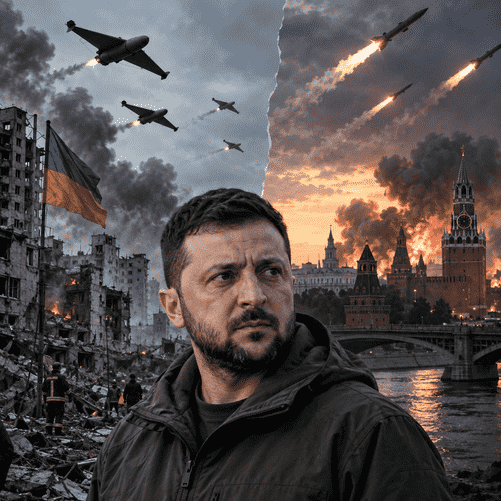
Zelenskyy’s defence technology adviser says escalating long-range attacks are turning the conflict into a “war of cities and infrastructure,” with civilians increasingly exposed and neither side capable of securing a decisive victory.

The war between Russia and Ukraine is entering an increasingly destructive phase in which deep strikes against cities, energy systems and industrial infrastructure risk inflicting enormous damage on both countries without delivering a clear military victory, according to one of President Volodymyr Zelenskyy’s senior defence technology advisers.
Serhii Beskrestnov, a Ukrainian radio and drone warfare specialist widely known by his call sign “Flash,” has warned that the rapid expansion of long-range missile and drone attacks is fundamentally changing the character of the conflict.
With the frontline largely deadlocked, both Russia and Ukraine are increasingly attempting to impose costs far behind enemy lines. That shift, Beskrestnov argues, is creating a war in which civilian populations and essential infrastructure are becoming ever more vulnerable.
“This is a war of cities, a war of infrastructure,” he told The Guardian, warning that neither side can ultimately emerge untouched if the escalation continues.
His assessment comes at a particularly sensitive moment.
Russia has continued expanding its capacity to strike Ukrainian cities with missiles and increasingly sophisticated drones, while Kyiv is simultaneously intensifying its own campaign against military installations, refineries, factories and logistics infrastructure inside Russia.
The result is a dangerous technological competition in which offensive capabilities are evolving faster than defensive systems can reliably counter them.
According to Beskrestnov, that imbalance is becoming one of the defining characteristics of the war.
He argued that attack systems are increasingly gaining an advantage over defence because both countries can manufacture or deploy large numbers of relatively inexpensive drones and missiles faster than air-defence networks can intercept them.
That problem becomes particularly severe when hundreds of weapons are launched simultaneously or in repeated waves designed to overwhelm defensive systems.
For Ukraine, the threat is especially acute ahead of winter.
Beskrestnov warned that Russia could attempt sustained attacks against electricity, heating and water infrastructure in Kyiv and other major cities, potentially creating a humanitarian crisis if essential services were disrupted for prolonged periods.
The Ukrainian adviser said the vulnerability of the capital should be taken seriously enough for authorities to consider contingency plans for evacuating vulnerable residents, particularly elderly people, if energy supplies were severely damaged.
He stressed that this was a personal assessment rather than an official evacuation recommendation.
The concern reflects Moscow’s continued emphasis on Ukraine’s energy system as a strategic target.
Russian President Vladimir Putin said earlier this week that Russian forces had been instructed to prepare mass strikes against Ukrainian energy facilities, according to reporting on the escalating aerial campaign.
At the same time, Ukraine is preparing its own substantial escalation in deep-strike operations.
Beskrestnov said Kyiv intends to increase the volume of long-range drone attacks dramatically, with an ambition eventually to launch as many as 1,000 drones a day against targets inside Russia. Current operations are reportedly closer to several hundred daily strikes or attempted strikes.
Factories, military sites, warehouses and oil-processing facilities are among the targets Ukraine has repeatedly attacked as it attempts to weaken Russia’s ability to finance and sustain the war.
The campaign is also increasingly aimed at creating wider economic disruption.
Zelenskyy has indicated that Ukraine intends to use drone activity to interfere with civilian aviation inside Russia. Beskrestnov said directly striking airports would not necessarily be required: the presence of hostile drones near airports can itself force temporary airspace closures and disrupt commercial flights.
That approach illustrates how modern drone warfare can create strategic effects without necessarily destroying a target.
A relatively inexpensive unmanned aircraft can force an airport to suspend operations, scramble air defences, divert aircraft and impose economic costs disproportionate to the price of the drone itself.
Russia, however, is developing similar capabilities at significant scale.
One of the most concerning developments identified by Beskrestnov is Moscow’s increasing deployment of faster jet-powered drones.
Russia has traditionally relied heavily on Shahed-type long-range attack drones, many derived from Iranian designs. But newer jet-powered versions are substantially faster and more difficult to intercept with the relatively inexpensive counter-drone systems Ukraine developed against earlier models.
Beskrestnov said Russia launched approximately 2,500 jet-powered Shahed drones into Ukraine during August, compared with around 1,500 in July. He also claimed Moscow plans a dramatic expansion of production in the years ahead.
Ukraine is developing jet-powered interceptor drones in response, with several domestic companies reportedly working on new systems.
But those weapons are not yet ready for full-scale production.
That creates a temporary but potentially significant advantage for Russia.
Until Ukrainian interceptors become available in sufficient quantities, Kyiv may have to rely heavily on fighter aircraft and more expensive air-defence systems to counter high-speed drones.
The economics of that contest matter.
Using sophisticated surface-to-air missiles against relatively cheap drones is rarely sustainable over a long period. Modern air warfare is therefore increasingly becoming a struggle not only over technology, but also over cost.
A country capable of producing thousands of inexpensive attack drones can potentially exhaust an opponent that must respond with much more expensive defensive weapons.
Ukraine already faces shortages of Patriot interceptors, one of the principal systems capable of countering Russian ballistic missiles.
Zelenskyy has publicly sought hundreds of additional Patriot missiles ahead of winter, but Beskrestnov expressed uncertainty over whether sufficient quantities could be obtained from foreign partners.
The technological race is also moving beyond conventional radio-controlled drones.
Ukrainian investigators recently concluded that a Russian Molniya drone involved in a fatal attack near Zaporizhzhia may have used artificial intelligence or autonomous navigation rather than conventional radio guidance.
If such technology were incorporated into larger long-range attack drones, it could significantly reduce the effectiveness of electronic warfare.
Ukraine has constructed extensive networks of jammers designed to interfere with the communications and navigation signals used by Russian drones.
But an autonomous system capable of identifying or navigating toward a target without maintaining a radio connection could potentially bypass those defences.
Beskrestnov said Ukraine is developing comparable autonomous systems of its own, although he believes Russia currently has an advantage in production scale.
These developments underline a larger transformation of the conflict.
For much of the war, attention focused on artillery, trenches, armoured vehicles and territorial gains along the eastern and southern fronts.
Those battles remain crucial.
But technological advances now allow both countries to attack strategic targets hundreds or even thousands of kilometres from the battlefield.
The frontline is consequently becoming only one component of a much broader conflict.
Energy infrastructure, airports, refineries, factories, logistics hubs and residential areas are increasingly part of the battlespace.
And civilians are paying a growing price.
United Nations figures cited in the latest reporting show that 437 civilians were killed and 2,610 wounded in Ukraine during July, the highest monthly casualty total since March 2022. Comparable comprehensive figures from Russian territory are more difficult to establish.
The increase reflects the growing intensity and reach of aerial attacks.
Recent Russian strikes have continued to hit Ukrainian cities and infrastructure, while Ukrainian attacks have also caused casualties and disruption inside Russia. Fresh fighting has coincided with renewed diplomatic activity involving US envoys seeking to revive negotiations between Moscow and Kyiv.
Yet diplomacy has so far failed to produce a durable ceasefire.
Instead, both countries continue expanding their ability to strike one another.
That is precisely the trajectory Beskrestnov fears.
His warning is not that military resistance is pointless, nor that Ukraine should abandon its defence. Rather, it reflects concern that technological escalation may gradually create a form of mutual strategic destruction in which both countries become capable of inflicting enormous economic and infrastructural damage while remaining unable to force the other into complete military defeat.
Such a scenario would resemble a prolonged war of attrition conducted not only through soldiers and artillery, but through factories, power grids and civilian economies.
The consequences could last far beyond the fighting itself.
Destroyed power stations require years to rebuild. Damaged industrial facilities can eliminate thousands of jobs. Repeated attacks on transportation and energy systems discourage investment and accelerate population displacement.
Even after a ceasefire, both countries could therefore emerge economically weakened and burdened with enormous reconstruction costs.
Beskrestnov’s warning that “nobody will win” is ultimately rooted in that calculation.
A military deadlock combined with rapidly expanding long-range strike capabilities could leave both sides increasingly capable of destruction but no closer to achieving their political objectives.
Ukraine still faces the fundamental problem that Russia possesses significantly greater industrial resources and a larger population.
Russia, however, faces its own vulnerabilities as Ukrainian drones become capable of reaching ever deeper into its territory and disrupting strategically important industries and transportation networks.
The longer that technological competition continues, the more difficult it may become to protect civilian life.
The situation is particularly dangerous because drone and missile technology is advancing at extraordinary speed.
Systems that were experimental six months ago can become mass-produced weapons within a year. Electronic countermeasures trigger new navigation technologies. Faster drones produce faster interceptors. Autonomous guidance makes jamming less effective.
Each innovation generates another response.
That cycle has transformed Ukraine into one of the most rapidly evolving battlefields in modern military history.
But technological sophistication does not necessarily produce strategic victory.
Instead, Beskrestnov’s warning points toward a darker possibility: a conflict in which the ability of both sides to destroy infrastructure continues to expand faster than their ability to protect it.
If that trajectory remains unchanged, the next phase of the Russia-Ukraine war may increasingly be measured not by kilometres of territory captured, but by power stations disabled, factories destroyed, airports closed and civilians forced from their homes.
And in that kind of war, even the side that ultimately claims victory could inherit a country profoundly damaged by the struggle required to achieve it.