European manufacturers are intensifying pressure on Brussels as cheaper Chinese components, high energy costs and widening trade imbalances fuel fears of a deeper erosion of the continent’s industrial base.

Europe’s manufacturing sector is entering an increasingly difficult confrontation with global competition, as industry representatives warn that hundreds of thousands of factory jobs could disappear before the end of 2026 unless the European Union moves more aggressively to protect domestic production and strategic supply chains.
Eurometal, the European federation representing steel distributors, service centres and traders, has warned that as many as 300,000 manufacturing jobs could be lost during the remainder of the year, pointing primarily to growing competition from Chinese producers and the penetration of Chinese-made components into European industrial supply chains.
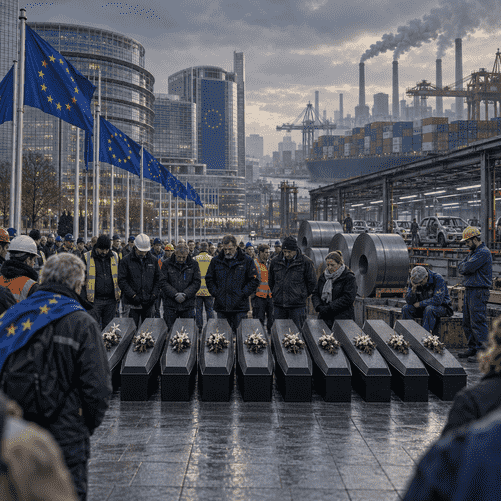
The organisation is taking its message directly to the heart of EU policymaking. On September 7, manufacturers and industry representatives are gathering in Brussels for what Eurometal calls the European Convoy for Industrial Competitiveness, culminating outside the European Commission’s Berlaymont headquarters.
The demonstration will feature 10 symbolic coffins, representing industrial capacity, employment and manufacturing expertise that campaigners argue Europe risks losing. Some are intended to symbolise concepts including European factories, industrial employment and the EU’s competitiveness.
The theatrical protest reflects a considerably broader concern now emerging across Europe: that the continent is at risk of surrendering important sections of its industrial value chain while remaining increasingly dependent on overseas suppliers for the components required to manufacture products at home.
From raw materials to entire supply chains
At the centre of Eurometal’s argument is a change in the nature of Chinese industrial competition.
European companies have long imported raw materials and manufactured goods from China. Industry representatives now argue, however, that Chinese companies are increasingly positioning themselves deeper inside global manufacturing networks by supplying the intermediate metals, chemicals, components and semi-finished products on which European factories depend.
Eurometal president Alexander Julius has described the process in stark terms, arguing that China increasingly seeks not merely to provide basic materials but to control more valuable stages of production.
The concern is that once European manufacturers become dependent on Chinese suppliers for critical industrial inputs, the economic advantages enjoyed by those suppliers could gradually weaken domestic producers until significant sections of the European supply chain become commercially unviable.
Eurometal has used the controversial term “colonisation” to describe that process. It is an industry characterisation rather than an official EU assessment, but it highlights growing anxiety about Europe’s ability to preserve control over strategic manufacturing capacity.
The debate extends far beyond steel.
Metals and industrial chemicals feed into enormous numbers of downstream businesses, ranging from automobiles and machinery to construction products, renewable-energy infrastructure, appliances and advanced manufacturing. Weakness at the component level can therefore travel progressively through an economy, even when the final assembly of a product remains in Europe.
A €1 billion-a-day imbalance
The warning comes as economic tensions between Brussels and Beijing are escalating.
China is currently running a trade surplus with the EU of approximately €1 billion per day, equivalent to roughly €360 billion on an annualised basis, intensifying European concerns about whether the existing commercial relationship remains sustainable.
EU Trade Commissioner Maroš Šefčovič has already indicated that Beijing must produce concrete measures to address the imbalance by October or risk tougher European action. EU-China negotiations are examining the rapidly growing trade deficit as well as issues surrounding market access and competition.
European policymakers have increasingly adopted defensive trade measures in recent years. Brussels has imposed additional tariffs on Chinese electric vehicles and strengthened protections surrounding some steel imports, while scrutinising subsidies and market practices in several strategically important sectors.
Yet industrial groups argue that tariffs applied to finished products alone cannot solve the problem.
Their fear is that Chinese producers could increasingly dominate the less visible intermediate layers of manufacturing—the components that eventually become part of products sold under European brands.
Europe’s competitiveness problem is bigger than China
Chinese competition is only one component of Europe’s industrial challenge.
Manufacturers across the continent are simultaneously dealing with comparatively high energy costs, stricter environmental requirements, labour shortages, weak economic growth and the enormous capital expenditure required for decarbonisation.
That combination has generated concerns that Europe is becoming a structurally expensive place in which to manufacture certain energy-intensive products.
Germany, historically the industrial engine of the European economy, provides one of the clearest illustrations. High energy prices following the disruption of Russian gas supplies have weakened the competitiveness of energy-intensive industries, while other European countries—and increasingly overseas markets—have attracted investments that might once automatically have gravitated toward Germany.
The resulting debate presents Brussels with an uncomfortable policy dilemma.
Europe wants to maintain ambitious climate objectives while protecting employment, strengthening economic security and reducing strategic dependence on China. Achieving all four simultaneously could require enormous investment as well as a significant redesign of European industrial policy.
Brussels turns toward “Made in Europe”
Signs of that shift are already becoming visible.
The European Union is preparing new “Buy European” public-procurement provisions under a broader Made in Europe industrial strategy. The proposed framework would give public authorities greater ability to favour European suppliers when awarding contracts, particularly when competing companies originate from countries that do not provide European businesses with equivalent access to their own procurement markets.
China would inevitably be one of the countries most affected.
Supporters argue that Europe can no longer maintain one of the world’s most open markets while European companies encounter substantially greater barriers overseas. They see procurement policy as a powerful mechanism for generating predictable demand for European manufacturing.
Critics, however, warn that a rapid turn toward protectionism could increase prices, reduce competition and provoke retaliation from Beijing.
That leaves European policymakers searching for a balance between maintaining an open trading economy and ensuring that openness does not progressively eliminate domestic industrial capacity.
The strategic dimension
The argument is increasingly about security as much as economics.
The disruption of supply chains during the Covid pandemic, followed by Russia’s invasion of Ukraine and the subsequent energy crisis, fundamentally altered European thinking about economic dependence.
Products that once appeared to be ordinary commercial commodities—from semiconductors and batteries to pharmaceuticals, rare-earth materials and industrial chemicals—are increasingly treated as strategic assets.
A recent study prepared for the European Parliament identified dozens of episodes in which economic dependencies or restrictions had been used to exert pressure on the EU, reinforcing calls for Europe to reduce vulnerabilities created by excessive concentration of critical supply chains.
China remains simultaneously one of Europe’s most important trading partners and one of its largest strategic competitors. A complete economic separation would be extraordinarily costly and is not currently Brussels’ stated objective.
Instead, the emerging European strategy revolves around “de-risking”: preserving trade with China while reducing excessive dependence in sectors regarded as economically or strategically critical.
The difficulty lies in determining where normal commercial competition ends and strategic dependency begins.
A warning Brussels cannot easily dismiss
The ten coffins arriving outside the European Commission are deliberately provocative symbols. But behind them lies a genuine economic argument that European leaders are finding increasingly difficult to avoid.
For decades, the European economic model combined relatively open markets, sophisticated manufacturing and access to inexpensive imported energy and components. Several pillars of that system have now weakened simultaneously.
Energy is more expensive. Global industrial subsidies have increased. China has moved rapidly up the manufacturing value chain. The United States has adopted increasingly interventionist industrial policies of its own. And European businesses are being asked to finance one of the largest technological and environmental transformations since the Industrial Revolution.
The debate is therefore no longer simply about whether Europe should impose another tariff on Chinese imports.
It is about whether the EU can preserve enough manufacturing capacity to remain an industrial power at all.
Eurometal’s forecast of 300,000 potential job losses remains an industry estimate rather than an inevitable outcome. Yet its warning arrives at a moment when concerns about factory closures, investment and competitiveness have moved from corporate boardrooms into mainstream European politics.
Brussels now faces a difficult choice: tolerate greater dependence on inexpensive global supply chains and accept the risks that accompany it, or intervene more forcefully to rebuild European industrial capacity—even if doing so means higher costs and greater trade friction.
The procession of coffins around the Berlaymont is designed to suggest that time is running out.
Whether Europe’s industrial decline proves as severe as its manufacturers fear will depend considerably on what policymakers decide to do next.