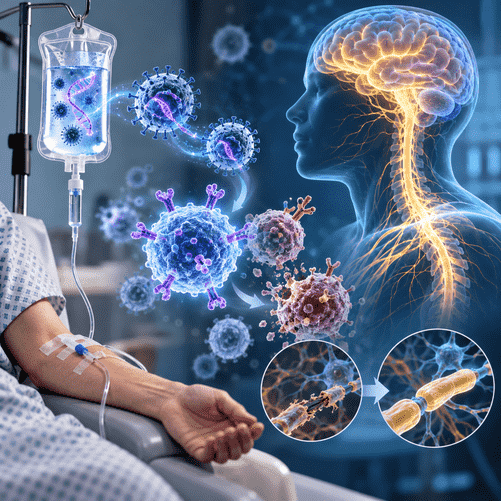
An experimental treatment that engineers immune cells directly inside the body improved symptoms in a small group of patients, raising hopes that powerful cell therapies could become simpler and more accessible

A new form of immune therapy has produced encouraging early results in people with multiple sclerosis and related autoimmune diseases, offering a glimpse of how one of modern medicine’s most powerful — and complicated — treatments might eventually be delivered without removing and genetically engineering a patient’s cells in a laboratory.
Researchers in China tested an experimental “in vivo” CAR-T therapy in 16 people with neurological autoimmune disorders. Instead of collecting T cells from each patient, modifying them outside the body and then reinfusing them, the team used a specially engineered viral vector to deliver genetic instructions directly into patients’ immune cells.
Those instructions caused some T cells to become chimeric antigen receptor, or CAR, T cells inside the body itself.
The early results, published in The New England Journal of Medicine on September 3, suggest that the approach can reduce populations of immune cells thought to drive autoimmune disease and may improve symptoms in some patients. Researchers and outside experts have described the findings as exciting, although the trial was small and much larger studies will be required before the therapy’s safety and effectiveness can be established.
The significance lies not only in what the treatment appears to do, but in how it does it.
Turning the body into the CAR-T laboratory
Traditional CAR-T therapy has transformed the treatment of some blood cancers.
Doctors remove T cells from a patient’s blood and send them to a specialised laboratory, where the cells are genetically modified so that they carry receptors capable of recognising a particular target. The engineered cells are then expanded in large numbers before being infused back into the patient.
The process can produce remarkable results, but it is technically demanding, expensive and time-consuming.
The new experimental approach attempts to eliminate much of that manufacturing process.
Researchers from Tongji Hospital at Huazhong University of Science and Technology in Wuhan, working with Shenzhen Genocury Biotech, used a modified lentiviral vector to carry instructions for a CAR designed to recognise CD19, a protein found on B cells.
Once administered intravenously, the vector enters selected T cells and provides the genetic instructions that enable them to recognise and destroy CD19-bearing B cells.
B cells are a normal and essential component of the immune system, but in several autoimmune diseases they can contribute to the production of harmful immune responses against the body’s own tissues.
Removing those dysfunctional populations may allow the immune system to rebuild in a less destructive form.
That concept has already generated intense interest in conventional CAR-T therapy for diseases such as lupus, systemic sclerosis and multiple sclerosis.
The new study asks whether essentially the same biological reset can be achieved without manufacturing the CAR-T cells outside the body.
Why multiple sclerosis is an important target
Multiple sclerosis, or MS, is a chronic neurological disease in which the immune system attacks myelin, the protective material surrounding nerve fibres in the brain and spinal cord.
The damage disrupts communication between the brain and the rest of the body and can produce symptoms ranging from visual disturbances and fatigue to muscle weakness, impaired coordination and progressive disability.
Modern treatments can substantially reduce inflammatory attacks in many patients, particularly during earlier stages of the disease.
But MS remains incurable, and some patients continue to experience progression despite available therapies.
That is one reason researchers are increasingly exploring strategies designed not merely to suppress individual immune pathways but to reset parts of the immune system more comprehensively.
CAR-T therapy represents one of the most radical versions of that idea.
Instead of continuously administering medication to suppress inflammation, researchers hope that eliminating disease-driving immune cells could create a period of deep and potentially durable remission.
Early signs of improvement
According to the report highlighted by Nature, symptoms improved in the 16 participants with multiple sclerosis or other neurological autoimmune conditions following the experimental treatment.
The therapy also produced evidence that the engineered immune cells were functioning as intended.
After receiving the treatment, patients experienced depletion of B cells, indicating that the newly created CAR-T cells were successfully identifying and eliminating cells carrying the CD19 target.
The approach therefore appears to have cleared one of its first major hurdles: demonstrating that CAR-T cells can be generated directly inside the human body in sufficient numbers to produce a biological effect.
That could have major implications well beyond multiple sclerosis.
If the technology eventually proves safe and reliable, it could potentially be adapted for other autoimmune diseases — and perhaps eventually for cancer — while reducing dependence on the highly specialised manufacturing infrastructure currently required for conventional CAR-T therapy.
The accessibility problem in cell therapy
Traditional CAR-T treatment is among the most technologically sophisticated therapies in medicine.
It is also among the most difficult to deliver.
Patients generally need to travel to specialist centres capable of collecting cells, coordinating manufacturing, administering chemotherapy before treatment and managing potentially dangerous immune reactions afterward.
The customised manufacturing process can take weeks.
Costs can also be extraordinary, with commercially available CAR-T cancer treatments priced in the hundreds of thousands of dollars before hospital care and related expenses are included.
An effective in-body system could radically change that equation.
Instead of manufacturing a unique batch of engineered cells for each patient, doctors might eventually administer a standardised genetic therapy capable of creating those cells inside the patient.
In principle, that could shorten treatment times and simplify logistics.
It could also make advanced immune therapies available to hospitals and countries that currently lack dedicated CAR-T manufacturing facilities.
But that possibility remains theoretical for now.
Safety will determine whether the idea succeeds
CAR-T therapy is powerful precisely because it can profoundly alter immune activity.
That power carries risk.
Existing CAR-T therapies can trigger cytokine release syndrome, an excessive inflammatory response that can range from fever to life-threatening organ dysfunction. Neurological complications can also occur.
Those concerns are especially relevant in autoimmune medicine.
Recent events elsewhere in the field have underscored the risks. Novartis paused multiple trials of its experimental conventional CAR-T therapy for autoimmune and neurological diseases after three patient deaths associated with severe immune reactions. Other companies have also temporarily halted autoimmune CAR-T studies following inflammatory complications.
Those incidents involved different therapies and manufacturing approaches and should not be treated as evidence against the new in-vivo system.
But they illustrate why safety data will receive intense scrutiny.
An in-vivo therapy raises additional questions because genetic modification occurs inside the patient rather than in a controlled laboratory manufacturing process.
Researchers will need to establish exactly which cells receive the genetic material, how long the modified cells persist and whether the vector could produce unintended effects.
Long-term monitoring will be essential.
A potentially important advantage
One of the most attractive features of the new approach is speed.
Traditional CAR-T production can require significant processing before treatment begins.
An in-vivo system potentially reduces that process to an infusion.
That could prove especially important for diseases in which rapid control of aggressive immune activity is necessary.
It could also transform the economics of personalised medicine.
CAR-T has often been described as a manufacturing platform disguised as a drug: each patient effectively receives a biological product manufactured specifically for them.
In-vivo engineering could shift that model toward something closer to conventional pharmaceutical distribution.
A hospital could theoretically receive a ready-to-administer vector rather than coordinate the manufacture of an individual cell product.
That is a profound difference.
From cancer treatment to immune-system reset
The evolution of CAR-T therapy is one of the more striking examples of technologies crossing medical boundaries.
The first major successes came in cancer, particularly leukaemias, lymphomas and multiple myeloma.
Scientists then began asking whether the same technique used to eliminate malignant B cells could eliminate B cells responsible for autoimmune disease.
Small studies using conventional CAR-T therapy have already produced remarkable remissions in some people with severe lupus and other autoimmune disorders.
The concept increasingly being explored is an “immune reset.”
After CAR-T cells remove large numbers of B cells, the immune system eventually generates new ones.
Researchers hope that the rebuilt population will no longer contain the same disease-driving characteristics.
In autoimmune diseases, that could potentially produce much longer periods without symptoms than medications requiring continuous administration.
Whether such remissions will last for years remains one of the most important unanswered questions in the field.
Not yet a cure
The excitement surrounding the new study requires considerable caution.
Sixteen participants is far too small a population from which to determine whether the treatment is broadly effective.
Early-phase clinical studies are primarily designed to evaluate feasibility and safety rather than prove that a therapy works better than established treatments.
There is also no evidence yet that this method cures multiple sclerosis.
MS is biologically complex, and damage already sustained by nerves may not automatically reverse even if the autoimmune process is successfully controlled.
Researchers will need longer follow-up to determine whether patients remain stable, whether symptoms continue improving and whether harmful immune activity eventually returns.
Future trials will also need comparison groups and significantly larger populations.
A wider race toward in-vivo cell engineering
The experiment nevertheless points toward a rapidly developing frontier in biotechnology.
Researchers and pharmaceutical companies are trying to create therapies capable of programming cells directly inside the body.
Several technologies are being explored, including viral vectors, lipid nanoparticles and other delivery systems.
The underlying goal is similar: take biological engineering techniques that currently require specialised laboratories and move part of that manufacturing process into the patient.
If successful, the implications could extend far beyond CAR-T.
Scientists envision systems capable of instructing immune cells to attack cancer, suppress autoimmune disorders or produce therapeutic proteins without repeatedly administering conventional drugs.
Medicine would effectively move from giving the body a finished treatment to giving it instructions for manufacturing part of the treatment itself.
That concept is already familiar from mRNA vaccines.
In-vivo CAR-T takes the principle significantly further by reprogramming living immune cells.
A breakthrough worth watching — with caution
For patients with multiple sclerosis, the new findings are not yet a reason to abandon established treatments or expect an imminent cure.
But scientifically, they represent an important proof of concept.
Researchers have demonstrated in humans that genetically engineered CAR-T cells can be generated directly inside the body and can produce measurable effects against autoimmune disease.
If larger trials reproduce the results while establishing acceptable safety, the consequences could extend well beyond MS.
CAR-T therapy could become faster to manufacture, easier to distribute and potentially available to far more patients.
The technology that began as an extraordinarily complex weapon against blood cancer could ultimately evolve into a programmable platform for resetting malfunctioning immune systems.
For now, the most important word is still “experimental.”
But the possibility demonstrated by this small study is unusually ambitious: instead of engineering a patient’s immune cells in a laboratory, medicine may eventually learn to perform the engineering inside the patient themselves.