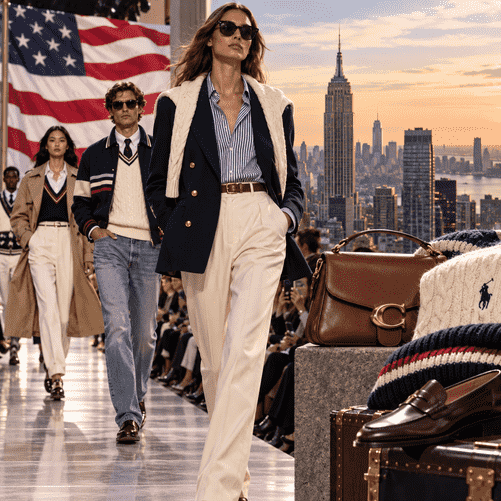
New York Fashion Week is putting Ralph Lauren, Coach and Tommy Hilfiger back at the centre of attention as younger consumers embrace familiar American brands in a luxury market searching for growth

Fashion’s obsession with the new is colliding with an unexpected commercial reality: some of the industry’s strongest momentum is coming from brands that have been around for decades.
As New York Fashion Week prepares to open its September 2026 edition, American heritage houses are taking an unusually prominent position on the schedule. Ralph Lauren, Coach and Tommy Hilfiger are among the labels benefiting from renewed interest among younger shoppers, providing a rare source of optimism at a time when the broader global luxury industry remains uneven and highly sensitive to economic and geopolitical disruption.
The revival is significant because it challenges one of fashion’s long-standing assumptions — that younger consumers inevitably demand constant reinvention. Instead, Generation Z is increasingly finding value in established symbols of American style: polo shirts, cable-knit sweaters, leather handbags, collegiate references, denim and preppy sportswear.
The result is not simply nostalgia. Fashion companies are learning how to reposition familiar products for a generation discovering them through social media, resale platforms, celebrity styling and digital culture rather than through the traditional department-store ecosystem.
That shift is helping reshape New York Fashion Week itself.
Nearly 70 runway shows and presentations are scheduled through September 15, with Ralph Lauren and Coach among the major names anchoring the event. Tommy Hilfiger is also returning, while Calvin Klein, Carolina Herrera, Christian Siriano and Thom Browne are part of a programme mixing established American businesses with younger designers.
The prominence of heritage labels comes at a particularly important moment for the industry.
Luxury fashion has spent several years navigating weaker demand, particularly among aspirational consumers who became more cautious following inflation, higher borrowing costs and repeated increases in luxury prices. Geopolitical instability has also disrupted tourism and consumer confidence in markets that traditionally generate substantial spending on fashion and accessories.
Against that backdrop, brands capable of generating excitement without abandoning their identity have gained an advantage.
Ralph Lauren turns Americana into a global product
Few companies illustrate the shift more clearly than Ralph Lauren.
The company has built its business around a highly recognisable vision of American life: equestrian culture, Ivy League tailoring, Western references, country-club sportswear and an idealised world of East Coast sophistication.
That aesthetic once risked being viewed as overly traditional. Today, many of the same codes have become fashionable again.
Ralph Lauren has experienced particularly strong demand in China and other important markets. Earlier this year, the company reported better-than-expected quarterly revenue, with strong Chinese sales helping push its shares sharply higher.
The commercial success reflects a broader trend.
Younger consumers are embracing clothing that looks identifiable rather than excessively experimental. Classic knitwear, rugby shirts, loafers, relaxed tailoring and traditional American sportswear have returned to fashion feeds, often styled in ways that deliberately mix generations and social categories.
A vintage-looking polo shirt may now be worn with oversized trousers and sneakers. A cable-knit sweater associated with conservative East Coast wardrobes can appear beside streetwear accessories or second-hand denim.
The garment itself may be traditional. The styling is not.
That flexibility has allowed Ralph Lauren to become relevant without aggressively changing its fundamental image.
Coach’s transformation offers another blueprint
Coach has followed a different but equally revealing path.
The New York leather-goods company has succeeded in making some of its most recognisable products desirable to younger buyers, particularly its Tabby handbag.
Its revival shows how an established company can reconnect with consumers through accessible luxury rather than competing exclusively at the highest end of the market.
For shoppers who admire European luxury houses but are increasingly reluctant to pay several thousand dollars for a handbag, brands such as Coach occupy an attractive middle ground.
They offer recognisable design, heritage and brand identity while remaining more attainable than the most prestigious luxury labels.
That positioning has become increasingly valuable.
Years of aggressive price increases across luxury fashion created enormous profitability during the post-pandemic boom, but they also widened the distance between major brands and younger consumers.
The industry is now confronting the consequences.
Some shoppers have shifted toward resale. Others buy fewer luxury products or favour smaller independent labels. Still others have moved toward premium brands whose prices are easier to justify.
Coach has benefited from that recalibration.
Tommy Hilfiger returns to the cultural conversation
Tommy Hilfiger represents another version of the same phenomenon.
The brand’s red, white and blue identity became one of the defining symbols of American fashion during the 1990s, crossing from preppy sportswear into hip-hop culture and eventually becoming a global mass-premium label.
Its return to greater visibility comes as fashion once again embraces unmistakably American imagery.
Hilfiger’s recent collaboration with NFL figure Travis Kelce further connected the company with contemporary sports and entertainment culture, reinforcing a strategy in which heritage is combined with personalities capable of reaching younger audiences.
The approach reflects a major change in fashion marketing.
Brands are no longer relying primarily on traditional celebrity endorsements or runway coverage. They increasingly position themselves inside overlapping ecosystems of music, sport, entertainment, social media and online fandom.
A collaboration with an athlete can generate as much cultural relevance as a conventional advertising campaign.
For American labels, that creates an especially powerful opportunity because global interest in U.S. sports, entertainment and celebrity culture can reinforce the appeal of the clothing itself.
Gen Z is redefining what “vintage” means
The generational dimension may prove even more important than any individual brand revival.
For consumers in their teens and twenties, the fashion of the 1990s and early 2000s is not necessarily remembered personally. It is historical material to be rediscovered.
That distinction changes how heritage operates.
A Ralph Lauren sweater or vintage Tommy Hilfiger jacket may feel nostalgic to a 45-year-old consumer but new to someone born in 2005.
Social platforms accelerate the process.
Archived advertising campaigns, old runway footage and celebrity photographs can circulate instantly, allowing a generation of consumers to discover decades of fashion history through an algorithmic feed.
The result is a strange compression of fashion time.
Styles from 1985, 1997, 2004 and 2026 can appear next to each other on the same screen, detached from their original context.
For brands with extensive archives, that represents an enormous commercial asset.
Fashion’s difficult luxury environment
The heritage revival does not mean the entire American premium-fashion industry is prospering.
Michael Kors, for example, continues to face difficulties, highlighting how uneven the sector remains.
Elsewhere, athletic and lifestyle brands are also confronting changing consumer loyalties. Lululemon recently cut its annual revenue and profit forecasts again after disappointing results, while competitors such as Alo Yoga and Vuori have increased pressure in the athleisure market.
The contrast is revealing.
Brand recognition alone is no guarantee of success.
Consumers may embrace heritage when it feels culturally relevant, but they can abandon established companies quickly when products appear repetitive or marketing loses connection with contemporary tastes.
That means the current revival of American classics is not simply a return to the past.
It is a test of whether old brands can remain flexible enough to participate in modern culture without diluting the identity that made them valuable in the first place.
New York seeks to reclaim cultural relevance
The renewed strength of American labels could also benefit New York Fashion Week.
For years, New York has competed with Paris and Milan for international attention. European luxury houses typically command larger marketing budgets and greater prestige, while some prominent American designers have experimented with showing outside the traditional calendar.
A strong group of commercially successful domestic brands gives New York renewed influence.
This year’s programme begins with designer Henry Zankov’s debut collection for Diane von Furstenberg and concludes with Thom Browne, while established names and emerging designers fill the days between them.
The mixture illustrates what New York increasingly wants to represent: not simply a runway showcase, but an ecosystem connecting luxury, sportswear, independent design, entertainment and mass culture.
That identity may ultimately distinguish the city from its European competitors.
Familiarity becomes fashion’s new luxury
The deeper story emerging from the 2026 season is that familiarity itself has become fashionable.
After years dominated by rapid trend cycles, viral micro-aesthetics and relentless product launches, some consumers appear increasingly interested in clothing that feels recognisable and durable.
That does not necessarily mean minimalist dressing.
Instead, it suggests a desire for products with identity.
A polo shirt bearing an embroidered horse, a structured leather bag or a varsity-inspired jacket immediately communicates cultural references that consumers understand.
Heritage brands possess decades of those visual codes.
The challenge is using them without becoming trapped by them.
For Ralph Lauren, Coach and Tommy Hilfiger, the early evidence suggests that the balance is working. Their strongest products often look unmistakably connected to their past, yet they are reaching consumers who have no personal memory of the eras in which those products first became famous.
That could prove particularly valuable as fashion’s economic environment becomes more difficult.
When consumers become selective, brand recognition matters. So does emotional familiarity. And when luxury shoppers question whether ever-rising prices still represent value, companies with established identities at more accessible price points can suddenly look much more attractive.
New York Fashion Week will still produce new silhouettes, emerging designers and unexpected trends.
But one of its most important messages may already be visible before the first major runway begins.
In 2026, the future of American fashion is being built partly from its past.