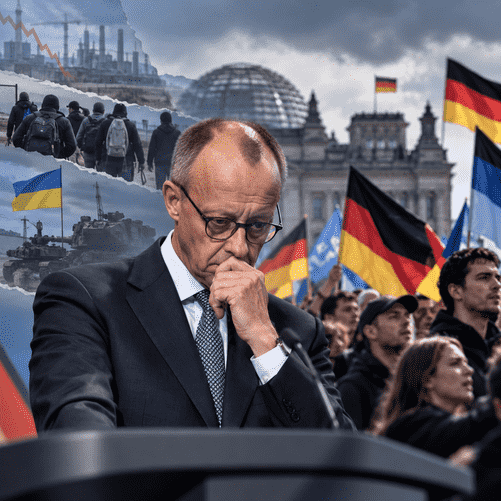
After a crushing far-right victory in Saxony-Anhalt, Chancellor Friedrich Merz faces attacks over migration, the economy and his own leadership — with few convincing answers for voters drifting toward the AfD

Friedrich Merz entered the German chancellery promising to restore confidence, revive Europe’s largest economy and halt the advance of the far-right Alternative für Deutschland. Instead, little more than a year into his government, he finds himself confronting a political crisis that increasingly appears to be defining his leadership.
The scale of the challenge became unmistakable in Saxony-Anhalt, where the AfD secured almost 44% of the vote in the September 6 state election, more than doubling its previous result. Merz’s Christian Democratic Union, which had governed the eastern state for more than two decades, collapsed to roughly 17%. The result represented the AfD’s strongest regional performance to date and brought it closer than ever to exercising executive power in a German state.
For Merz, the defeat was more than an embarrassing regional setback. It exposed a deeper problem: the political strategy he has pursued since taking office has so far failed to weaken the AfD.
The chancellor has responded by acknowledging the anger driving voters toward the far right and promising a government that listens more closely and displays greater empathy toward citizens who feel economically or politically abandoned. But after such a dramatic electoral rebuke, appeals for greater compassion risk sounding vague beside the highly targeted campaign being waged by the AfD.
Merz himself admitted that his CDU had been shaken “to its very foundations” by the result. Yet he rejected speculation about his political future and insisted that he intended to remain chancellor. “Giving up is not an option for me,” he said after the defeat.
The question is increasingly what he intends to do differently.
The AfD attacks on several fronts
The effectiveness of the AfD lies partly in its ability to combine several sources of public discontent into a single political narrative.
Immigration remains one of its most powerful issues. Although Merz has already pushed German policy sharply to the right on border controls and asylum, the AfD argues that the government remains unwilling to take the drastic measures required to reduce migration substantially.
The strategy leaves the chancellor in a difficult position.
Moving further toward AfD policies risks legitimising the party’s argument that it was correct all along. Refusing to move risks allowing the far right to claim that the political establishment remains unwilling to respond to voters’ concerns.
The same dilemma exists on the economy.
Germany is beginning to show signs of recovery after years of stagnation, helped by increased infrastructure and defence investment. Berlin has embarked on an enormous programme of public spending, including a €500 billion infrastructure fund intended to modernise transport, energy networks and other parts of the country’s ageing economic foundations.
But the improvement has yet to translate into widespread political optimism.
German industry continues to face high energy costs, demographic pressure, global competition and difficult adjustments in sectors such as automobiles and manufacturing. The AfD has successfully linked these frustrations to its broader attack on environmental regulation, migration policy and the European Union.
For many voters, promises of eventual economic recovery are competing with immediate concerns over living costs, job security and the future of German industry.
That gap between macroeconomic policy and everyday perception has become one of Merz’s most serious vulnerabilities.
An extraordinarily unpopular chancellor
The scale of dissatisfaction with Merz personally is striking.
An ARD DeutschlandTrend survey published on September 3 found that only 13% of respondents were satisfied with the chancellor’s performance, matching the lowest approval level recorded for a German chancellor in the history of the survey. Eighty-three percent said they were dissatisfied.
The AfD, meanwhile, has moved ahead of Merz’s conservative bloc in a series of national polls.
Recent surveys place the party at approximately 27% to 28%, compared with around 20% to 22% for the CDU/CSU. At the 2025 federal election, the conservatives had won 28.5% and the AfD 20.8%.
The reversal is politically significant.
Merz originally presented himself as the conservative leader capable of winning back voters who had abandoned the CDU for the AfD. His sharper rhetoric on immigration, national identity and security was intended to prevent the far right from monopolising those concerns.
Instead, the AfD has continued growing.
The danger for Merz is that voters who favour tougher policies may increasingly prefer the original rather than a more moderate version offered by the CDU, while centrist voters may become uncomfortable with the conservatives’ rhetorical movement to the right.
That leaves the chancellor squeezed from both directions.
Saxony-Anhalt changes the political calculation
The Saxony-Anhalt result has intensified the pressure because it moves the AfD closer to a political objective it has pursued for years: breaking Germany’s so-called “firewall.”
Mainstream parties have traditionally refused to enter coalitions with the AfD because of the party’s extremist elements and its challenges to Germany’s postwar political consensus.
That arrangement becomes increasingly difficult to sustain when the AfD approaches or exceeds 40% of the vote.
In Saxony-Anhalt, the party won 43.8%, while the CDU fell dramatically from the 37.1% it achieved in 2021.
The AfD may still struggle to form a government because other parties refuse to cooperate with it. But every electoral breakthrough makes the exclusion strategy harder to explain to voters who support the party.
The mathematics of coalition building could eventually become equally difficult.
If the AfD continues expanding while traditional parties decline, Germany could increasingly face governments assembled from ideologically incompatible parties whose primary common purpose is preventing the far right from taking office.
Such coalitions can themselves become politically vulnerable.
They allow the AfD to portray itself as the only genuine opposition while blaming a broad establishment alliance for every unpopular compromise produced by government.
Russia and Ukraine offer another opening
Foreign policy provides the AfD with another battlefield.
Merz has positioned Germany firmly behind Ukraine and has sought to strengthen Berlin’s role in European defence. The AfD instead advocates restoring relations with Moscow, ending or sharply reducing German support for Kyiv and reversing sanctions that it argues have damaged German economic interests.
Those positions remain deeply controversial, particularly following concerns over Russian hybrid operations and attacks on European infrastructure.
But the AfD’s message appeals to voters who associate the Ukraine war with higher energy prices, military spending and prolonged geopolitical uncertainty.
Recent tensions over alleged Russian activity around German infrastructure have only sharpened the divide.
Merz cannot easily neutralise the issue without undermining one of the central pillars of his foreign policy.
The result is another area in which the chancellor faces an opponent willing to offer simple answers to problems that, in reality, have no simple solution.
Compassion may not be enough
Following the Saxony-Anhalt disaster, Merz has suggested that political leaders must show voters that they understand their frustrations more clearly.
The instinct is understandable.
Many voters supporting populist parties across Europe express a feeling not merely of economic disadvantage but of political neglect. They believe decisions are taken by governments, institutions and experts who neither listen to them nor experience the consequences of those decisions.
But empathy is not itself a policy.
The political weakness in Merz’s response is that voters already know the government understands the AfD threat. What they increasingly want to know is whether it can produce visible improvements in their lives.
Economic reform may eventually help.
Infrastructure investment may eventually improve productivity.
Reduced bureaucracy may eventually encourage businesses to invest.
Tougher migration enforcement may eventually change public perceptions of border control.
But politics operates on a much shorter timetable.
The AfD is exploiting the period between government promises and tangible results.
The firewall remains — for now
Despite the scale of the AfD victory, Merz has given no indication that he intends to abandon the CDU’s refusal to cooperate with the party.
Doing so would create potentially existential problems for his conservatives.
The CDU contains politicians who believe the firewall should remain absolute, both because of the AfD’s extremist factions and because of Germany’s historical responsibility to prevent the normalisation of radical nationalism.
Others increasingly argue that permanently excluding a party supported by more than a quarter of the electorate is politically unsustainable.
The Saxony-Anhalt election will strengthen the second group.
Merz therefore faces pressure not only from the opposition but from within his own political family.
Should further regional elections produce similar results, questions about whether his strategy toward the AfD has failed will become unavoidable.
Germany’s crisis goes beyond Merz
The problem confronting the chancellor is ultimately larger than one politician.
The German political system that dominated the postwar era is fragmenting.
The CDU and Social Democrats once commanded overwhelming majorities between them. Today, both are struggling to retain voters while the AfD, Greens, Left party and other movements divide the electorate.
The result is a political landscape in which stable majority governments become harder to construct.
That fragmentation matters economically as well.
Germany needs difficult reforms to pensions, labour markets, energy policy and public administration. Yet governments assembled from increasingly diverse coalitions find it harder to agree on precisely the reforms necessary to restore long-term growth.
The AfD benefits from that paralysis without having to assume responsibility for solving it.
Reuters Breakingviews warned this week that the far right’s rise represents a potentially serious long-term economic risk because political instability could delay reforms precisely when Germany needs them most.
Merz is running out of political space
There is still time for the chancellor to recover.
Germany’s economy could strengthen. Major infrastructure projects could begin producing visible results. Migration numbers could decline. International developments could reinforce Merz’s argument that Germany requires experienced, pro-European leadership rather than political experimentation.
But the electoral evidence is becoming increasingly difficult to dismiss.
Saxony-Anhalt was not simply another strong result for the AfD. It demonstrated that the party can dominate an election outright while simultaneously inflicting catastrophic losses on the CDU.
Merz promised to stop that process.
So far, he has not.
The danger is not necessarily that the AfD will bring down the chancellor tomorrow. Germany’s parliamentary system and the continuing refusal of mainstream parties to cooperate with the far right provide Merz with substantial institutional protection.
The greater threat is slower.
Every regional defeat weakens his authority. Every poll showing the AfD ahead of the conservatives strengthens his internal critics. Every government dispute reinforces the far right’s argument that Germany’s political establishment has exhausted itself.
Merz can promise to listen more closely, speak more sympathetically and better understand voters’ concerns.
But unless his government begins producing results that Germans can see and feel, compassion alone is unlikely to reverse the political momentum.
The AfD has discovered multiple routes through which to attack the chancellor.
Merz has yet to demonstrate that he has found a convincing way to close any of them.