A rapid rebel advance toward the Bab al-Mandab maritime chokepoint has displaced almost 50,000 people and threatens to pull Yemen back into a prolonged conflict shaped increasingly by the wider struggle for control of Middle Eastern trade and energy routes.

Tens of thousands of Yemeni civilians have fled their homes as Houthi forces sweep through territory along the country’s Red Sea coast, transforming a renewed domestic offensive into a confrontation with potentially far-reaching consequences for international shipping and regional security.
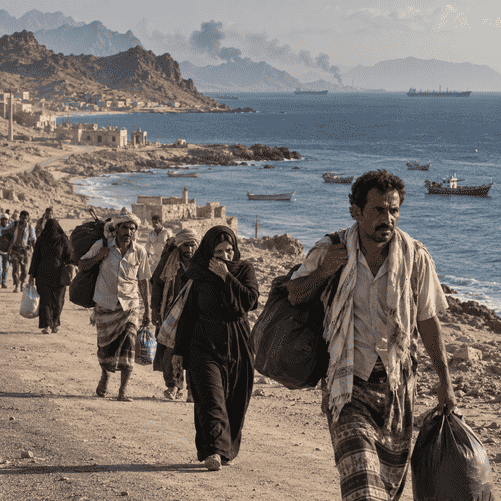
United Nations data indicated that more than 46,000 people had already been displaced by the latest escalation, with humanitarian officials warning that the number was continuing to rise as families abandoned communities threatened by fighting between the Iran-aligned Houthis and forces loyal to Yemen’s internationally recognised government.
The advance represents one of the most significant changes on Yemen’s battlefield in years.
Houthi fighters have captured a succession of strategic positions along the western coastline, including the historic port city of Mocha, before extending their reach toward islands controlling access to the Bab al-Mandab Strait, the narrow maritime passage connecting the Red Sea with the Gulf of Aden and, ultimately, the Indian Ocean.
The offensive has forced government troops to retreat from several areas and has effectively brought the Houthis to the edge of one of the world’s most strategically important shipping corridors.
For civilians caught between the opposing forces, however, the geopolitical significance of the coastline is secondary to an increasingly urgent struggle for survival.
Families have left villages and towns with limited belongings, while humanitarian organisations report growing demand for food, drinking water, healthcare and emergency shelter. Roads and communications have also been disrupted in some areas, complicating efforts by aid agencies to reach displaced communities.
The latest fighting threatens to dismantle the fragile period of relative calm that followed the UN-brokered truce of 2022, which significantly reduced large-scale hostilities even after its formal expiration.
A Battle for the Gate of the Red Sea
The strategic importance of the Houthi offensive lies primarily in geography.
The Bab al-Mandab — whose name is commonly translated as the “Gate of Tears” — is only about 18 miles wide at its narrowest point. Vessels passing through it connect the Indian Ocean and Gulf of Aden with the Red Sea, Suez Canal and Mediterranean, making the waterway one of the principal commercial links between Asia and Europe.
Roughly 7% of global petroleum flows and about 12% of international trade are associated with the route, according to recent assessments.
Control of territory overlooking the strait does not necessarily mean the Houthis can completely close the waterway. But possession of coastal territory and nearby islands dramatically increases their ability to monitor, threaten or attack vessels passing through it.
That capability is no longer theoretical.
Beginning in late 2023, the Houthis launched repeated missile and drone attacks against commercial shipping in the Red Sea, initially describing their campaign as an attempt to pressure Israel over the war in Gaza.
Shipping companies responded by diverting vessels around the Cape of Good Hope at the southern tip of Africa, adding thousands of kilometres to voyages between Europe and Asia.
Traffic through the Red Sea remains roughly 60% below pre-crisis levels, according to reporting on current shipping patterns.
The latest territorial gains therefore strengthen an existing Houthi capability rather than creating an entirely new threat.
But they also potentially give the movement a more secure physical presence around the shipping lanes it has already demonstrated an ability to disrupt.
Mocha and Mayun Shift the Strategic Balance
The fall of Mocha carries particular military and symbolic importance.
Once famous as an international centre of the coffee trade, the port sits close to the Bab al-Mandab and had remained under the control of forces aligned with Yemen’s internationally recognised government.
Its capture brought Houthi forces substantially closer to dominating Yemen’s southwestern coastline.
The subsequent seizure of Mayun Island, also known as Perim, intensified those concerns. The island sits directly inside the Bab al-Mandab, dividing the waterway into two channels and providing a strategically valuable position overlooking maritime traffic.
For Saudi Arabia and other regional powers, the timing is particularly sensitive.
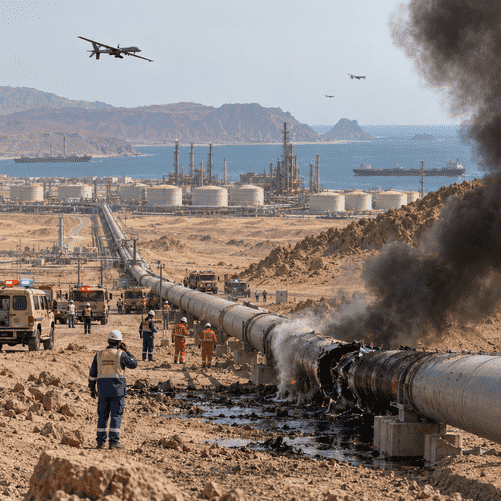
The Red Sea has become increasingly important as an alternative route for Saudi oil exports when passage through the Strait of Hormuz becomes difficult or dangerous.
Saudi crude can travel by pipeline from the country’s eastern oil-producing regions to the Red Sea port of Yanbu, allowing tankers to avoid Hormuz altogether.
But that alternative depends on ships being able to leave the Red Sea through Bab al-Mandab.
If both maritime chokepoints become threatened simultaneously, the global energy system faces a considerably more complicated problem.
Yemen Drawn Into a Wider Regional Struggle
The conflict can no longer be understood solely as a Yemeni civil war.
The Houthis remain closely aligned with Iran, while Saudi Arabia has historically backed the internationally recognised Yemeni government. The United Arab Emirates has also supported southern and anti-Houthi factions, although competing interests among Yemen’s external partners have repeatedly complicated efforts to build a unified military front.
The United States has meanwhile conducted repeated operations against Houthi military infrastructure in response to attacks on international shipping.
The growing importance of the Bab al-Mandab means that Yemen’s internal front lines are now increasingly shaped by a much larger competition involving Iran, Saudi Arabia, the United States and other regional powers.
Reuters reported that the latest Houthi advance has created a new strategic dilemma for Washington as the United States attempts to protect vital maritime routes without becoming drawn more deeply into another Middle Eastern conflict.
A major external military response could slow or reverse Houthi territorial gains, but it could also restart a cycle of escalation that devastated Yemen during the most intense years of its civil war.
That is precisely what humanitarian organisations fear.
Civilians Once Again Pay the Price
Yemen remains extraordinarily vulnerable to renewed warfare after more than a decade of conflict.
Years of airstrikes, ground fighting, economic collapse and political fragmentation have weakened healthcare services, damaged infrastructure and left millions dependent on international assistance.
Approximately half the country’s population is facing acute food insecurity, according to UN assessments cited in reporting on the renewed fighting.
Fresh displacement adds pressure to communities already struggling to accommodate people uprooted during earlier phases of the war.
The International Organization for Migration has warned that the humanitarian situation is changing rapidly, with the number of displaced people increasing as fighting moves through populated areas.
For many Yemenis, displacement is also not happening for the first time.
Families who previously fled earlier battles may once again be forced to move, often with little money and few possessions.
The danger is that a geographically limited offensive develops into a broader confrontation in which civilians become trapped between competing military coalitions and regional powers.
The Risk of a “Forever War”
The central question is whether the Houthi advance becomes a temporary military operation or the beginning of another prolonged phase of Yemen’s conflict.
The rebel movement already controls the capital, Sanaa, and much of Yemen’s heavily populated north. Its expansion along the Red Sea coast further strengthens its negotiating position and demonstrates the continuing weakness and fragmentation of its opponents.
Recovering the lost coastline would require government-aligned forces either to launch a major counteroffensive or to secure significant new external military assistance.
Either option risks expanding the conflict.
Yet allowing the Houthis to consolidate their gains could permanently alter the balance of power around Bab al-Mandab.
The result is an increasingly dangerous strategic trap.
Foreign governments have strong incentives to prevent one armed movement from dominating a maritime chokepoint crucial to global commerce. At the same time, years of experience in Yemen have demonstrated the enormous humanitarian and political costs associated with trying to defeat the Houthis militarily.
That contradiction could ensure that Yemen remains caught in conflict even when periods of relative calm emerge.
The country’s war has already survived shifting alliances, ceasefires, diplomatic negotiations and changing regional priorities.
Now the battle for the Red Sea is giving it another reason to continue.
For the nearly 50,000 Yemenis already driven from their homes, however, the immediate consequences are far less abstract. The contest for one of the world’s most valuable maritime corridors is once again being fought through their towns and villages — leaving ordinary civilians to carry the heaviest burden of a war that increasingly extends far beyond Yemen itself.