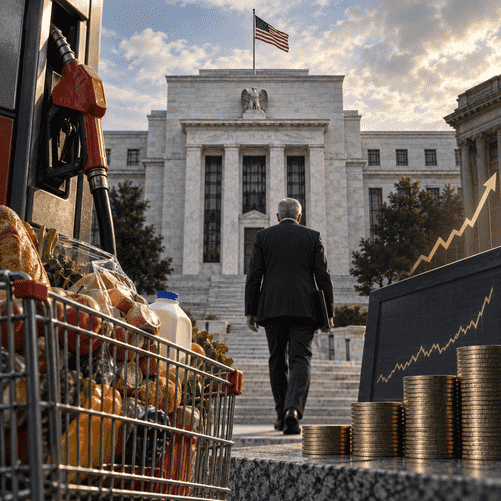
Consumer prices remained 3.4% higher than a year earlier in August, while firmer underlying inflation increased expectations that the Federal Reserve could tighten monetary policy at its September meeting.

U.S. inflation remained stubbornly elevated in August, reinforcing expectations that the Federal Reserve may soon raise interest rates as policymakers confront renewed price pressures and signs that inflation is proving more difficult to contain than previously hoped.
The annual consumer inflation rate stood at 3.4% in August, unchanged from July and in line with economists’ forecasts. On the surface, the lack of acceleration offered some reassurance that inflation had not deteriorated further. But the details of the report presented a less comfortable picture for the Federal Reserve, particularly after underlying prices recorded a stronger monthly increase.
Consumer prices rose 0.4% from July, the fastest monthly increase since May, compared with a much smaller 0.1% gain in the previous month. Energy costs were an important source of pressure, with elevated gasoline prices feeding directly into household expenses and indirectly into transportation and distribution costs across the economy.
More importantly for the Federal Reserve, core prices — which exclude the volatile food and energy categories — increased 0.3% during the month. The reading was strong enough to intensify concerns that inflationary pressure may be broadening beyond the immediate impact of higher energy costs.
The figures have placed additional pressure on a Federal Reserve already engaged in an increasingly difficult debate over the appropriate level of interest rates.
Inflation remains well above the central bank’s long-term 2% objective, leaving officials with the challenge of determining whether the latest price increases represent a temporary shock or the beginning of a more persistent inflationary cycle. The Fed formally targets inflation using the personal consumption expenditures price index rather than the consumer price index, but CPI figures remain an important indicator of the direction of household prices and underlying inflationary pressures.
Markets Prepare for Higher Rates
Financial markets responded to the inflation figures by increasing expectations that the Federal Reserve will tighten monetary policy at its forthcoming meeting.
Interest-rate futures indicated roughly an 85% probability of a quarter-percentage-point rate increase following the inflation report, according to market estimates cited by The Wall Street Journal. Other market measures showed the probability climbing even higher as investors digested the latest figures.
Such a move would represent an important change in the direction of U.S. monetary policy. A quarter-point increase alone would have a relatively modest immediate effect on the economy, but its broader significance would lie in the signal it sends: the Federal Reserve is once again prepared to tighten financial conditions if inflation fails to move convincingly toward its target.
Higher policy rates typically filter through to borrowing costs across the economy, affecting mortgages, credit cards, automobile loans and corporate financing. They can reduce demand and help limit price growth, but the same mechanism can also weaken investment, employment and economic activity if monetary policy becomes too restrictive.
That balancing act has become increasingly complicated.
Federal Reserve Chair Kevin Warsh has recently questioned whether financial conditions are sufficiently restrictive given the strength of the economy, while several policymakers have indicated that further tightening could become necessary if inflation does not show clearer evidence of declining.
Energy Complicates the Inflation Outlook
One of the biggest uncertainties facing policymakers is the effect of energy prices.
Higher oil and gasoline costs have contributed significantly to recent inflation. Energy shocks can initially appear temporary because commodity prices frequently fluctuate, but sustained increases can gradually spread throughout the wider economy.
Transportation companies face higher fuel bills. Manufacturers pay more to move components and finished goods. Retailers encounter higher distribution costs. Airlines, logistics companies and agricultural producers can all experience similar pressures.
Businesses must then decide how much of those costs they can absorb and how much they must pass on to consumers.
The danger for the Federal Reserve is that temporary price shocks could eventually influence broader expectations. If households begin to assume that inflation will remain elevated, workers may demand larger wage increases to preserve purchasing power. Companies, expecting higher future expenses, may become more willing to raise prices.
That process can make inflation significantly harder to eliminate.
Recent surveys have provided policymakers with another reason for caution. Short-term inflation expectations have risen sharply even as longer-term expectations remain comparatively more stable, suggesting that consumers remain concerned about immediate increases in the cost of living.
A Difficult Decision for the Fed
The August inflation report therefore leaves the Federal Reserve facing an uncomfortable choice.
Holding rates steady would give policymakers additional time to determine whether recent inflation pressures fade as energy markets stabilize. But delaying action also carries risks if inflation becomes more deeply embedded.
Raising rates would demonstrate the Fed’s determination to protect price stability, but tighter monetary policy could place additional pressure on households and businesses already facing elevated borrowing costs.
For investors, the immediate question is increasingly shifting away from whether the Federal Reserve will increase rates and toward what happens afterward.
A single quarter-point increase could be presented as an insurance move designed to prevent inflation from regaining momentum. A sequence of increases, however, would represent a much more substantial shift in the monetary-policy outlook and could have far-reaching consequences for equities, bonds, housing and the U.S. dollar.
The tone adopted by policymakers after the September meeting may therefore prove almost as important as the rate decision itself.
Inflation Is No Longer Moving Comfortably Lower
The broader message from the latest figures is that the path back toward price stability remains uncertain.
The fact that annual inflation remained unchanged at 3.4% rather than accelerating further provides some reassurance. Yet the renewed monthly increase, resilient underlying price pressures and persistent energy costs suggest that inflation is not retreating rapidly enough for policymakers to declare victory.
For the Federal Reserve, that distinction matters.
Central banks typically prefer to act before inflation expectations become entrenched rather than attempt to reverse them afterward. The experience of recent years has also left policymakers particularly sensitive to the risks of assuming too quickly that an inflationary episode will prove temporary.
The August report therefore strengthens the argument for another dose of monetary restraint.
Unless economic conditions change materially before policymakers meet, the United States appears increasingly likely to enter a new phase of monetary policy — one in which the Federal Reserve once again turns toward higher interest rates to prevent persistent inflation from becoming an even more difficult problem.