A new peer-reviewed study explores a personalized approach to wearable glucose sensing, combining short-term calibration with longer-term non-invasive monitoring.
A Nature Communications study pairs a conventional minimally invasive CGM with a metabolic-heat wearable for about two days, then removes the invasive sensor and relies on a patient-specific AI model—an intriguing prototype strategy that still falls short of today’s commercial CGM accuracy and needs broader validation.

A new route around the oldest problem in wearable glucose sensing
The promise of a truly non-invasive continuous glucose monitor is easy to understand and extraordinarily difficult to deliver. Existing continuous glucose monitors have transformed diabetes care, but the mainstream systems still obtain their signal from a sensor that crosses the skin and samples glucose in interstitial fluid. The new study, published on 28 September in Nature Communications, takes a different approach. Rather than asking one universal non-invasive model to work equally well for everyone, the researchers let each user’s non-invasive sensor learn from a conventional minimally invasive glucose monitor for roughly two days. After that training period, the minimally invasive component is removed and the personalized non-invasive system continues on its own.
That architecture matters because it reframes the central challenge. The study does not claim that researchers have discovered a single optical, thermal or biochemical signal that maps cleanly to blood glucose across the entire population. Instead, it starts from the opposite premise: the relationship between a person’s non-invasive physiological signals and their glucose level is strongly individual. The system therefore tries to learn that relationship for each user separately. The paper calls the strategy “Adaptive Non-invasive CGM,” and the authors report a mean absolute relative difference, or MARD, of about 15.6 percent in a five-day test, with “reasonable accuracy” persisting in interval testing more than two months later at a MARD of about 23.9 percent.
Those numbers are not a declaration that the needle-free glucose problem has been solved. A lower MARD is generally better, and mature commercial CGM systems tested in clinical studies can achieve single-digit to low-double-digit MARD values under appropriate conditions. The prototype’s accuracy therefore remains behind the performance users and clinicians expect from established invasive or minimally invasive products, particularly after the longer interval. But the work is significant for another reason: it demonstrates a plausible engineering strategy for turning a weak, person-dependent non-invasive signal into something more useful by using a trusted sensor temporarily as a teacher.
What the researchers actually built
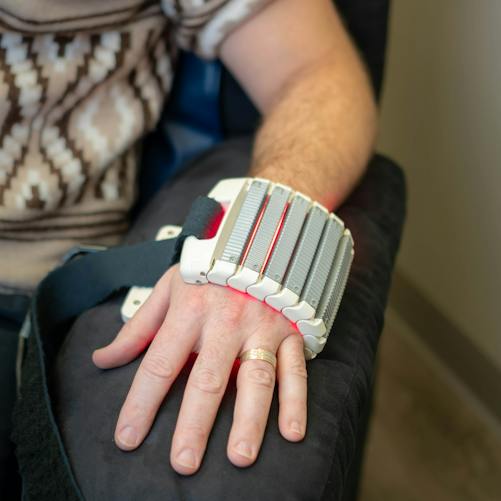
The system described by Chuanjie Yao, Lukang Gao, Xinze Wang and colleagues combines two measurement paths. The first is a short-term minimally invasive CGM module that measures glucose in interstitial fluid. That component functions as the temporary reference stream. The second is a long-term non-invasive module based on metabolic heat conformation, a class of techniques that attempts to infer glucose-related metabolic changes from combinations of physiological variables associated with heat production and heat transfer. The exact task of the software is not to replace a laboratory assay directly. It is to learn how the non-invasive signals collected from one person correspond to the glucose trajectory reported by the reference CGM during the calibration period.
For about two days, both systems operate together. A gated recurrent unit, or GRU, neural network is trained on the paired streams. GRUs are a form of recurrent neural network designed for sequential data. They can retain information about what happened previously in a time series and use that context when estimating the next value, which makes them a natural candidate for physiological signals that evolve continuously rather than as isolated measurements. At the end of the training interval, the invasive reference sensor is no longer required by the proposed workflow. The non-invasive device and the user-specific model become the monitoring system.
This is a subtle but important distinction from the familiar idea of calibrating a sensor with one or two finger-stick measurements. The study’s method uses a dense time series over an extended training window. In effect, the reference CGM supplies many examples of how one particular body behaves across meals, activity, rest and ordinary fluctuations. The AI model can then fit a mapping that would be difficult to derive from a small number of manual calibration points. The authors’ core hypothesis is that personalization can compensate for part of the physiological variability that has repeatedly undermined universal non-invasive glucose algorithms.
Why a universal non-invasive glucose monitor is so hard
Glucose is not an isolated signal waiting to be read from the surface of the skin. Any non-invasive method has to work through layers of biology and physics. Skin temperature changes with ambient conditions and blood flow. Heat loss depends on local perfusion, sweating, tissue composition and contact with the environment. Optical signals are affected by pigmentation, hydration, tissue thickness, movement and the geometry of the measurement site. Cardiovascular variables change with posture, stress, exercise, caffeine and medication. Even the timing between glucose in blood and glucose in interstitial fluid can introduce a lag when concentrations are changing rapidly.
These sources of variation are not merely electronic noise. Many are real physiological differences between people, or even within the same person at different times. A model trained to infer glucose from temperature, perfusion or other indirect signals may perform well in one individual and poorly in another because the relationship among those signals is not constant across a population. That is why the paper’s personalization strategy is more than a software flourish. It is an attempt to align the model with the biology instead of forcing the biology into a universal calibration curve.
The difficulty is compounded by the clinical stakes. A fitness tracker can tolerate a modest error in estimated calories or sleep staging without immediate danger. Glucose is different. People may use CGM readings to guide food intake, exercise, insulin dosing or responses to suspected hypoglycemia. Errors can have consequences, especially at the low end of the glucose range or during rapid changes. Any non-invasive system intended for medical decision-making therefore has to do more than produce a plausible trend line. It must demonstrate accuracy, reliability, stability across conditions, alarm performance and safe behavior when the signal becomes uncertain.
Metabolic heat conformation: an indirect window into glucose metabolism
The non-invasive module in the new study is based on metabolic heat conformation, or MHC. The general idea is not new. Earlier work explored whether the heat generated and dissipated by the body could provide information related to glucose metabolism. Because glucose metabolism contributes to cellular energy production, investigators have tried to combine thermal measurements with other physiological signals to estimate glucose concentration without drawing blood or placing a sensing filament under the skin. The challenge has always been separating the glucose-related component from the many other processes that influence heat production and circulation.
That history helps explain why the new paper’s contribution is primarily architectural. The authors are not presenting metabolic heat as a perfectly specific glucose signal. Instead, they treat it as a rich but ambiguous set of measurements whose meaning can be sharpened when the system observes the same individual alongside a more direct reference. In machine-learning terms, the reference CGM provides labels; the non-invasive sensor provides features; and the GRU learns a person-specific function between them. The novelty lies in making temporary invasiveness part of the commissioning process for a device that is intended to become non-invasive after training.
This hybrid philosophy may be more realistic than the expectation that a consumer could open a box, strap on a device and immediately obtain medical-grade glucose values without any individual calibration. It accepts a small upfront burden in exchange for the possibility of reducing long-term skin penetration. For some users, especially those who dislike repeated sensor insertions, that trade could be attractive if the accuracy, durability and ease of retraining were ultimately good enough. But the study is still a research demonstration, not evidence that such a product is ready for routine use.
What MARD tells us—and what it does not
MARD is one of the most common summary metrics for continuous glucose monitor accuracy. It is calculated by taking the absolute relative difference between a sensor reading and a reference value across matched pairs and averaging those differences. A MARD of 15.6 percent does not mean every reading is wrong by exactly 15.6 percent, and it does not describe the worst errors. It compresses a distribution of errors into one number. Two systems with the same overall MARD can still behave very differently during hypoglycemia, during rapid glucose changes or from one sensor session to another.
For that reason, the new result should be read as a useful performance signal rather than a clinical verdict. The five-day figure suggests that the personalized non-invasive model can track glucose with a degree of quantitative agreement after the training phase. The longer-interval figure of about 23.9 percent shows that some learned relationship can remain detectable after more than two months, but it also shows substantial degradation. That gap is arguably one of the most important findings in the paper: personalization helps, yet the mapping is not perfectly stable over time.
There are many plausible reasons a personalized model could drift. Seasonal temperature, changes in body composition, hydration, cardiovascular fitness, medications, sensor placement, skin condition, illness or changes in daily routine could alter the physiology observed by a non-invasive device. Even if the sensor electronics remain stable, the person being measured is not a fixed system. A deployable product would therefore need an explicit strategy for detecting model drift and deciding when retraining is necessary. It would also need to communicate uncertainty to the user rather than silently producing confident-looking numbers from stale calibration.
Why personalization may be the most important part of the study
Personalized algorithms are becoming more common across digital health because biological data are heterogeneous by default. A model that performs well on an average population can hide significant individual errors. The new glucose study makes that problem central rather than peripheral. Instead of treating person-to-person differences as residual noise, it builds a workflow around them. The temporary reference period creates a private calibration set that is unique to the user, and the final model is effectively a sensor built in software for that person.
This concept has implications beyond glucose. Many wearable measurements are indirect: cuffless blood-pressure estimates, hydration metrics, stress scores, respiratory indicators and metabolic measurements all depend on proxies that vary between individuals. A short period of paired training against a trusted reference could become a general pattern for making wearable sensors more useful. The reference might be invasive, cumbersome or expensive, but only required briefly. The wearable could then take over for longer-term monitoring with periodic revalidation.
The attraction is obvious, but so are the engineering risks. Personalization can overfit. A model may learn the circumstances present during a two-day calibration window and struggle when the user later experiences different meals, exercise patterns, sleep schedules or environmental temperatures. A personalized model also complicates quality control: manufacturers can no longer validate only one global algorithm because performance may depend on how each individual model is trained. Regulators and clinicians would need confidence not only in the hardware, but also in the training procedure, drift detection, software updates and rules that trigger recalibration.
The AI layer is useful precisely because the physiology is messy
The use of a GRU-based model is easy to describe as an “AI breakthrough,” but that phrase can obscure the real contribution. The network is not discovering glucose in a magical way. It is acting as a flexible statistical mapper between two time-dependent signal sets. Its value comes from the fact that the relationship is nonlinear, context-dependent and temporally structured. A sequential model can use recent history to distinguish a transient fluctuation from a sustained trend and can learn patterns that a simple static regression might miss.
At the same time, the presence of AI does not reduce the need for measurement science. A model cannot recover information that is absent from the sensor signals, and it can amplify biases or correlations that happen to appear during training. If the non-invasive signals change for reasons unrelated to glucose, the algorithm may still interpret them through the lens of what it learned earlier. Robust systems will therefore need redundancy, signal-quality checks and fail-safe behavior when the physiological inputs move outside the range represented in the calibration period.
This is one reason medical AI is often most valuable when it is paired with a well-defined sensing architecture rather than deployed as a free-standing predictor. In the new study, the algorithm has a narrow job: learn one person’s mapping from non-invasive physiological data to a reference glucose stream. That constrained purpose is more credible than claiming that a general model can infer glucose from arbitrary wearable signals across everyone. The research question becomes testable: how accurately can that learned mapping persist, under which conditions, and for how long before it needs to be refreshed?
A prototype result is not a product claim
The paper was peer reviewed and published in Nature Communications, which gives the work more weight than a company demonstration or an unreviewed prototype announcement. The journal page reports that the manuscript was received in August 2025, accepted in June 2026 and published on 28 September 2026. The authors list support from several Chinese national and regional research programs and state that they have no competing interests. Those details are relevant because the non-invasive glucose field has a long history of bold commercial promises that did not survive rigorous validation.
Peer review, however, is not the same as regulatory authorization, and a published accuracy number is not enough to establish safety for treatment decisions. A future clinical device would need prospective studies designed around intended use, with enough participants to test performance across age groups, skin characteristics, diabetes types, therapies, environmental conditions and the full clinically relevant glucose range. Investigators would also need to quantify the frequency and magnitude of outliers, not just the average error.
The low-glucose range deserves particular attention. Relative-error metrics can become difficult to interpret when the reference value is small, and hypoglycemia is precisely where missed or false readings can matter most. Modern CGM evaluations therefore typically include several complementary measures, including percentages of readings that fall within specified absolute or relative differences from a reference method and error-grid analyses that estimate the potential clinical consequence of inaccuracies. Any non-invasive system intended to influence insulin dosing would need similarly detailed evidence.
How the result compares with established CGM
The U.S. Food and Drug Administration describes conventional CGM as a system in which a subcutaneous sensor measures glucose in interstitial fluid and sends a continuous stream of information to a receiver or mobile device. That architecture is already mature enough to support real-world diabetes management, including alarms and integration with insulin-delivery systems. In other words, the benchmark for a new non-invasive approach is not the finger-stick meter of decades ago. It is an ecosystem of increasingly accurate, small and automated sensors that people already use continuously.
Published studies of current subcutaneous CGM devices frequently report MARD values around 10 percent or lower in controlled evaluations, although accuracy varies by device, population, glucose range and conditions of use. Research in hospitalized patients also shows that performance can worsen under difficult physiological conditions. These observations cut both ways for the new technology. They show that a 15.6 percent MARD still leaves a meaningful accuracy gap, but they also show that no sensor is perfect and that personalization may have value even for established systems when conditions or individual physiology create systematic error.
The most defensible interpretation is therefore not that the new device beats existing CGM. It does not, based on the reported summary figures. The more interesting point is that it may offer a path to reduce the duration of skin penetration if a short invasive training period can support a much longer non-invasive phase. That trade would be meaningful only if later studies can close the accuracy gap and demonstrate that the personalized model remains reliable between recalibrations.
The long-term drift problem may decide whether the concept succeeds
The difference between the five-day performance and the more than two-month interval result should be treated as a research target rather than a footnote. If the non-invasive model is accurate shortly after calibration but degrades substantially with time, a practical device would need to answer three questions. First, how often must it be retrained? Second, can the system detect the need for retraining before its readings become unsafe? Third, does retraining require another invasive sensor, or can occasional finger-stick or laboratory measurements restore accuracy?
Those questions determine whether the approach would actually reduce burden. If users needed a conventional CGM for two days every few weeks, the benefit might be limited. If a two-day training period supported months of dependable monitoring, the proposition would look very different. The current paper shows persistence of a personalized relationship over a long interval, but the reported MARD of roughly 23.9 percent indicates that the relationship is not yet stable enough to assume medical-grade performance over that timescale.
A future system could potentially use self-monitoring to manage drift. For example, the device might track whether its physiological inputs remain within the range seen during training, flag abrupt changes in signal relationships, or request a reference measurement when confidence falls. Those mechanisms are not substitutes for clinical validation, but they illustrate how the hardware and software could evolve together. In a personalized sensor, uncertainty estimation may be as important as the headline glucose estimate.
What broader wearable technology can learn from the approach
The study arrives as wearables are moving from step counts and heart rate toward biochemical and clinically meaningful measurements. That transition is forcing developers to confront a basic truth: many desirable health variables are easier to estimate indirectly than to measure directly without penetrating the body. The more indirect the signal, the more vulnerable it is to confounding. Personalization is one way to recover useful information, especially when a short reference period can teach the device how a specific person differs from the population average.
This pattern resembles transfer learning in machine learning. A general sensing architecture supplies the starting point, while a small amount of user-specific data adapts the model to the individual. The new glucose system goes further by making that adaptation an explicit part of the device workflow. If the concept proves robust, it could influence how companies design non-invasive blood-pressure, hydration, lactate, stress and metabolic monitors. Instead of advertising “calibration-free” as an absolute virtue, future products may distinguish between burdensome repeated calibration and a short onboarding phase that materially improves long-term accuracy.
There is also a data-governance dimension. A patient-specific model is built from intimate physiological time series. Manufacturers would need to decide where training occurs, how the resulting model is stored, whether raw calibration data leave the device, and how model updates are audited. Local or on-device training could reduce privacy exposure, but it can also make troubleshooting and post-market surveillance more complex. These questions are manageable, yet they must be designed into the system rather than added after clinical deployment.
What scientists need to show next
The next stage is not a more dramatic demo; it is broader and harsher validation. Researchers need to test whether the adaptive approach works across a large and diverse population, including people with different forms of diabetes and different treatment regimens. Studies should intentionally include daily-life conditions that disrupt non-invasive sensing: exercise, sleep, temperature swings, sweating, dehydration, illness, rapid glucose excursions and changes in sensor placement. The system should be evaluated not only immediately after calibration but repeatedly over the period in which the authors expect the personalized model to remain valid.
Researchers will also need to compare different retraining strategies. A two-day conventional CGM period is a clear starting point, but it may not be the optimal one. Perhaps a shorter interval is sufficient for some users and longer training helps others. Perhaps the system can maintain accuracy with occasional reference checks rather than another full CGM session. The answer will affect cost, convenience and adoption. An adaptive device should ideally know when it has learned enough and when it no longer trusts what it learned.
Finally, the clinical purpose must be specified. A non-invasive monitor that reliably shows broad glucose trends for wellness has a different safety threshold from one intended to warn of hypoglycemia or guide insulin dosing. The current work is most persuasive as a platform concept for personalized sensing. Translating it into a medical device will require matching performance claims to clearly defined uses and proving safety for each one.
The human-factors test will be as important as the sensor test
Accuracy is only one part of whether an adaptive monitor would work in everyday life. The onboarding process has to be simple enough that users perform it correctly. A two-day calibration period sounds modest in a laboratory, but a commercial workflow would have to explain when training begins, whether the reference CGM and non-invasive wearable must remain on the same body sites, what happens if either device loses data, and whether meals or exercise should be logged. If the model is trained on incomplete or poor-quality reference data, the user may never know that the personalized sensor started from a weak foundation.
The interface would also need to distinguish a sensor reading from the system’s confidence in that reading. Consumer electronics often hide uncertainty because a single number is easier to understand. Medical monitoring sometimes requires the opposite. If the model encounters a physiological state it has not seen before, the safest behavior may be to warn that the estimate is unreliable and request confirmation. That kind of friction can feel inconvenient, but it is preferable to a smooth interface that masks uncertainty behind a precise-looking glucose value.
Wear comfort will matter too. The whole rationale for a non-invasive phase is to reduce skin penetration and repeated insertion, so the remaining hardware has to be comfortable enough for long-duration use. Thermal and cardiovascular measurements can be sensitive to contact pressure and placement, which creates a design tension between comfort and signal quality. A laboratory prototype can tolerate careful positioning by researchers; a consumer device must tolerate ordinary movement, loose straps, sweat, sleep and the small mistakes people make every day.
The economics depend on how often the system must be retrained
The proposed architecture also changes the cost equation. A conventional CGM incurs recurring sensor costs because the sensing element is replaced periodically. An adaptive non-invasive system could theoretically shift some of that recurring expense toward a reusable wearable, but only if the invasive training phase is infrequent. If the personalized model must be refreshed every few weeks, users would still consume conventional sensors regularly and would also need the additional non-invasive hardware. If retraining is required only a few times a year, the economics could become much more attractive.
That is why the long-term interval result deserves close attention even though its accuracy is weaker. It suggests that the individualized mapping retains information over a period measured in months rather than days. The central development challenge is to preserve more of the short-term accuracy across that interval. Improvements could come from better sensing hardware, richer physiological inputs, stronger sequence models, controlled recalibration or algorithms that adapt cautiously over time without losing their original reference.
Health systems and insurers would likely judge such a device on outcomes rather than novelty. A non-invasive monitor would need to show that it improves adherence, expands access, reduces complications or lowers total cost while maintaining acceptable safety. The appeal of a needle-free or mostly needle-free experience is substantial, but reimbursement decisions generally depend on evidence that the new workflow delivers measurable clinical value. In that sense, the technology’s eventual success will be determined as much by longitudinal trials and usability as by the elegance of its machine-learning architecture.
Why this matters now
The technology industry has spent years searching for a painless way to monitor glucose continuously, because glucose sits at the intersection of chronic disease management, preventive health and consumer wearables. The difficulty has tempted some companies to oversell weak correlations or to imply that software can substitute for a physically specific measurement. The new study is more interesting because it does not pretend the biological variability has disappeared. It makes that variability the problem the system is designed to learn.
That makes the result both encouraging and appropriately limited. The demonstrated five-day accuracy is not competitive enough to displace the best current CGMs, and the longer-term decline shows that personalization is not permanent. Yet the study provides evidence that a short period of trusted, minimally invasive data can train a non-invasive sensor to follow an individual’s glucose dynamics after the reference device is removed. If subsequent work can improve accuracy, identify drift early and extend the useful interval between retraining sessions, the approach could offer a practical middle ground between fully invasive sensing and the elusive dream of instant, universal, calibration-free glucose measurement.
For now, the important word is “adaptive.” The prototype does not eliminate the need for a reference sensor; it concentrates that need into a short training phase. It does not prove a consumer-ready needle-free CGM; it demonstrates a personalized pathway worth testing. In a field where sweeping claims have often run ahead of evidence, that distinction is not a weakness. It is the reason the research deserves attention.
Verified sources
Primary study: Chuanjie Yao, Lukang Gao, Xinze Wang and colleagues, “Adaptive personalization for wearable non-invasive continuous glucose sensors,” Nature Communications, published 28 September 2026. Nature Communications article and DOI record.
Regulatory background on how conventional continuous glucose monitors measure interstitial glucose: U.S. Food and Drug Administration, “What is the pancreas? What is an artificial pancreas device system?”.
Context on CGM accuracy metrics and individual variation: American Diabetes Association publications including “Perceptions of Continuous Glucose Monitoring Systems in the T1D Exchange Diabetes Registry” and “Real-world Accuracy of CGM in Inpatient Critical and Noncritical Care Settings at a Safety-Net Hospital.”
Historical background on metabolic heat conformation as a non-invasive glucose approach: “Noninvasive measurement of glucose by metabolic heat conformation method,” indexed by PubMed.