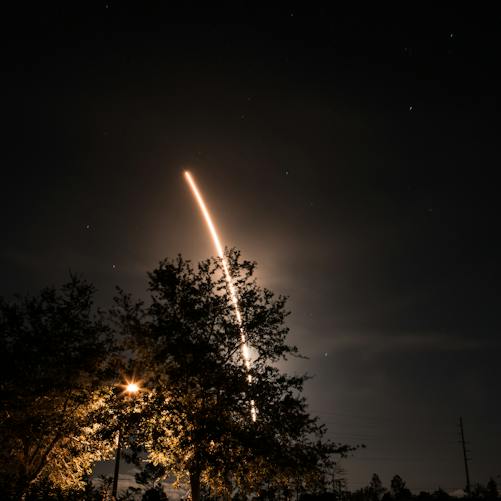
Kyiv says its domestically developed tactical ballistic missile has been used in combat for the first time, underscoring a push to reduce dependence on scarce Western long-range munitions while striking deeper into Russian military infrastructure.

Ukraine has entered another stage of its effort to build a domestic long-range strike arsenal. President Volodymyr Zelenskiy said on October 1 that the country had used its FP-7 tactical ballistic missile in combat for the first time, according to Reuters. Kyiv did not disclose the target or launch location, leaving the operational result unverified in public reporting, but the announcement is significant because it points to a weapon Ukraine hopes can fill a persistent gap between short-range battlefield systems and scarce Western-supplied precision missiles.
The FP-7 is being developed by Ukrainian defence company Fire Point and is reported to have a range of about 200 kilometres. That places it in a category useful for striking command posts, logistics hubs, missile launch sites and other military targets behind the front. The system is also intended to be cheaper and easier to procure than imported missiles such as ATACMS, whose availability has been constrained by Western stockpiles and competing demand.
Domestic production is becoming a strategic requirement
Ukraine’s dependence on foreign munitions has shaped the war since Russia’s full-scale invasion in 2022. Western weapons have provided capabilities Kyiv could not quickly manufacture on its own, but every imported system comes with limits: production rates, political approval, export restrictions and the stockpile needs of the donor country. Long-range precision missiles are among the most sensitive categories because they are expensive, technically complex and limited in number.
The FP-7 programme is part of a broader Ukrainian effort to shift that equation. Domestic development does not remove the need for Western support, but it can give Kyiv more control over production, targeting policy and replenishment. A locally built missile can be adapted to Ukrainian operational requirements without waiting for the procurement cycle of another government, and the supply chain can theoretically be expanded inside the country or with partner firms.
That autonomy matters most when the tempo of combat is high. Long-range weapons can be consumed faster than factories replace them. The United States and European countries have all confronted production constraints in missiles, air-defence interceptors and artillery ammunition. Ukraine’s answer has increasingly been to build its own drones, cruise missiles and now ballistic systems alongside imported weapons.
A 200-kilometre weapon changes more than the map
Range is often treated as the defining characteristic of a missile, but military value depends on more than distance. Accuracy, survivability, launch preparation, warhead size, guidance resilience and production volume all determine whether a system can affect the battlefield. A 200-kilometre range can still be strategically useful if a missile is available in sufficient numbers and can reliably strike high-value targets.
For Russia, a domestically produced Ukrainian ballistic missile adds another layer to the problem of protecting rear-area infrastructure. Airfields, logistics nodes and missile units already face pressure from Ukrainian drones and other stand-off weapons. A faster ballistic trajectory can complicate interception and reduce warning time, although the actual performance of the FP-7 has not been publicly demonstrated in enough detail to judge how difficult it will be to stop.
For Ukraine, the system offers another option for attacking the support architecture behind Russian operations. The front line is sustained by depots, transport routes, headquarters and launch sites distributed across occupied territory and parts of western Russia. The ability to threaten those points forces an opponent to disperse, harden or relocate assets, all of which carry costs even when no strike occurs.
The announcement comes amid a broader missile-production race
Russia has expanded missile and drone production during the war, while Ukraine and its allies have raced to increase air-defence capacity and long-range strike output. This is turning the conflict into an industrial contest as much as a battlefield one. The country that can sustain the flow of precision weapons, interceptors and drones gains leverage not only through individual strikes but through the ability to maintain pressure over months.
Ukraine has faced a particularly difficult asymmetry because Russia possesses a larger industrial base and can draw on external suppliers. Kyiv has responded by accelerating domestic production of relatively inexpensive systems and by trying to turn innovation cycles measured in months rather than years into a wartime advantage. The FP-7 fits that pattern: a weapon designed for a specific operational need, developed under pressure and fielded before Ukraine has the industrial depth of a major missile power.
The approach carries risk. Rapid development can expose reliability problems, and scaling production from small batches to sustained output is difficult. Components must be sourced, guidance systems must remain resistant to electronic warfare, and launchers must survive Russian reconnaissance. A successful first combat use does not answer those questions; it simply establishes that the programme has moved from development into operations.
Western missile shortages have changed Kyiv’s calculations
The war has exposed how slowly many advanced munitions were produced before 2022. Western defence companies designed production lines for peacetime demand, not continuous large-scale conflict. Increasing output requires new machinery, suppliers, trained workers and long-term orders. Even when governments commit billions, factories cannot instantly create missiles.
That constraint has been especially visible in air defence and long-range strike systems. Ukraine has repeatedly asked partners for more interceptors and precision weapons, while donor governments balance those requests against their own readiness requirements. A Ukrainian-produced tactical ballistic missile therefore has political value as well as military value: it reduces the number of missions that depend on a foreign government deciding whether to release another limited weapon.
The FP-7 does not replace Western systems. Different weapons carry different warheads, guidance packages and operational ranges. But a domestic missile can absorb missions that would otherwise consume imported stock. If Ukraine can manufacture it in meaningful numbers, the effect could be to reserve more expensive Western weapons for targets that require their particular capabilities.
Fire Point is also looking beyond the FP-7
Reuters reported that Fire Point is also developing a longer-range FP-9 missile, with the company aiming for further progress by the end of the year. The existence of a follow-on system suggests the FP-7 is not an isolated project but part of a broader attempt to establish a domestic missile family.
That matters because a sustainable weapons programme requires more than one successful design. It needs propulsion expertise, guidance engineering, production tooling, testing infrastructure and a network of suppliers that can survive wartime disruption. Each new missile can reuse part of that industrial base, allowing the programme to improve more quickly than if every design began from zero.
Ukraine has already demonstrated a similar learning cycle in unmanned systems. Drone designs evolved rapidly as both sides developed countermeasures. Missile development is more difficult, but the same wartime pressure encourages iteration. The FP-7’s operational use will now generate data that can feed back into guidance, launch procedures and manufacturing.
Russia will adapt if the system becomes a recurring threat
Any new weapon has its greatest effect before an opponent understands it. Once Russia collects debris, radar tracks and strike patterns, it will try to identify the FP-7’s signatures and vulnerabilities. Air-defence positions can be adjusted, likely launch areas watched more closely and likely targets hardened or dispersed.
That adaptation is one reason volume matters. A small number of missiles can surprise an opponent; a larger inventory can force persistent changes in behaviour. If the FP-7 becomes common enough that Russian commanders must assume rear-area facilities are within reach, the weapon’s value will extend beyond direct damage. It can shape basing decisions and logistics planning even on days when no missile is fired.
Ukraine, in turn, will need to protect launchers and production facilities from Russian strikes. Moscow has repeatedly targeted Ukraine’s defence industry and energy infrastructure. The more important the FP-7 becomes, the greater the incentive to attack the factories, storage sites and supply chains supporting it.
The first combat use is a milestone, not yet a verdict
The public evidence surrounding the FP-7 remains limited. Kyiv has not identified the target, released a detailed battle-damage assessment or provided independent confirmation of the strike’s effect. Those gaps are normal for a weapon entering service during an active war, but they mean claims about accuracy or battlefield impact should remain cautious.
The strategic significance is clearer. Ukraine is trying to reduce one of its biggest vulnerabilities: dependence on allies for the weapons that can reach beyond the immediate front. The first combat deployment of a domestic tactical ballistic missile shows that this effort has progressed from ambition to at least one operational use.
If production scales, the FP-7 could become part of a layered Ukrainian strike network that includes drones, cruise missiles and Western systems. That would complicate Russian defence planning and give Kyiv more flexibility in selecting targets. If production remains limited or the missile proves unreliable, its impact will be narrower.
A new industrial front is taking shape behind the battlefield
The broader lesson is that the war is increasingly being decided by manufacturing capacity as well as tactical innovation. Russia is expanding missile and drone output. The United States and Europe are rebuilding munitions lines. Ukraine is trying to create a domestic arsenal while under attack.
The FP-7 sits at the intersection of those trends. It is a weapon, but also a test of whether Ukraine can build complex long-range systems in sufficient numbers to matter. The answer will depend on production, reliability and survivability more than on a single launch.
For now, the first combat use marks a threshold. Kyiv has shown that its domestic missile programme has reached the battlefield. The next question is whether that milestone becomes a sustained capability — one able to influence Russian logistics, reduce pressure on Western stockpiles and reshape the long-range balance of a war that is increasingly fought far beyond the front line.