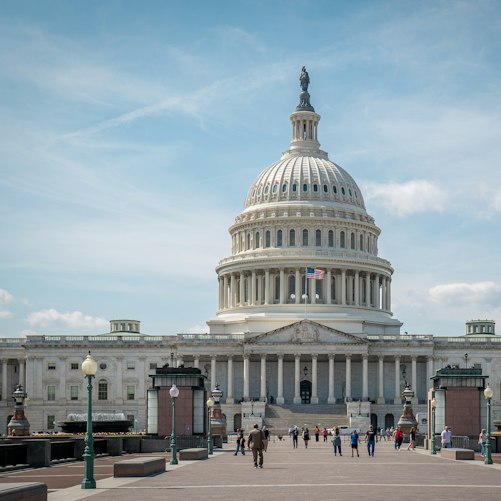
Reuters and the Associated Press report Democratic victories in both chambers of Congress. The outcome points to divided government from January, with new pressure on presidential appointments and legislation while individual election counts and certification continue.

Democrats were projected to win control of both the US House of Representatives and the Senate in the 3 November midterm elections, according to Reuters and the Associated Press, in reporting checked at 08:36 UTC on 4 November. The calls point to divided government for President Donald Trump’s final two years in office. They are news organisations’ assessments of the results, with official canvassing and certification still to follow.
The AP reported that high prices, the war in Iran and concerns about government corruption featured prominently in voters’ frustrations. Its account described Democratic gains reaching into states that had backed Trump strongly in 2024. The election has changed the expected balance in Washington while leaving the separate task of finalising each contest with election authorities.
Democratic gains reach beyond the usual battlegrounds
In its election takeaways, Reuters reported that James Talarico defeated Ken Paxton in Texas, Sherrod Brown won in Ohio, and Adam Hamilton beat Republican incumbent Roger Marshall in Kansas. It also reported a Democratic Senate victory in South Carolina. Those outcomes give the party a geographically broader set of gains than a result confined to closely divided states.
Reuters also reported that Texas voters removed Republican Governor Greg Abbott. That state result is separate from control of Congress, but it adds to the scale of the Republican losses. The congressional calls establish the central political outcome of the night without requiring every district or state to have completed its count.
Senate control changes the appointments contest
One direct consequence concerns presidential nominations. The Senate’s explanation of its constitutional role sets out its authority to confirm federal judges and specified senior executive officials. The president chooses nominees, but appointments covered by that process require Senate consent. That includes Supreme Court nominations if a vacancy arises, as well as many administration positions.
A Democratic majority would therefore give the opposition a stronger institutional position when considering future appointments. It would not itself create a judicial vacancy or remove an already confirmed official. The immediate change is in the political composition of the chamber that can approve, reject or leave nominations without action. The practical consequences will depend on which nominations reach the new Senate.
Oversight gains a different political direction
Congressional scrutiny is another significant part of the transition. The US Capitol Visitor Center’s account of the separation of powers explains that Congress investigates government activity, potential misuse of federal funds and abuses of power. Those inquiries also provide information for legislation and public debate. The powers belong to Congress regardless of which party holds a majority.
Their use can change sharply when control changes. New majorities can pursue different questions and give different subjects sustained attention. For the administration, that creates the prospect of a more challenging relationship with lawmakers. An investigation, however, is a process for establishing facts; the election result alone establishes no finding about any particular allegation or individual.
The president retains a veto and legislation still requires votes
Divided government also means negotiation over legislation. As the House’s guide to lawmaking explains, proposals pass through committees and both chambers before reaching the president. Differences between House and Senate versions must be resolved. Winning congressional majorities gives Democrats a stronger role in that process, but does not automatically turn campaign proposals into law.
The president retains the power to veto legislation. Congress can override a veto only with the constitutionally required two-thirds support in both chambers, as the Capitol’s legislative guide explains. Consequently, a majority large enough to organise a chamber is not necessarily a majority capable of overcoming presidential opposition. The eventual size of each party’s delegation will help determine the scope for agreements.
Senate procedure imposes a further distinction. The Senate’s voting guide notes that ending debate on ordinary legislation generally requires three-fifths of senators duly chosen and sworn. That threshold is separate from the final passage vote. Under the rules described by the Senate, control of the chamber and an ability to advance every legislative priority are different questions.
The transfer takes effect in January
The new congressional terms begin at noon on 3 January 2027 under the Twentieth Amendment. The election therefore changes the expected composition of the next Congress, rather than immediately replacing the lawmakers now serving. There remains an interval in which the outgoing Congress continues to hold office.
That timing separates the political reaction to Tuesday’s vote from the formal exercise of new congressional authority. Decisions about priorities, appointments and legislation will take place through the institutions once the incoming members assume their terms. Specific policy outcomes remain to be negotiated; a change in party control does not settle them in advance.
Media calls and official results serve different purposes
The US Election Assistance Commission stresses that election-night results remain unofficial even when a reporting system shows every precinct counted. During the canvass, officials check and reconcile election data and include all valid ballots. Certification records the authorities’ formal determination that the results accurately account for the votes.
Those steps have their own timetables, which vary between jurisdictions. A news organisation can call a race once it considers the outcome clear, while election officials continue their statutory work. Both processes can therefore be underway at the same time. The political development reported on Wednesday morning is the projected change in congressional control; final totals and official certification belong to the continuing election process.
Sources
Democrats seize Congress in sweeping midterm repudiation of Trump; Reuters report syndicated by Investing.com; Democrats win the US House and Senate as voters deliver a strong rebuke to Trump and Republicans; Top takeaways from the US midterm elections; U.S. Senate: About Nominations; Congress and the Separation of Powers; The Legislative Process; Making Laws; U.S. Senate: About Voting; The Constitution: Amendments 11–27, Twentieth Amendment; Election Results, Canvass, and Certification; 2026 US midterms: Full live results and maps.