European ministers have backed work towards signing a long-delayed association agreement with Syria while preparing a modernised pact. The initiative offers a framework for closer ties, but damaged services, pressure on returning families and demands for an inclusive transition will shape what it can deliver.

European Union foreign ministers agreed on Monday to advance work towards signing the EU–Syria Association Agreement, reviving a text negotiated in 2008 as Damascus seeks deeper international engagement. The decision moves the relationship into a new diplomatic phase, with European governments linking closer cooperation to progress on Syria’s political transition, economic recovery and respect for rights.
The agreement has not yet been signed or brought into force. Technical and legal preparations remain, and ministers also intend to pursue a modernised version. That distinction matters for businesses, aid organisations and Syrians considering a return home: Monday’s political backing creates a direction for future cooperation, while practical improvements will depend on subsequent decisions and conditions inside the country.
An older agreement, with a second negotiation to follow
EU foreign policy chief Kaja Kallas described a two-track approach after the Brussels meeting. Officials will prepare the existing agreement for signature, while the Council works towards a fresh mandate to negotiate updated provisions. The intended framework covers trade, political dialogue and broader cooperation between the EU and Syria.
Kallas said ministers wanted the newer agreement to address issues that were absent or different when the original text was negotiated. These include clearer human-rights conditions and questions concerning Syrian positions on occupied Ukrainian and Georgian territories. She presented the preparation of the existing accord and the mandate for its modernisation as separate processes.
This approach seeks to create an institutional channel for engagement without waiting for every contemporary dispute to be resolved in a rewritten text. Its effectiveness will depend on whether the initial framework produces useful cooperation and whether the later negotiation establishes commitments that can be assessed. Neither an agreed timetable for signature nor a completed modernisation emerged from Monday’s announcement.
The relationship has already begun to reopen
The initiative follows earlier steps to restore relations. In May, the Council adopted a decision ending the partial suspension of an older EU–Syria Cooperation Agreement. That suspension had restricted specified trade provisions from 2011, with an extension the following year, in response to abuses under Bashar al-Assad’s government. The cooperation agreement and the proposed association agreement are distinct instruments.
The EU had lifted most economic sanctions in May 2025, while retaining measures based on security grounds and restrictions connected to the Assad regime. Closer diplomatic engagement therefore does not mean that every restriction has disappeared or that every commercial transaction is automatically permissible. The remaining measures continue to shape the environment in which businesses and public institutions operate.
The first high-level political dialogue between the EU and Syria took place on 11 May this year. European support announced for 2026 and 2027 amounts to approximately €620 million across humanitarian assistance, early recovery and bilateral cooperation. That existing package provides context for Monday’s decision; it should not be read as newly announced money attached to the association agreement.
Recovery must become visible in everyday life
The Council said stronger ties should accompany an inclusive transition, human rights and the rule of law. Ministers also emphasised state institutions, security-sector reform and Syria’s territorial integrity. These priorities connect diplomacy with the practical question of whether the transition can produce reliable public services and institutions that different communities regard as legitimate.
A UN briefing on Monday illustrated the economic pressures. Deputy Special Envoy Claudio Cordone reported that recent fuel-price increases had raised transport and production costs, while currency depreciation further weakened purchasing power. He said food prices had risen by an average of around 30 per cent following those increases, prompting the authorities to announce measures including lower diesel prices.
Cordone also highlighted shortages of medicines and medical supplies, protests by teachers over pay and working conditions, and disruption to municipal services. Investment announcements and renewed financial connections offer possibilities, but his account underlined how distant those developments can feel when households face higher bills or cannot access essential services.
For any recovery partnership, the useful test will be delivery across these ordinary systems. Financing a project, making it operational and keeping it available to the public are different stages. Public financial management, transparent implementation and access across communities will influence whether new international engagement translates into dependable improvements.
Returning families face needs beyond the journey home
UN humanitarian official Mohamed Yahya told the Security Council on Monday that nearly four million Syrians had voluntarily returned to their homes since December 2024. The figure includes people previously displaced inside Syria as well as refugees returning from abroad. It should therefore not be described as four million refugees crossing back into the country.
Yahya said more than 730,000 people remained in camps. He also warned that the winter response was underfunded: an estimated 2.4 million people needed additional seasonal assistance, while a plan targeting more than 970,000 particularly vulnerable people was only 40 per cent funded. Return movements and continuing humanitarian needs are occurring simultaneously.
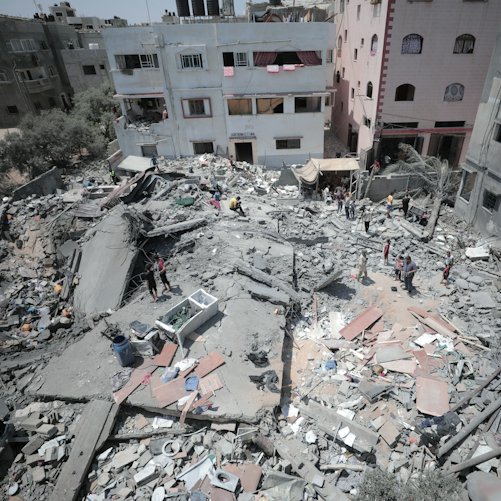
UNHCR’s recent account of conditions after return identifies damaged housing, limited basic services, documentation difficulties and a shortage of livelihoods as major obstacles. Its assistance includes cash support, housing repairs and help with economic reintegration. These are reminders that a return becomes sustainable through what follows arrival, including the ability to earn, secure shelter and use public services.
The next test is implementation
The EU’s diplomatic opening places several tasks alongside one another: preparing the original agreement, defining the modernisation mandate and supporting recovery during a still-fragile transition. Movement on one does not automatically complete the others. A signature would be a significant institutional milestone, but would not by itself repair infrastructure, resolve displacement or establish confidence in every public institution.
For Syrians, the most consequential results will be tangible: functioning schools, accessible healthcare, usable homes and opportunities to work. Monday’s decision expands the framework through which Europe can contribute. Its value will be measured by how consistently that engagement supports recovery and the conditions for voluntary, safe and sustainable return.