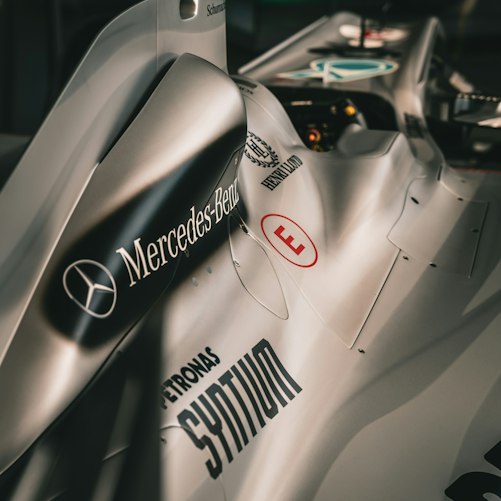
Kimi Antonelli topped both Friday practice sessions at Lusail, with George Russell second each time. McLaren and Red Bull remain close enough to keep qualifying open, while front-left tyre wear and a 27-lap limit will influence Sunday’s strategy.

Mercedes established the early benchmark for the Qatar Grand Prix on Friday, November 27, as Kimi Antonelli led George Russell in both practice sessions. Antonelli’s best evening lap of 1 minute 23.077 seconds left his team-mate 0.127 seconds behind, with the two McLarens and two Red Bulls occupying the next four positions.
The results provide an encouraging starting point for Mercedes, but the weekend’s central question extends beyond a single quick lap. Lusail’s sustained cornering loads are putting particular pressure on the front-left tyre. Teams must combine qualifying speed with a race plan that respects a maximum of 27 laps on each tyre set.
Mercedes sets the pace in changing conditions
Antonelli had been substantially further ahead in the opening session. His 1:23.217 put him 0.507 seconds clear of Russell and 0.661 ahead of Isack Hadjar. Lando Norris and Oscar Piastri followed in fourth and fifth, with Max Verstappen sixth. Antonelli completed 31 laps in that first hour, combining his fastest time with a useful volume of running.
The order tightened under the lights. Norris ended second practice 0.445 seconds from the lead, followed by Piastri at 0.472, Verstappen at 0.499 and Hadjar at 0.506. Charles Leclerc and Lewis Hamilton occupied seventh and eighth, more than a second behind Antonelli. Those gaps describe the completed laps, rather than a settled competitive order for the race.
Both Mercedes drivers set their quickest evening times on the medium compound. Interruptions prevented them from completing their intended soft-tyre efforts, complicating any straightforward comparison with rivals. Fuel loads, programme choices and track conditions also make practice a less controlled test than qualifying, when the field concentrates on outright speed.
A promising balance, with work still required
Mercedes described a productive day of testing the medium and soft compounds, with Russell more comfortable in the second session after a difficult opening hour. Antonelli felt positive about the car from the start, while identifying the energy going through the front-left tyre as an issue the team would need to manage throughout the weekend.
Trackside engineering director Andrew Shovlin said the car had worked well immediately and that medium-tyre pace had come relatively easily. After the disrupted attempts on softs, the team prioritised longer runs. That gave the engineers more information about how the car behaved over a stint, even though their assessment of maximum qualifying performance remained incomplete.
The distinction matters at a circuit where a strong first lap can be followed by a more difficult sequence. A driver needs confidence in the balance as the tyres change, and a setup that produces the best headline time may not offer the most useful compromise over the full race distance.
Front-left wear becomes a shared concern
Pirelli’s Friday assessment identified graining, particularly on the front-left tyre, as a major contributor to wear. Its chief engineer, Simone Berra, linked the effect to the dirty track surface and aerodynamic loading. Several tyres reached high wear levels during the race simulations, keeping tyre management firmly on the agenda despite the mandatory limits.
The supplier also reported substantial performance degradation on the front axle. The soft compound could deliver a competitive single lap, although teams did not consistently extract its potential. The hard offered an alternative: it showed steady performance despite relatively limited use, leaving teams that retained two sets with another possible route through the race.
Friday therefore produced different pieces of evidence rather than one universal answer. A compound that offers an immediate pace advantage can demand more attention later in a run. The value of the remaining practice session will include testing whether the surface improves enough to change that balance.
The 27-lap limit makes two stops the starting point
Pirelli has selected its three hardest compounds for Qatar: C1 as the hard, C2 as the medium and C3 as the soft. In agreement with the FIA, it has limited each set to 27 laps to protect tyre integrity at a circuit with repeated high-speed turns and substantial lateral loads. Over the scheduled 57-lap Grand Prix, that requires at least two tyre changes.
The allowance is two laps longer than last year. Pirelli attributes the change to the reinforced construction of the 2026 tyres and the lower aerodynamic loads produced by the current cars. Qatar has also returned to a conventional weekend, giving teams three practice sessions instead of the reduced preparation associated with a Sprint event.
A minimum number of stops does not make the strategic choices identical. Teams still have to decide when to make those stops, how to distribute their available sets and how much pace to sacrifice to protect them. Traffic and interruptions can change the value of an otherwise attractive pit window.
McLaren looks for gains before qualifying
McLaren completed 119 laps across its two cars on Friday and is placing particular emphasis on the medium tyre. The team judged that it offered better lap times without a large degradation disadvantage against the hard. That assessment differs in emphasis from Pirelli’s interest in the hard’s consistency, illustrating why teams may arrive at different solutions.
Norris and Piastri both acknowledged Mercedes’ strength while identifying room to improve. McLaren plans to fit the floor introduced in Las Vegas to both cars for Saturday, expecting an additional measure of downforce rather than a dramatic change. Its engineers are looking for a balance that preserves speed in the fast final sector without weakening performance in the slower corners.
Qualifying is scheduled for 21:00 in Qatar on Saturday, November 28, equivalent to 19:00 Central European Time. Sunday’s race is due to start at 19:00 local time, or 17:00 CET. Mercedes reaches that next stage with the strongest Friday results; whether it can convert them will depend on improving the car while retaining control of the tyres over more than one fast lap.