A prototype growth chamber bound for the International Space Station will test water delivery and the use of limited growing space. The work could help future crews produce fresh food, while building on years of smaller orbital gardens.

NASA is preparing to send a new crop-production experiment to the International Space Station, with an engineering question at its centre: how to deliver water reliably to plants when gravity no longer organises the flow. The Ohalo III growth chamber, highlighted in the agency’s November 27 mission update, is due to travel aboard Northrop Grumman’s NG-25 cargo mission.
The prototype will also test how to make better use of the limited volume available for growing food. Its purpose is to gather evidence for future systems supporting longer journeys and habitats beyond low Earth orbit. This remains a technology demonstration, with its orbital performance still to be established.
A garden designed around its operating limits
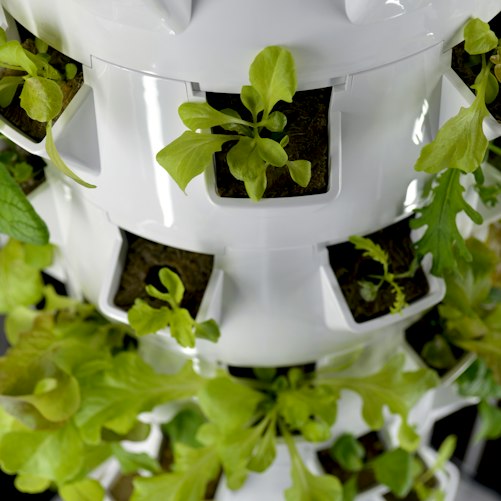
Ohalo III’s research objectives extend beyond keeping leaves green. The project aims to address gaps in productivity, nutrition, food safety and operational reliability. The investigation’s project scientist is Matthew Mickens of NASA’s Kennedy Space Center. The agency’s description shows a multi-crop arrangement containing lettuce, tomato, basil and mustard varieties.
Growing several crops in a compact chamber raises practical questions about how much useful food can be produced within the available space. For a crew travelling farther from Earth, a growing system must fit alongside other equipment and remain manageable throughout a mission. An attractive plant display is only one part of that engineering task.
NASA expects the results to inform future crop-production designs and potentially contribute to controlled-environment agriculture on Earth. Those are proposed applications of the research. Establishing a dependable production system requires evidence about repeated operation, rather than an assumption that one successful planting settles the problem.
Water must reach roots without shutting out air
The difficulty starts with the root zone. Plants require both water and oxygen, and familiar drainage arrangements depend on conditions that change in microgravity. Earlier NASA Plant Water Management experiments explored how surface tension, wetting and the shape of hydroponic channels could guide liquid when there is no ordinary downward flow.
Those experiments used equipment including pumps, valves and specially shaped channels to examine filling, flow stability, gas separation and different operating configurations. Such work provides an engineering foundation for future growing systems, although testing liquid behaviour and sustaining an actual crop are separate steps.
This makes the plumbing a central part of the food system. Supplying enough liquid is insufficient if roots cannot also obtain oxygen or if flow becomes difficult to control. The useful question is whether a design can maintain the required balance across changing plant needs and operating conditions.
Earlier orbital gardens provide a starting point
Plants have already been cultivated and eaten aboard the space station. NASA’s Veggie facility uses small planting pillows containing a clay-based growing medium and fertiliser, with lights above the crop. The pillows help distribute water, nutrients and air around the roots, while the lighting supports growth in the absence of a familiar gravitational direction.
The Advanced Plant Habitat takes a more automated approach. Its enclosed chamber combines LED lighting with cameras and more than 180 sensors, allowing researchers on the ground to monitor conditions. Temperature, moisture, atmospheric conditions and water management are controlled to reduce the amount of routine attention required from astronauts.
Ohalo III therefore enters an established programme of space horticulture. Its significance lies in the particular production and operational questions it will investigate. Earlier crops demonstrate that orbital cultivation is possible; they do not, by themselves, establish that a small spacecraft can produce an entire crew’s diet.
Choosing the crop is another engineering decision
A separate NASA update on November 25 described work on strawberries, cucumbers and lemon basil as possible future menu additions. The strawberry tests illustrate why harvest numbers alone are insufficient. A wild variety produced more buds, flowers and fruit than the leading Delizz candidate when grown from seed, but its spreading runners demanded valuable space.
Delizz consequently retained its position as NASA’s leading strawberry candidate. The comparison was conducted under simulated space conditions, with researchers at Kennedy and Australian universities, rather than demonstrating that either variety has already become a routine orbital food supply.
Cucumber research has examined growth, yield and nutrition, while lemon basil has completed preliminary testing and seed sanitisation. Together, the candidates show the range of considerations behind a spacecraft menu: edible output, physical size, preparation requirements and the value of providing different flavours. A crop that performs well on one measure may be less suitable on another.
Repeated harvests will depend on the whole system
In an explanation of space agriculture published by the US Department of Agriculture, crop scientist Ray Wheeler identified short, high-yielding plants with a large edible fraction as attractive candidates. Leafy vegetables can supplement existing food supplies, while larger future growing areas could make grains, legumes and root crops more practical.
Water can also circulate through a wider life-support loop. Moisture released by plants remains inside the chamber or spacecraft, where it can be condensed, treated and reused. That possibility does not remove the need for an initial water supply or reliable equipment to recover and manage it.
Cleaning between plantings, limiting pathogens and keeping sensors working are equally important to sustained production. Multiple crops may also compete for resources within a common environment. These considerations explain why the next phase of space farming must examine maintenance and repeatability alongside the appearance of a successful harvest.
Cargo delivery comes before the results
Northrop Grumman says NG-25 will carry around 11,000 pounds of scientific investigations and essential cargo aboard a Cygnus XL spacecraft. The vehicle is named for astronaut Jim Lovell, whose missions included Apollo 8 and Apollo 13. Delivery will place the experiment within the station’s broader programme of research and resupply.
For Ohalo III, the important milestone will come after transport and installation, when researchers can assess how the equipment operates in microgravity. The mission offers a way to test the practical foundations of fresh-food production: getting water and air to roots, using scarce space effectively, and learning what a crew would need to keep the system productive.