How an ageing society, shrinking workforce and record‑low fertility are reshaping the world’s third‑largest economy
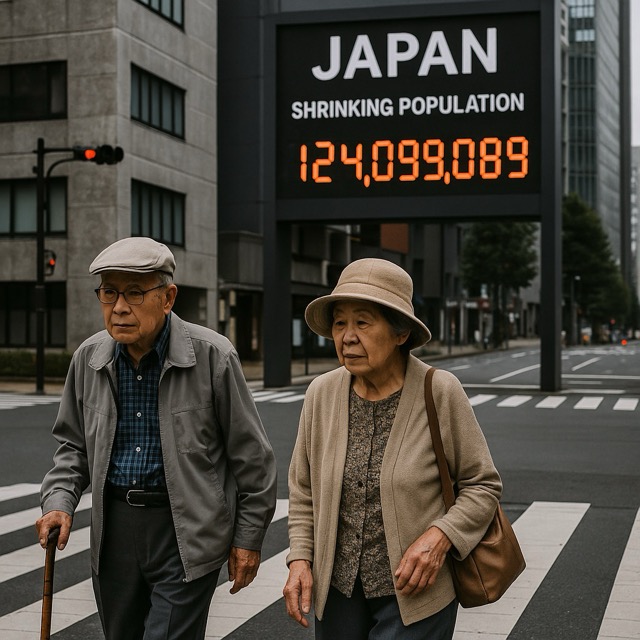
On 13 May 2025 Japan’s Ministry of Internal Affairs quietly confirmed what demographers had long forecast: the nation’s population fell for a twelfth straight year, to 123.9 million, the lowest since 1994. Births dropped to just 720,000, while deaths exceeded 1.55 million, widening the natural‑decrease gap to a record 830,000. The figures underscore what Prime Minister Fumio Kishida calls the “grimmest national challenge—Japan’s demographic time bomb.”
Anatomy of a decline
Japan’s fertility rate slid to 1.26 children per woman in 2024—far below the 2.07 replacement level and half its 1973 peak. Couples marry later (average age 31 for women), the cost of urban childcare is among the OECD’s highest, and career‑track women still face a formidable “mummy penalty.” Simultaneously, life expectancy reaches 87.1 years for women and 81.9 for men, giving Japan the world’s oldest median age at 49.2. By 2050 one in three Japanese will be over 65; centenarians already number 92,000.
Economic shockwaves
The working‑age population (15‑64) has shrunk by 9 million since 2010, eroding the tax base that funds pensions and health care. The International Monetary Fund estimates potential GDP growth at just 0.5 % per year through 2030, unless productivity surges. Labour shortages are acute in construction, elder‑care and agriculture; on Shikoku island, over half the tea farms operate with skeleton crews.
The fiscal strain is visible: social‑security spending now absorbs 33 % of the national budget, while gross public debt stands at 262 % of GDP—an OECD record. Municipalities from Akita to Kōchi have merged schools and repurposed abandoned homes into “ghost apartment blocks,” yet infrastructure costs remain fixed.
The policy tool‑box—half full
1. Pro‑family incentives — In April 2024 Kishida doubled the monthly child allowance and promised free university tuition for third children, but surveys show money ranks behind work‑life balance in parental decisions.
2. Womenomics 2.0 — New quotas require firms with 301+ employees to publish gender pay gaps, but Japan’s female labour‑force participation plateaued at 72 % in 2023, still below Scandinavia.
3. Selective immigration — A 2018 visa category for lower‑skilled jobs has attracted only about 200,000 workers—less than 0.2 % of the population—due to language barriers and limited path to permanence. Big business lobbies for an annual quota of 500,000, yet public opinion remains wary.
4. Robotics & AI — From Panasonic’s elder‑care exoskeletons to Lawson’s shelf‑stocking robots, automation fills gaps but is capital‑intensive and unevenly adopted by small and medium‑sized firms that employ 70 % of workers.
Social fault‑lines
A shrinking youth cohort shoulders the pension burden: today 1.8 workers support each retiree; by 2040 the ratio will fall to 1.2. Inter‑generational inequality is rising, with asset‑rich older home‑owners contrasted against contract‑based “freeter” millennials who cannot afford Tokyo rents. Rural depopulation accelerates cultural erosion—half of Japan’s 1,700 sake breweries risk closure within two decades, according to trade groups.
Silver linings?
Some economists argue decline offers a chance to pivot toward quality‑of‑life metrics and green growth. Vacant rural land opens space for rewilding and renewable projects; smaller class sizes could boost education outcomes. And Japan’s ageing expertise has export value: companies like INTEC design smart‑care homes for German clients, while Toyota’s Woven City will serve as a global test‑bed for autonomous mobility.
The clock is still ticking
Yet time is short. The National Institute of Population and Social Security Research predicts Japan’s populace could plunge below 100 million by 2056—a loss equivalent to the entire population of the Tokyo metropolitan area. Demography is not destiny, but it is stubborn: even if fertility miraculously rose to 1.8 tomorrow, the momentum of ageing means workforce numbers would continue falling until the 2040s.
As Kishida warned, “If we cannot arrest the decline now, there will be no social security, no economic vibrancy, and no communities to protect.” The real challenge lies not in slogans but in threading together child‑care reform, immigration openness and technological diffusion—while convincing a cautious electorate that existential change is both necessary and beneficial. Until then, the demographic clock in Japan will keep on ticking—louder each year.
Sources
Ministry of Internal Affairs and Communications (MIC) Population Survey, 13 May 2025.
National Institute of Population and Social Security Research, “Population Projections for Japan 2024–2070,” March 2024.
OECD Economic Outlook, Japan chapter, December 2024.
International Monetary Fund, Article IV Consultation, February 2025.
Nikkei Asia, “Kishida’s child allowance doubles: can cash alone boost births?” 15 April 2024.
Financial Times, “Japan’s hidden labour crisis,” 21 February 2025.




 The Tower Post