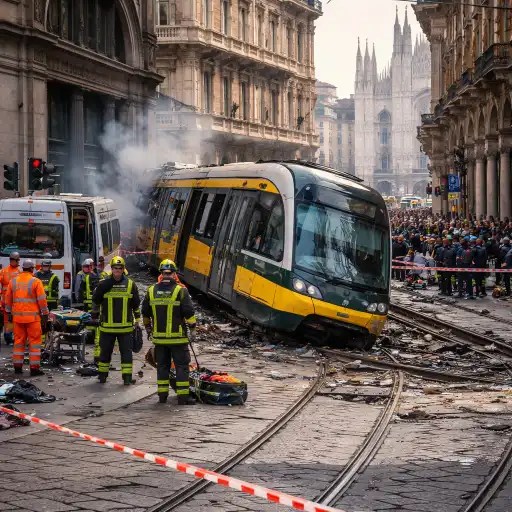
Serious accident in the historic heart of the city raises urgent questions about urban transport safety and aging European infrastructure

Milan awoke to sirens and stunned silence after a dramatic tram derailment in the city’s central district left multiple casualties and sent shockwaves far beyond Italy’s borders.
The accident unfolded along one of the busiest and most historically significant routes in the Lombard capital, transforming an ordinary weekday morning commute into a scene of chaos that would soon dominate headlines across Europe.
Witnesses described a sudden violent jolt followed by the metallic shriek of steel against steel as the front carriage lurched off the tracks, tilted sharply, and struck nearby street infrastructure before grinding to a halt across the boulevard.
Passengers scrambled to escape through shattered windows and forced-open doors while bystanders rushed forward to pull the injured clear of debris scattered across the roadway.
Emergency services arrived within minutes, sealing off multiple blocks as firefighters stabilized the damaged tram and paramedics treated victims on the pavement beneath a web of sagging overhead power lines.
Authorities confirmed that the derailment resulted in multiple casualties, including fatalities and serious injuries, prompting hospitals throughout the city to activate emergency protocols to receive the wounded.
City officials expressed condolences to families affected by the tragedy and pledged a comprehensive investigation into how a tram could leave the rails in one of the most closely monitored sections of Milan’s extensive network.
The incident has rapidly evolved into a cross-border infrastructure story, as Milan’s tram system is widely regarded as one of Europe’s most emblematic and forward-looking urban transport networks.
Blending historic rolling stock with modern articulated units, the network carries hundreds of thousands of passengers each day and is frequently cited as a benchmark for sustainable metropolitan mobility.
That such an accident could occur in a city celebrated for design, efficiency, and transport innovation has unsettled policymakers from Paris to Berlin and intensified scrutiny of aging infrastructure across the continent.
Preliminary inquiries are examining track integrity, switching systems, signaling mechanisms, and vehicle maintenance records, although officials have cautioned against premature conclusions while technical teams analyze data retrieved from onboard systems.
Transport safety specialists note that while urban tram derailments are relatively rare, the combination of increased passenger volumes, expanding networks, and legacy infrastructure can create vulnerabilities if investment and oversight do not keep pace.
Italy’s national transport authority has dispatched inspectors to work alongside municipal investigators, and service on several central lines has been suspended pending comprehensive safety checks.
The broader implications are already reverberating across Europe, where cities are investing heavily in tram and light rail systems as pillars of climate transition strategies aimed at reducing car dependency and urban emissions.
The Milan derailment has sharpened debate over maintenance funding and long-term renewal plans, particularly in cities where parts of tram networks date back more than a century.
Urban planners emphasize that tram systems remain among the safest forms of public transport, yet they warn that safety depends on sustained financial commitment, rigorous inspections, and the integration of predictive maintenance technologies.
Public reaction in Milan has been marked by grief and solidarity, with residents gathering near the accident site to leave flowers and messages while survivors recount the terrifying seconds before the carriage left the rails.
Political leaders across Europe have issued statements of support and signaled that transport safety and cross-border cooperation will feature prominently in upcoming ministerial discussions.
Market analysts are also watching closely, as the accident may accelerate regulatory tightening and increase pressure on operators and manufacturers to upgrade equipment and monitoring systems.
For Milan, the derailment strikes at the heart of a civic identity closely tied to its iconic yellow trams that glide past historic façades and modern skyscrapers alike, symbolizing continuity between tradition and progress.
As investigators work to determine the precise cause, the city faces disrupted commutes and a pressing need to restore public confidence in the very system designed to keep it moving.
What began as a tragic morning in the historic center has become a continental reckoning over how Europe maintains, modernizes, and safeguards the infrastructure underpinning its sustainable urban future.