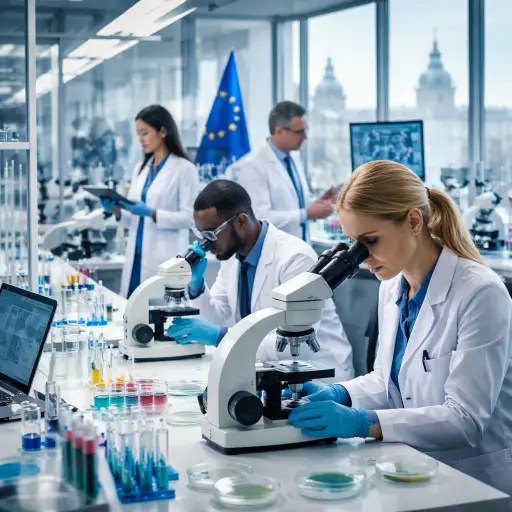
As U.S. funding cuts and a politicised research climate unsettle academia, European institutions position themselves as a new global magnet for scientific talent.

Across Europe’s laboratories and university campuses, a decisive shift is taking shape as leading scientists based in the United States increasingly look eastward for stability, funding and academic freedom, reversing a decades-long pattern that once saw Europe’s brightest minds cross the Atlantic in search of opportunity.
Rectors, research directors and policymakers describe the moment as a turning point, driven not by a single dramatic event but by a steady erosion of confidence in the predictability of American research support, where federal funding reductions and intensifying political battles over science policy have introduced uncertainty into long-term projects.
For many researchers in fields ranging from physics to molecular biology and artificial intelligence, the concern is not only financial but structural, as multi-year grants become harder to secure and public debates increasingly shape which areas of inquiry are politically palatable, complicating the careful planning that ambitious scientific work requires.
European governments and institutions have responded with unusual speed, expanding grant programs, simplifying visa procedures and launching targeted recruitment initiatives designed specifically to attract U.S.-based scholars seeking continuity and intellectual autonomy.
Austria’s APART-USA fellowship has emerged as a flagship example, offering multi-year funding packages, laboratory resources and relocation support to researchers willing to establish themselves within Austrian institutions, sending a clear signal that Europe intends to compete aggressively for global talent.
At the broader continental level, the European Union has reinforced its framework research funding, channeling additional resources into frontier science, green technologies and next-generation computing, while emphasizing funding horizons that extend beyond the rhythms of short political cycles.
Scientists who have recently relocated say the appeal lies in institutional predictability as much as in financial support, arguing that stable grant structures and cross-border collaboration within the European Union create an environment where research agendas can unfold without constant recalibration to shifting political winds.
Physics has become an early beneficiary of the movement, with major European facilities in particle research, quantum science and fusion energy reporting growing interest from American-trained specialists eager to join large-scale projects backed by sustained public investment.
In life sciences and biomedicine, Europe’s dense network of collaborative research centers has strengthened its standing in genomics, immunology and pandemic preparedness, fields that rely heavily on international cooperation and long-term data collection.
Artificial intelligence represents another strategic frontier, as European policymakers combine substantial infrastructure investments with regulatory frameworks centered on transparency and ethical oversight, a balance that some researchers see as offering both technical ambition and social legitimacy.
Economists note that talent migration rarely stops at individual careers, often reshaping entire innovation ecosystems by influencing where startups are founded, where doctoral candidates enroll and where intellectual property is ultimately generated.
If the current influx continues, Europe could consolidate its position as a primary innovation hub, narrowing a gap that widened during the postwar decades when American universities dominated global rankings and drew scholars from every continent.
The historical irony is not lost on observers, who point out that Europe was once the cradle of many of the scientific revolutions that shaped the modern world, only to see leadership drift westward as U.S. investment in research surged during the twentieth century.
Today’s reversal is not absolute and transatlantic collaboration remains deep, with joint projects in climate modeling, aerospace engineering and medical research continuing to bind institutions on both sides of the ocean.
Yet recruitment offices across Europe report a measurable rise in inquiries from U.S.-based faculty and postdoctoral researchers, suggesting that the shift is more than anecdotal and may reflect a structural reassessment of where cutting-edge research can thrive.
Challenges remain, including housing pressures in major cities, the administrative complexity of cross-border appointments and the need for sustained political commitment to research spending, but European leaders increasingly frame scientific talent as a strategic resource tied directly to economic resilience and technological sovereignty.
For early-career scientists in particular, the promise of labor protections, coordinated funding systems and mobility across multiple member states presents a compelling alternative at a moment when long-term certainty feels increasingly valuable.
Whether this realignment marks a temporary fluctuation or the beginning of a durable transformation will depend on policy decisions still unfolding, but as March begins, the momentum appears unmistakable, with Europe positioning itself not merely as a refuge from turbulence but as a confident architect of the next chapter in global scientific leadership.