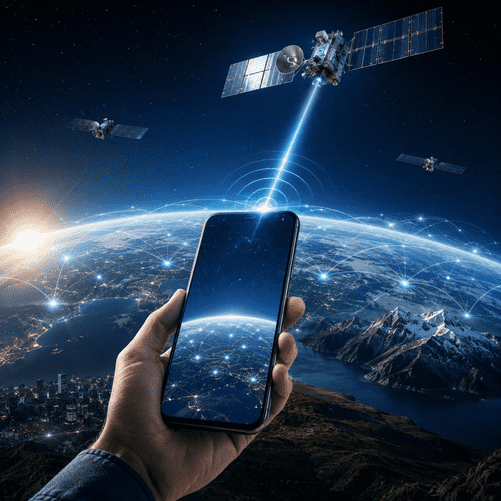
A new Space42-Skylo partnership and growing European telecom trials show that satellite-to-phone connectivity is becoming one of the next major frontiers in mobile technology.

The idea of a smartphone connecting directly to a satellite is rapidly moving from emergency novelty to commercial strategy.
On Monday, UAE-based space technology company Space42 announced a strategic partnership with Skylo Technologies to deliver standards-based direct-to-device connectivity through Thuraya-4, its next-generation geostationary mobile communications satellite. The companies said the service is designed to integrate satellite coverage into existing mobile network architectures, allowing operators to extend service beyond the reach of terrestrial towers.
The announcement comes as direct-to-device, or D2D, satellite connectivity gains momentum across the telecom industry. The technology allows ordinary smartphones to connect to satellites without specialized satellite phones or external terminals, making it potentially valuable in remote regions, maritime areas, disaster zones and places where conventional mobile infrastructure is damaged or unavailable.
Europe is already moving into early commercialization. Omdia reported that, as of March 2026, 22% of European mobile network operators had launched, trialed or announced partnerships related to D2D satellite services. The figure suggests that satellite connectivity is becoming a serious part of mobile operators’ coverage strategies rather than a distant research concept.
The market is still young. Ookla data cited by industry outlets showed that global D2D satellite connections rose by about 24.5% between July 2025 and March 2026, but actual consumer usage remains limited. Today’s services are still largely focused on low-bandwidth functions such as text messaging, emergency alerts and basic data, while voice and broader mobile-data capabilities remain under development.
Major telecom companies are moving carefully but deliberately. Orange recently added AST SpaceMobile and Satellite Connect Europe to its satellite-to-mobile strategy, with demonstrations of voice, SMS and data planned in Romania later in 2026. The French operator is also working with other satellite providers, including Eutelsat, SES, Starlink and Telesat, reflecting a multi-vendor approach designed to improve coverage and resilience.
The appeal is clear. For consumers, satellite-to-phone service could mean basic connectivity in national parks, rural areas, at sea or during emergencies. For governments, it could strengthen communications resilience during natural disasters, cyberattacks or war. For telecom operators, it offers a way to fill coverage gaps without building costly towers in areas where traditional infrastructure is economically difficult.
But the technology still faces major constraints. Satellite signals must reach small smartphone antennas from hundreds or thousands of kilometers away, often while both the phone and satellite are moving. Regulators must also manage spectrum rights, emergency-service rules and competition between terrestrial mobile operators and satellite networks.
For now, D2D satellite connectivity is not about replacing mobile networks. It is about extending them. The next phase of the race will depend on whether companies can move from emergency messaging to reliable voice and data — and whether users decide that “always connected” is worth paying for.
If they do, the smartphone’s next great leap may not come from a better screen or camera, but from the sky above it.