Previously unreported attacks on Iranian soil suggest the regional conflict is widening, even as Gulf states try to avoid a full public rupture with Tehran.

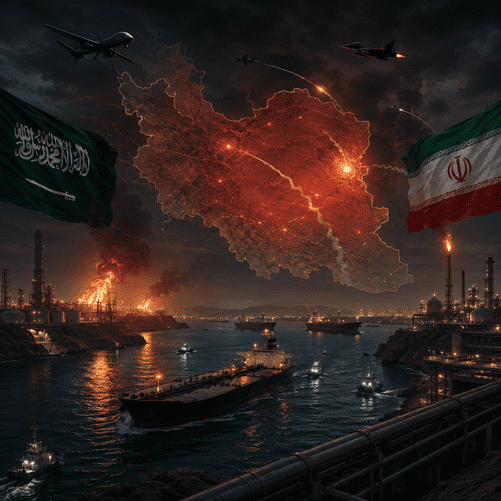
Saudi Arabia has carried out covert strikes inside Iran during the widening Middle East war, according to a Reuters report citing Western and Iranian officials, marking what would be a major escalation in the kingdom’s confrontation with its longtime regional rival.
The reported attacks were launched in response to strikes on Saudi territory during the conflict, Reuters said. The operations were not publicly announced by Riyadh, but they were followed by a decline in Iranian attacks on the kingdom, according to the same report.
The development is significant because Saudi Arabia and Iran restored diplomatic relations in 2023 after years of hostility, and both governments had tried to maintain communication channels even as the current war spread across the region. The reported Saudi strikes suggest that private retaliation and public diplomacy may now be moving in parallel — a dangerous pattern that could make the conflict harder to contain.
The Iran war has already disrupted the Gulf’s most important strategic chokepoint: the Strait of Hormuz. An officer from Iran’s Islamic Revolutionary Guard Corps said Iran now defines the strait as a much larger “operational area,” stretching from Jask in the east to Siri Island in the west, according to Iranian state-linked media cited by Reuters.
That claim matters because the Strait of Hormuz is one of the world’s most important routes for oil and gas shipments. Any expansion of Iran’s military posture around the waterway increases the risk that commercial shipping, energy exports and regional naval operations could become direct targets or bargaining chips.
The economic consequences are already global. The International Energy Agency now expects global oil supply in 2026 to fall below demand because of the Iran war, reversing earlier expectations of a surplus. Reuters reported that disruptions linked to the conflict have shut in more than 14 million barrels per day of supply and caused cumulative losses from Gulf producers exceeding 1 billion barrels.
For Saudi Arabia, the stakes are especially high. The kingdom is one of the world’s largest oil exporters, and any Iranian threat to its energy infrastructure or shipping lanes directly affects its national security and economic strategy. Riyadh has spent years trying to diversify its economy under Vision 2030, but its geopolitical weight still rests heavily on energy exports and Gulf stability.
The reported covert strikes also show how the war is moving beyond the original confrontation between Iran, the United States and Israel. Saudi Arabia’s involvement, even if undeclared, points to a broader regional security crisis in which Gulf states may be forced to act militarily while avoiding open declarations that could trigger wider escalation.
Washington is facing its own dilemma. President Donald Trump has defended the economic pain caused by the conflict, arguing that stopping Iran’s nuclear program outweighs the cost to American consumers, according to Reuters. But rising fuel prices, market uncertainty and pressure on global supply chains are making the war increasingly difficult to separate from domestic politics.
Inside Iran, the war is also putting severe pressure on the economy. The Associated Press reported that inflation has surged above 53%, food prices have risen sharply, and the rial has lost more than half its value amid the conflict and U.S. blockade pressure.
The central danger now is miscalculation. Saudi Arabia may believe limited covert strikes can deter Iran without provoking a larger war. Iran may see expanded control around Hormuz as a way to increase leverage. The United States and Israel may view continued pressure as necessary to weaken Tehran’s nuclear and military capabilities.
But in the Gulf, limited actions can quickly become strategic turning points. A strike on a refinery, a damaged tanker, a misidentified aircraft or a failed backchannel message could push the region into a broader war that no government officially claims to want.
For now, the reported Saudi strikes reveal a conflict becoming more regional, more opaque and more economically dangerous. The Iran war is no longer only a military confrontation over nuclear capacity and deterrence; it is becoming a test of whether the Gulf’s fragile security architecture can survive under direct pressure.