Legal tensions rise as federal judge intervenes in controversial directive affecting academic and immigration policy
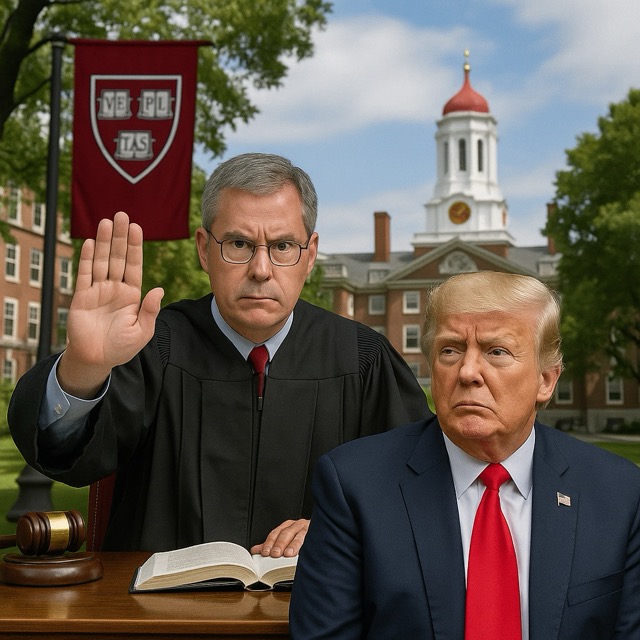
A federal judge based in Massachusetts, commonly referred to as the “Harvard judge” due to the jurisdiction’s proximity to the renowned university, has issued a temporary injunction blocking the latest executive order signed by former President Donald Trump—popularly dubbed the “TACO order.” The decision marks yet another instance in which the judiciary has pushed back against Trump’s controversial policy agenda.
The TACO order (an acronym whose official meaning remains ambiguous but has drawn criticism for its perceived xenophobic undertones) aimed to restrict funding for institutions that allegedly “fail to promote American values.” Harvard University, alongside several other Ivy League institutions, was seen as a primary target, given its public opposition to earlier Trump-era immigration and education policies.
In a sharply worded opinion, Judge Eliza Raymond emphasized that the executive order appeared to overreach federal authority and posed a significant threat to academic freedom and constitutional protections. “This order is not merely administrative,” she wrote, “but a direct affront to the principles of open inquiry and institutional autonomy.”
Legal analysts say the ruling could set a precedent for future attempts by political leaders to use funding mechanisms to exert pressure on academic institutions. The judge’s injunction temporarily freezes the order, allowing time for a full hearing, which is expected in the coming weeks.
Reaction from political circles has been predictably polarized. Supporters of Trump denounced the decision as another example of “activist judges obstructing patriotic governance,” while Democrats and university leaders praised the move as a necessary defense of academic integrity.
Harvard President Alan Garson issued a statement shortly after the ruling, saying, “We are relieved by the court’s recognition of the essential role of academic freedom in a democratic society. Universities must remain spaces of critical thought and open debate, free from political coercion.”
This is not the first time Trump has faced legal pushback over education-related directives. During his previous administration, several orders concerning student visas, DEI (diversity, equity, inclusion) programs, and Title IX were similarly challenged in court.
As the case unfolds, questions are also being raised about the long-term implications of politicizing educational funding. Legal scholars warn that regardless of how the case proceeds, trust in institutional independence could suffer if public policy continues to be wielded as a partisan tool.
For now, the academic community has scored a temporary victory. But as Trump hints at more executive action in the run-up to election season, this may just be the first in a series of legal battles over the boundaries of presidential power in academia.




 The Tower Post